
Kevin Costner advocates for national parks during Congressional hearing in Hot Springs
by June 13, 2026 8:37 am 1,774 views
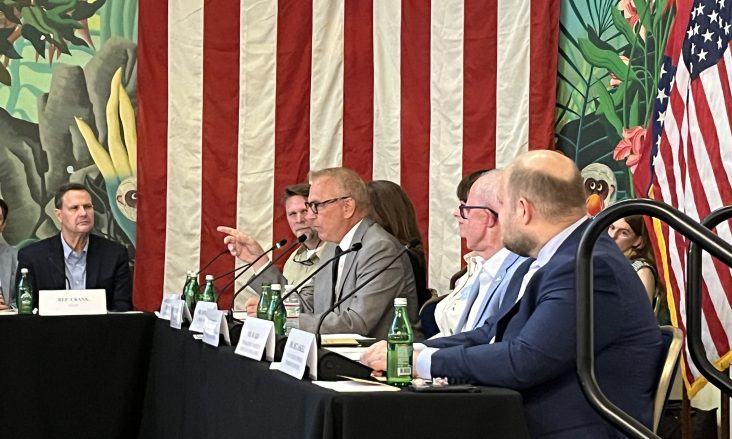
Actor and director Kevin Costner testified about the importance of preserving and funding national parks and public lands during a field hearing Friday of the U.S. House Committee on Natural Resources. Photo: Michael Hibblen
Just outside of Hot Springs National Park, a field hearing was held Friday (June 12) by members of the U.S. House Committee on Natural Resources who heard testimony and advocacy for passage of the Great American Outdoors Act 250. The bipartisan bill would reauthorize a law passed by Congress in 2020 that was designed to protect public lands and repair aging infrastructure.
U.S. Rep. Bruce Westerman, R-Hot Springs, who chairs the committee, invited members from around the country to his district. He noted that 40 years before Yellowstone was designated as the United States’ first national park, Congress protected the thermal waters of Hot Springs in 1832. That created “America’s first federal reservation of a natural resource, making Hot Springs the birthplace of what a lot of people call ‘America’s best idea.’ Today, Hot Springs serves as a powerful example of what can happen when federal investment, local leadership and private partnerships come together.”
Westerman and Rep. Jared Huffman, D-California, introduced the reauthorization bill Wednesday. The measure would expand on the 2020 legislation, which Westerman said represented the largest investment in public lands infrastructure in generations, providing long-overdue resources to address deteriorating trails, campgrounds, visitor facilities and historic structures.
In Arkansas, Westerman said more than $52 million has been invested in projects at Hot Springs National Park, the Buffalo National River and the Dale Bumpers White River National Wildlife Refuge.
“Those investments have improved visitor access, strengthened recreational opportunities and supported some of our state’s most treasured public lands,” Westerman said, adding that “record visitation continues to place new demands on aging infrastructure.”
The new legislation builds on the successes of the original law, he said, while addressing lessons learned through its implementation. Deferred maintenance over several decades is also a problem that Westerman said still has not been rectified.
“While inflation and rising construction costs may make needed repairs even more expensive, we have also learned important lessons about how these funds are allocated, how projects are selected, how agencies measure deferred maintenance and how we can better leverage partnerships to stretch taxpayer dollars even further,” Westerman said.
The legislation would invest $1.9 billion annually in national parks, public lands and Bureau of Indian Education facilities for the next five years. Funding would come from private donations, onshore energy revenue and new fees paid by foreign visitors.
Among those who testified during the hearing was actor and director Kevin Costner, who has long advocated for preserving national parks, largely through his documentary films. He spoke about growing up in a family that did not have the money to travel to major tourist destinations, but made annual drives to national parks.
“We could afford the gas to get us to the mighty sequoias, the high Sierras, to Yosemite. It was better than Paris, at least for a kid with my imagination. We could fish in a lake, sleep in a tent next to a stream, wake up to the smell of bacon and an open fire. It seemed wild,” Costner said.
“What always struck me, but I couldn’t articulate as a child, was that it never changed. It was undisturbed. It was comforting to know when I came back, it would look the same every time. It was perfect,” Costner said. “Nature doesn’t need a lot of help being perfect. But getting to this spot would not have been impossible without a road, a marked trail, even our campsite was the perfect distance from the next camper.”
That infrastructure is critical to ensuring visitors have good experiences in parks, Costner said, but the signs of deferred maintenance are becoming increasingly apparent.
He also spoke of the role of explorer, geologist and physician Ferdinand Hayden, who led the first government survey of the Yellowstone region in 1871 and advocated for preserving the area. The following year Yellowstone was established as the nation’s first national park.
“The odds of that happening in the area and the era lived, and the forces that stood against it, at a time when America’s natural resources were up for grabs, free to be exploited, with little or no regard for the future — it was zero. But he did it,” Costner said. “He had a vision and the courage to champion preservation over profit.”
Nature remains vulnerable, he said, which is why he supports the legislation.
“While visitations continue to grow, many of our parks are struggling with aging roads, deteriorating trails, outdated water systems, historic buildings in need of repair and staffing shortages that make it increasingly difficult to protect these resources and serve the public. We need the people who care for these places,” Costner said. “There’s really no better time for us to reaffirm our commitment to these places that tell America’s story. Conservation can’t afford to be a partisan issue.”
In addition to restoring infrastructure, backers of the legislation say it would support 72,500 jobs nationwide and generate $26.4 billion in economic activity for communities neighboring national parks, forests, wildlife refuges and public lands. It also would promote transparency and accountability by streamlining contracting and procurement, expediting project reviews and requiring regular reporting.
Others testifying at the hearing included U.S. Department of the Interior Deputy Secretary Kate MacGregor, Arkansas Department of Parks, Heritage and Tourism Office of Outdoor Recreation Director Katherine Andrews, and Coalition to Protect America’s National Parks Executive Council Member Mike Ward.
The hearing was held at the historic Arlington Resort Hotel & Spa, which sits alongside Hot Springs National Park and provides direct access to the park’s trail system. The landmark hotel, which has hosted several presidents over the last century, has recently undergone extensive renovations.
After the hearing, Westerman acknowledged that despite having bipartisan support, the legislation is far from a done deal.
“It’s an act of Congress — there’s always a challenge — but I’m working with our colleagues in the Senate [to build support]. You saw the administration is supportive. It would be great in our 250th anniversary to somehow get this to President Trump to sign by July 4th. That would be a very tall task to happen, but it’s something we all care about and I think it could happen,” Westerman said.