
Gov. Sanders: Student proficiency scores up since LEARNS
by June 18, 2026 4:23 pm 396 views

Average public school student proficiency levels across all subjects have increased from 35% in 2024 to 42.2% this spring, Gov. Sarah Sanders and Secretary of Education Jacob Oliva announced Thursday (June 18).
The increase occurred over the three-year period following the passage of the LEARNS Act in 2023. Sanders said the law, which she said is “the largest investment in our public school system in state history,” led to the increases.
“This year, Arkansas students did something extraordinary,” she said. “They improved in every single grade level across every single subject. To put it simply, LEARNS is working.”
The results were measured on the state’s Arkansas Teaching, Learning and Assessment System (ATLAS) end-of-year summative examination. The overall percentage of students scoring proficient increased from 35% in 2024 to 36.9% last year to 42.2% in 2026.
Sanders said that 44,000 more public school students are learning at or above proficiency.
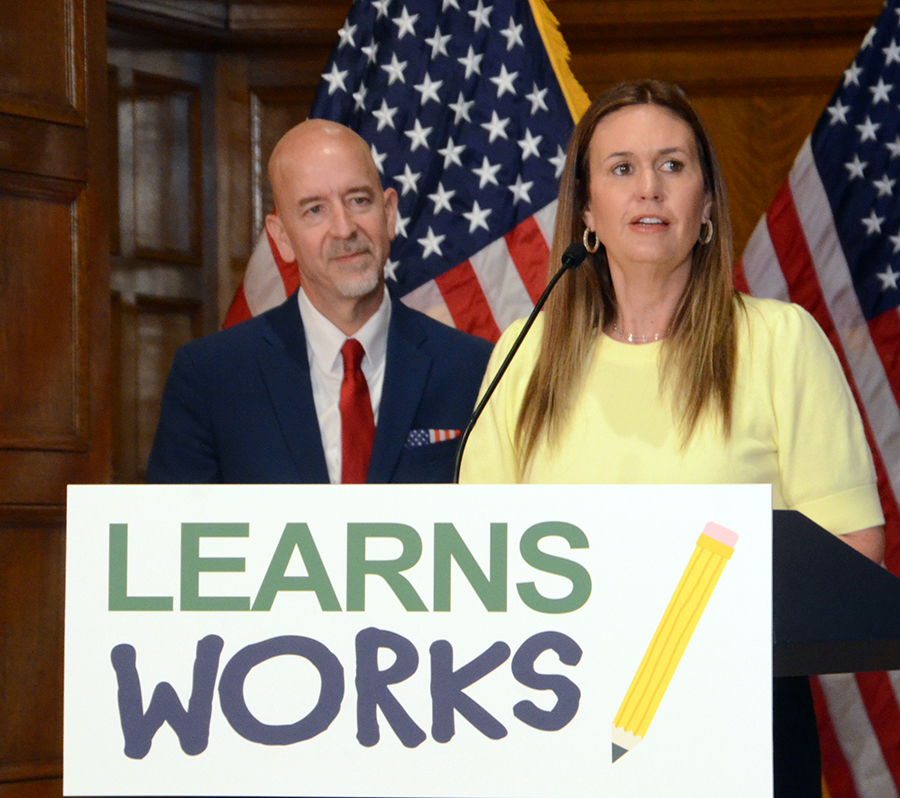
The LEARNS Act is best known for its educational freedom accounts that provide state funding for students to attend private and home schools, and for increasing minimum public school starting teacher salaries to $50,000.
It also assigned more than 120 literacy coaches statewide to all D- and F-rated schools. Sanders said those coaches provided 73,000 hours of assistance and served 45,000 students last year. More than 23,000 students now receive high impact tutoring.
Oliva said LEARNS provided clarity and alignment as well as a unified progress monitoring system. Teachers receive information on student progress in real time so they can make instructional decisions throughout the school year. Some students taking the summative assessment at the end of the year had results the same day.
Students are deemed “proficient” if they scored a Level 3 or Level 4 on the ATLAS exam. Level 2 scorers are considered to perform at or near grade-level expectations but have not consistently mastered the material. Level 1 students are significantly behind grade-level expectations.
Over the past three years, overall proficiency scores have increased in all the subject areas.
– Math scores increased from 36.4% in 2024 to 38.7% in 2025 to 44.2% in 2026.
– English language arts scores increased from 33.8% in 2025 to 34.7% in 2025 to 39.5% in 2026.
– Science proficiency scores increased from 35.6% in 2024 to 38.2% in 2025 to 44% in 2026.
In addition:
– Algebra proficiency scores increased from 26.9% in 2024 to 30.8% in 2025 to 37% in 2026.
– Geometry proficiency scores increased from 18% in 2024 to 21.5% in 2025 to 26.5% in 2026.
– Biology proficiency scores increased from 36.4% in 2024 to 37.7% in 2025 to 42.8% in 2026.
Proficiency for K-2 students, who started school after the LEARNS Act was signed in 2023, rose above 50% across every subject in every grade level except second grade literacy, which increased from 39.4% in 2025 to 48.5% in 2026. Kindergarten English language arts proficiency rates increased from 50.2% in 2025 to 66% in 2026.
“I’ve never seen 5, 7, 8% increases across the board in my time in education,” Oliva said in an interview after the announcement. “This is statistically significant, and it proves what we’re working on is getting the results it’s intended to get.”
The percentage of students scoring proficient in third grade English language arts increased from 36% in 2025 to 42.9% in 2026. Furthermore, the percentage of students scoring Level 1 in that subject fell from 29.3% to 22.4%. The LEARNS Act requires third grade students scoring at Level 1 to be retained in that grade unless they qualify for one of numerous “good cause exemptions.” Students can retake the test this summer.
Along with the increases in proficiency scores, the percentage of students performing at the lowest level, Level 1, likewise have decreased across all subjects.
– In English language arts, the percentage fell from 26.2% in 2024 to 22.7% in 2026.
– In math, the percentage fell from 30.4% in 2024 to 24.3% in 2026.
– In algebra, the percentage fell from 42.6% to 32.8%.
– In geometry, it fell from 58.1% to 50.3%.
– In science, it fell from 27.9% to 22.4%.
– In biology, it fell from 24.6% to 22.2%.
A summary of the 2026 ATLAS results is available at this link. Oliva will be a guest on this week’s Talk Business & Politics television program.