
$6 billion in transportation infrastructure needed to accommodate NWA growth
by July 6, 2026 1:08 pm 1,743 views
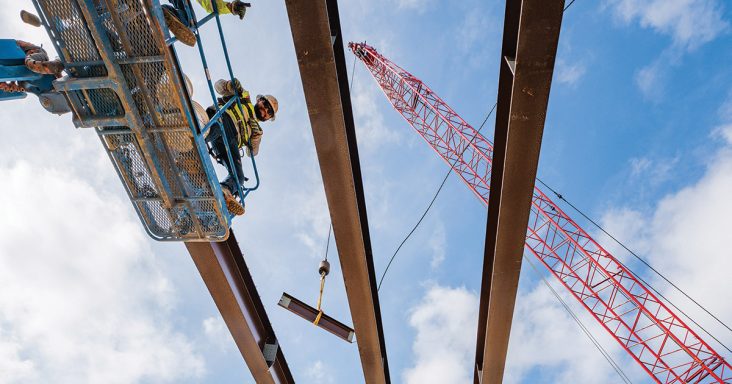
Pictured is work on the U.S. 412 bypass in Northwest Arkansas.
Tim Conklin, executive director of the Northwest Arkansas Regional Planning Commission, said the region needs about $6 billion in transportation infrastructure improvements over the next 25 years but has identified only about half the funding.
The commission recently invited several highway agencies, including Oklahoma’s toll roads operator, to help find ways to accelerate the completion of infrastructure projects as the need for them rises amid rapid population growth.
Conklin cited the 2025 population estimates recently released by the U.S. Census Bureau, showing that Northwest Arkansas is the ninth-fastest growing U.S. metro area.
The population of Northwest Arkansas, or the Fayetteville-Springdale-Rogers metro, rose by 2.4% to 622,177 in 2025 from 607,433 in 2024. The metro had the 27th largest numeric growth, adding 14,744 people, and is the 94th most populous metro in the United States, up two positions from 2024.
“It is definitely all hands on deck to continue to plan for and deliver the infrastructure that we need,” Conklin said.
Area leaders expect the region to reach 1 million people by 2045 or 2050. This year, the commission completed its Forward 2050 regional transportation plan and a transit alternative analysis. Based on the studies, the commission determined that $6 billion in infrastructure improvements will be needed over the next 25 years but only half of the funding has been identified, based on existing and past revenue levels.
“There’s a delivery gap of what we’d like to see implemented and constructed and the ability to fund that infrastructure,” he said. “That’s probably the most pressing need is to really understand … what can we learn from other regions that have rapid growth and how they planned for and program and implement that infrastructure.”
Recently, the commission’s board of directors asked the Arkansas Department of Transportation to update its 2006 Interstate 49 study.
“We have one north-south freeway that we just completed a few years ago here in Northwest Arkansas, with the five-mile section in McDonald County (Mo.),” he said. “However, today there’s 110,000 vehicles a day when you combine both directions, north and south, by J.B. Hunt corporate on I-49. And our ability to plan for that 1 million population, along with all of the jobs, services and travel demand, is that we are going to have to take a close look at how we manage our transportation system.”
Conklin cited two key issues: how the region funds the necessary infrastructure and how it manages its travel demand.
The commission’s Forward 2050 plan has three goals to implement a safe, efficient and reliable transportation system, he said. The commission wants to work with its regional planning partners to advance its plans and policies to enable transportation choice. Also, the aim is to protect the region’s natural environments, air quality, water quality and quality of life.
“What we’ve focused on is how can we collaborate better together, how can we convene and work together to deliver that infrastructure that will allow the region to thrive,” he said.
‘ACCELERATE PROJECT DELIVERY’
The commission recently invited the Oklahoma Turnpike Authority, the Oklahoma Department of Transportation, the Kansas Department of Transportation, and consultants who worked on projects in the Kansas City metro area and in Oklahoma to discuss some “partnership projects to accelerate project delivery,” Conklin said.
Over the next few years, the commission plans to close the funding gap and work with other agencies to accelerate project delivery in the region, he said.
Conklin cited the Northwest Arkansas Council’s Growing Home NWA regional growth strategy, which outlines land use and development patterns that are fiscally responsible and enable the region to thrive. It includes transportation and housing choices, strategies for strengthening existing city centers, and ways to promote and develop additional city centers.
“We at the commission have worked with all of our smaller cities, and none of them want to lose their identity into just the big four cities,” he said. “We need to work as a region on our regional network connectivity, and it’s not just the Arkansas Department of Transportation that we’re working with to complete out our grid system of transportation facilities.”
The commission is also working with cities and counties to complete the network. The aim is to create a network of “complete streets and complete streets design principles that allow all users, no matter how they choose to move throughout the region, that they have transportation choice,” he said.
The commission’s alternative transit study, which the board approved this year, called for implementing bus rapid transit along the Highway 71B corridor. Bus rapid transit is a bus system with higher bus frequency than traditional fixed-route service, “so if you miss the bus, you’re not waiting an hour for the next bus to come,” he said. The system is expected to connect the region throughout the corridor.
The commission recently approved a Highway 71B corridor study between Fayetteville and Bentonville to connect the region with a bus rapid transit system and to plan for and invest in the fixed-route system that feeds into it.
HIGHWAY PROJECT TIMELINES
More than $300 million in highway improvements that are underway but nearing completion include the Northwest Arkansas National Airport (XNA) connector running four miles from the extension of Arkansas Highway 612 (Springdale Northern Bypass) to the south entrance of XNA at Arkansas Highway 264, and the second phase of Highway 612 running nearly seven miles from Arkansas Highway 112 north of Elm Springs to U.S. Highway 412 in western Tontitown. Both highways will be four-lane, interstate-style freeways.
Dave Parker, communications division head for ARDOT, said the Highway 612 project is expected to reach substantial completion by mid-August. Columbia, Mo.-based Emery Sapp & Sons is the general contractor on the $180.78 million project.
Crossland Construction Co. is the general contractor on the $127.87 million project for the XNA connector. Parker said its estimated completion date is Sept. 4. A ceremony for the completion of the XNA connector and the second phase of Highway 612 is likely to take place in late August or early September, Parker said. He noted that the weather can be a factor and that there are still several months of work to be completed.
“Once a project is deemed substantially completed, we try to have that event very soon after, so the opening is not slowed in any way,” he added.
Keli Wylie, assistant chief engineer for program delivery at ARDOT, said the third phase of Highway 612, from I-49 to Arkansas Highway 265, is expected to go to bid in November and is estimated to cost $200 million to $250 million. This segment will include interchanges at highways 71B and 265.
“The bypass project has received $59 million in Community Project Funding, which was requested by Congressman Steve Womack in fiscal year 2026,” Wylie said. “We do plan to use those funds for phase three.”
The fourth and final phase of the Highway 612 project, from Highway 265 to U.S. Highway 412 east of Springdale and the Sonora community, is in project development and doesn’t have a scheduled bid date, she said. It’s expected to cost $250 million to $300 million and will have interchanges at highways 265 and 412 and five overpasses.
In July 2025, a $24.5 million Better Utilizing Investments to Leverage Development grant was awarded to this phase of the project to acquire the property needed to build the highway. In December 2024, the Arkansas Highway Commission agreed to allow ARDOT “to enter into partnerships with local entities interested in providing funding to expedite construction of the final phase,” Wylie said.
‘MAJOR PRIORITY’
Conklin said completing Highway 612 to Sonora is a “major priority and has been a priority for the last 30 years in our region. So we need to figure out ways to accelerate those projects to delivery.”
The future Interstate 42 was designated in the Infrastructure Investment and Jobs Act and runs from Interstate 35 in Noble County, Okla., to I-49 in Benton County at the interchange with Highway 612. The plan includes converting Highway 412 to I-42, but funding has yet to be identified.
Conklin said the Oklahoma Turnpike Authority was invited here in part because of this project and how to accelerate the completion of such projects. The authority is the state agency responsible for constructing, maintaining, and operating Oklahoma’s toll roads.
“Currently, I-42 is an unfunded project in our long-range plan,” Conklin said. “It’s not shown to be moving forward over the next 25 years, and so we’re looking at other regions, other states, other ways to fund infrastructure that are being implemented across the U.S., and see if there are some ideas that we can bring back here to accelerate project delivery.”