
Col. Ihde notes ‘hurdles and challenges’ with foreign pilot training center
by June 21, 2026 4:44 pm 980 views
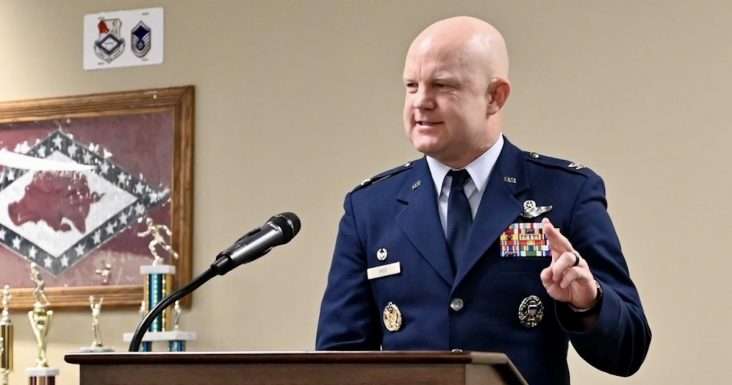
Col. Nicholas Ihde speaks during a July 2024 event at Ebbing Air National Guard Base in Fort Smith. (photo courtesy of the U.S. Air Force)
The past two years in the life and work of Col. Nicholas “Matrix” Ihde has been a collection of analogies. He’s had to pack 10 pounds of stuff into a 5-pound bag. Also, herding cats. Also, having a lot of irons in the fire. Also, keeping the train on the track. Also, it’s not a cookie-cutter job.
He expands upon the cat-herding analogy.
“Herding cats just means you’re trying to get the cats to go where you want them to go,” Ihde said in a recent interview. “I’m not only herding cats, I’m also having that cat understand what the timelines are so that they can be at a specific spot at a specific time.”
The work is serious beyond the analogies. There is nothing shallow, nothing clever or campy in creating a one-of-a-kind military training center for foreign pilots who will be on the front lines of their respective and allied defense systems and strategies.
Ihde in July 2024 was named commander of the 85th Fighter Group and tasked to establish the foreign military pilot training center at Ebbing Air National Guard Base in Fort Smith.
THE TRAINING CENTER
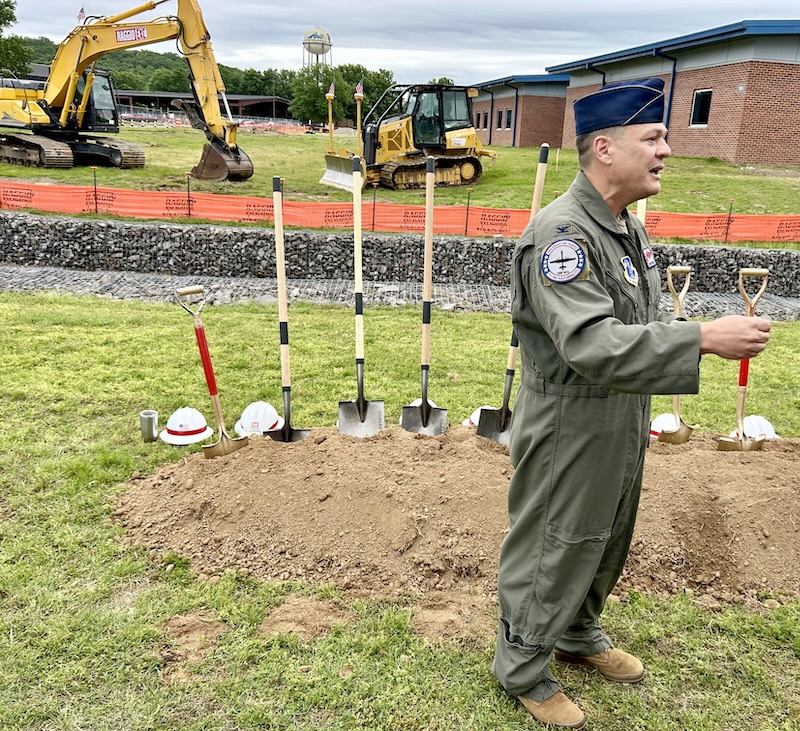
Ebbing was selected in March 2023 by the U.S. Air Force (USAF) to be the Foreign Military Sales (FMS) program pilot training center supporting F-35 fighter planes purchased by Singapore, Poland, Finland, Germany, Switzerland, Czechia, Greece, and Romania. U.S. Sen. John Boozman, R-Ark., and U.S. Rep. Steve Womack, R-Rogers, have led efforts to fund the center estimated to cost at least $800 million. A ceremonial groundbreaking was recently held to mark construction of a $74 million academic training center.
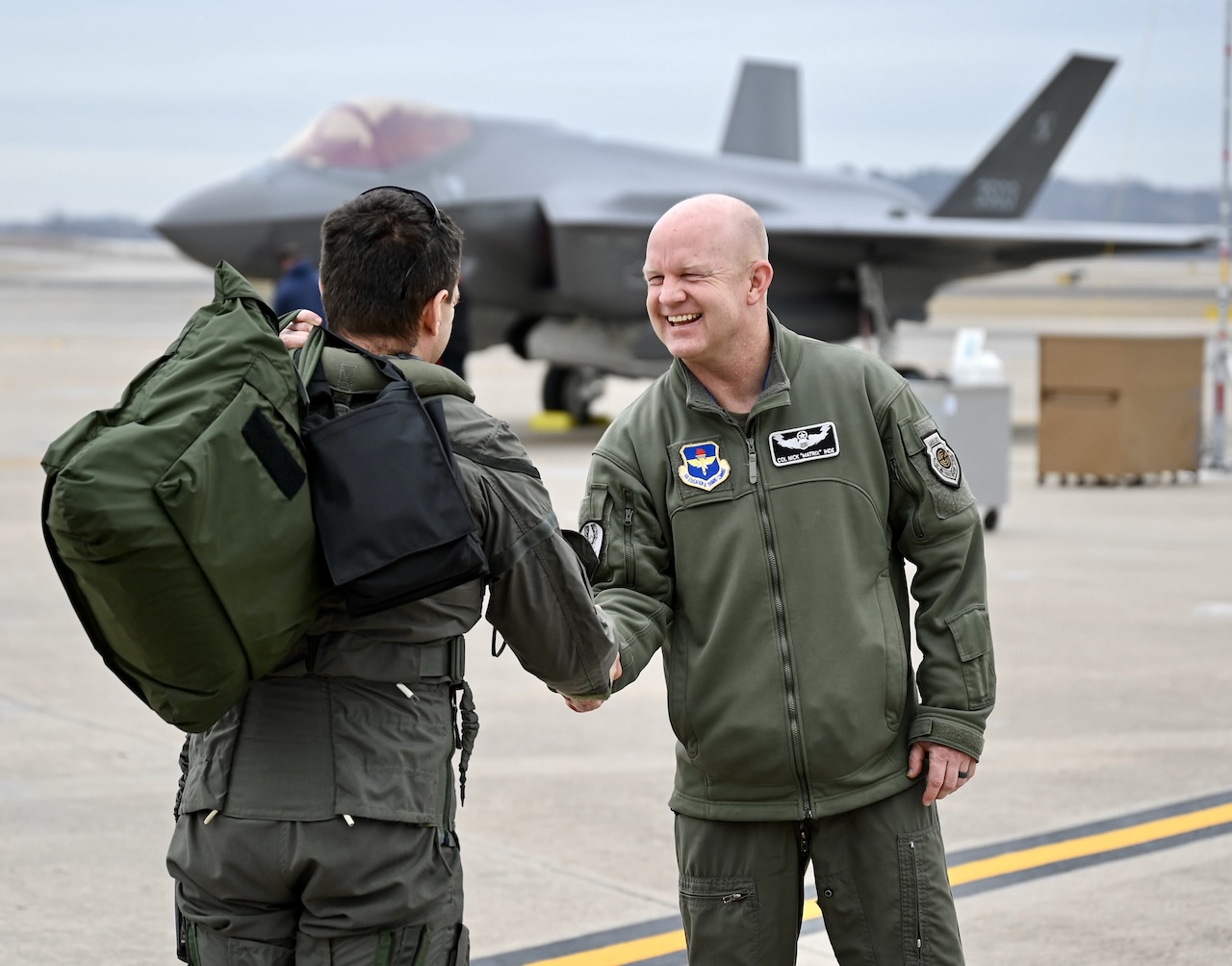
The 85th Fighter Group and the 57th Fighter Squadron, both under the Eglin, Fla.-based 33rd Fighter Wing, operate at Ebbing and are responsible for training F-35 pilots from numerous U.S. and North Atlantic Treaty Organization (NATO) countries. The center receives support from the 188th Wing, which is also based at Ebbing. Ebbing is co-located with the Fort Smith Regional Airport. The first F-35s to arrive were with the Polish Air Force. Jets from Finland arrived soon after.
‘BEING BRAND NEW’
Ihde, who is set to transfer responsibility to Col. Dan Wynn in a July 2 change-of-command ceremony, recently talked with Talk Business & Politics about the challenges of standing up the unique training center, lessons learned, his thoughts about the community, and next steps for the center and his career. He said what has happened and continues to happen at Ebbing is development of a “first-of-its-kind pilot training center that is fully focused on foreign military sales upgrade training only.”
“There is greatness to being the first at doing anything; you shape and mold it how you want,” Ihde said about the pros and cons of the task. “There are also sometimes hurdles and challenges that you didn’t foresee and kind of sometimes the bureaucracy that is not used to something like this being brand new, it doesn’t nicely fit into the mold.”
He said the initial challenge was a delay in deliveries of F-35 jets for the Polish pilots. The jets are manufactured by Bethesda, Md.-based Lockheed and built in Fort Worth, Texas.
“That delay immediately put us behind a training schedule that was built,” Ihde said. “Now, to Lockheed’s credit, we were able to get the jets unwound out of Fort Worth in an expedited fashion.”
Ihde said “it wasn’t roses and rainbows every day” between Poland, the USAF and Lockheed, but all parties were able to work together to develop solutions. But the most challenging part of the job, according to Ihde, was and is the “entirety of everyone that has a vested interest in it and trying to get everyone on the same sheet of music.” Everyone includes the 188th Wing that geared up to provide “airfield and supply support,” Pentagon and USAF officials, Arkansas’ Congressional delegation, community leadership, airport officials, and, more critically, Ihde noted, the officials of each country who had different interests and expectations.
“(They) all want to do the right thing for the program, but getting them moving out in the same direction, it’s a challenge,” he said. “Because it’s not like I need to get one or two people on board and have compromise … I need to get eight, nine, 10, 11, 12 types of people going in the same direction.”
The willingness of all parties to work through initial issues has resulted in a center and a mission that is on a good path, according to Ihde.
“Yes, there is a lot going on, but remember, just like in building a house at the beginning when deadlines start happening is when you feel like that (challenged),” he said. “But in retrospect, when you get going and get the foundation laid and you get everything up, things start to fall in place. And I think that’s currently where we sit.”
Ihde said this command has required more public relations work than other previous commands and assignments. He said the job began with “a lot of irons in the fire, and every iron counts.”
‘LARGE LEAP’
The process of strengthening iron produced what Ihde said is the biggest lesson learned since July 2024. The lesson is that each country has different military needs, requiring flexibility in how the center crafts and executes pilot instruction.
“Each country is different,” he said. “It’s not cookie-cutter. That’s very cliche to say, but we’re talking about Poland transitioning to a fourth- and fifth-generation air force. They literally are changing out F-35s for Russian-made MIG 21s and MIG 29s. That’s a large leap in technology for that country and that air force to understand.”
Ihde also stressed during the interview that the community may see and hear jets, but the training mission has serious, real-world implications in a world with ever-changing geo-political realities. He said a key part of the training focus is to more quickly establish “the deterrent factor” of having at some point 500 or more F-35s flown by U.S. allies. The training must result in pilots who are able to effectively use the jet in a way that “makes some of our adversaries think twice about doing anything nefarious,” Ihde said.
On that point, command of the pilot training center will transfer from the Air Education Training Command to the Air Combat Command on July 10. The shift, according to the USAF, “is designed to further strengthen our collective defense by integrating the latest tactics, techniques, and procedures into the training pipeline, enabling international military students to transition seamlessly from foundational skills to combat-ready capabilities tailored to their nation’s requirements.”
NEXT STEPS
A next big step for those at Ebbing is to getting planes and personnel with the Republic of Singapore “acclimated quickly” at Ebbing and surrounding communities, Ihde said. While other countries will be at Ebbing for a limited time during training, the Singapore jets — F-35s and F-16s — will have a longer stay at Ebbing.
Singapore’s F-35 fighter jets are expected to arrive at Ebbing in early 2027, with the country’s F-16 fighters set to arrive in the summer of 2027. Up to 400 personnel are to be stationed in Fort Smith when all Singapore planes arrive.
The Defense Security Cooperation Agency (DSCA) of the Department of Defense has approved $353 million for construction of Singapore operations at Ebbing, which will be paid by the country, a small nation in Asia located at the end of the Malayan peninsula.
“Getting them onboard in a timely manner next summer is key,” Ihde said. “They will be the community’s greatest asset and partner here, and they are a long-term player here.”
The other hard part of the job, Ihde said, will be leaving Fort Smith.
“My family and I were super excited to come here from Washington, D.C.,” he said. “It was something brand new to our family, and this community of Fort Smith opened their arms greatly to us and made it even more apparent that this was the right place at the right time for us.”
Based on the experience he and his family have had in Fort Smith, Ihde is confident the pilots, personnel and families from other nations will find the region welcoming.
“(The) community bends over backwards for the foreign families that come in as well, and that just takes the stressors off the families so that their students, whether it be their husbands or their wives that are going through the program as either maintainers or pilots, don’t have to worry about that (acclimating),” Ihde said. “Those are everyday stressors that happen to everyone, but if we’re able to take those off the table and let the students concentrate on flying or maintaining F-35s, then we’re in a better spot and able to learn at a greater level.”
What’s next for Ihde is command of the 56th Fighter Wing at Luke Air Force Base near Phoenix, Ariz. The wing has more than 20,000 people, and 150 F-35s, making it the largest USAF fighter wing, Ihde said.
He said the Ihde family — wife Emily, and daughters Maddy and Charlotte — is “sad to leave the relationships” in the Fort Smith area and Arkansas, but is excited about the next adventure. The one thing he will not miss are the much smaller flying objects that buzz around the Fort Smith area.
“I’m not a huge fan of the mosquitos,” Ihde said.