
Rep. Hill says President, administration supportive of new housing law
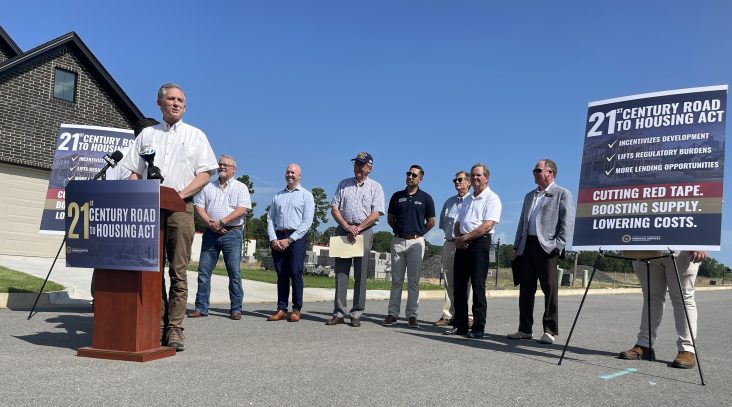
U.S. Rep. French Hill, R-Little Rock, touts the new law on housing affordability with industry leaders.
He held a press conference on Easy Street in Maumelle, Ark., mainly for the irony of celebrating the 21st Century Road to Housing Act into law.
“Getting this bill into law has been anything but [easy],” U.S. Rep. French Hill, R-Little Rock, said outside of a Maumelle single home subdivision that aims to provide home health care and other amenities for older residents.
At 12:01 a.m. Saturday (July 11), the bipartisan housing bill he co-authored became law without President Donald Trump’s signature. Trump scrapped a bill signing ceremony almost two weeks ago and tried unsuccessfully to use the bill as a negotiating tool to get the U.S. Senate to pass his SAVE Act voting reform measure.
In the following weeks, Trump referred to the housing affordability bill as a “big yawn” before letting it go into law without his signature. Hill defended the president’s position.
“The president has worked for the last eight months on this bill. He’s written two statements of administration policies saying that he would sign it along the way – one for the Senate version, one for the House version. His staff, his secretary of HUD [Housing and Urban Development], his Treasury Department, all have been involved in helping this bill get to the state it’s in,” said Hill.
“But as you saw just a few days ago, the president – and he reaffirmed it last night – he’s fine with the housing bill, but he’s very frustrated that the Senate is not working with him on his SAVE America Act, which has passed the House three times,” Hill added.
HOUSING LAW FEATURES
The 21st Century Road to Housing Act is one of the larger landmark pieces of legislation passed by Congress in recent years. Bipartisan in nature, it received 396 of the 435 votes in the House of Representatives and 89 votes in the 100-member Senate.
A former banker and the chairman of the House Financial Services Committee, Hill worked closely with Republicans and Democrats in both chambers on the legislation. U.S. Rep. Mike Flood, R-Neb., attended the press conference with Hill and reiterated the months of toil that went into the bill.
The 21st Century Road to Housing Act includes many provisions, including:
- The bill streamlines federal processes and modernizes programs, supports manufactured housing, and boosts veteran housing access.
- It emphasizes reducing regulatory barriers, increasing local flexibility, and improving financing for affordable, manufactured, and small-dollar mortgage homes.
- It addressed HUD building codes, modular building techniques, and building offsite exceptions.
- It allows for Community Development Block Grant (CDBG) funding to be used in ways to address the housing challenge.
- The new law offers more money and incentives, new zoning and land use policies, and faster regulatory approval of changes to help with housing.
- The federal legislation also seeks to modernize the use of manufactured housing to help with affordable housing needs. One of those provisions removed is a “permanent chassis requirement,” which will allow for manufactured and modular housing to be built with more modern techniques.
“The removal of the permanent chassis requirement contained in these bills will allow producers to embrace more modern architectural designs – including two-story factory-built homes – and help make manufactured homes more compatible in single-family neighborhoods,” said J.D. Harper, executive director of the Arkansas Manufactured Housing Association.
“This is one of the most important pieces of legislation, I believe, that’s ever passed for manufactured housing, because it recognizes the critical role that this product’s going to play in meeting our nation’s housing shortage. It allows and enables these houses to be built more quickly, more efficiently, and at a lower cost,” Harper added.
Jeff Lynch, president and CEO of Eagle Bank and Trust in Little Rock and the chairman-elect of the Arkansas Bankers Association, said the new law would strengthen local lending and allow banks to diversify their capital resources.
“Community banks are the primary source of financing for homes and small businesses, as far as community development across our state. This bill recognizes that a strong banking system is essential in lowering the cost of housing and increasing home ownership for all Americans,” said Lynch.
“It will promote the formation of new community banks. The result is simple. Stronger community banks need more capital available to finance affordable housing, supports local businesses, and create economic opportunities for Arkansas families,” he added.