
Arkansas metro job numbers revised, most areas see job gains in January
by April 16, 2026 3:46 pm 516 views
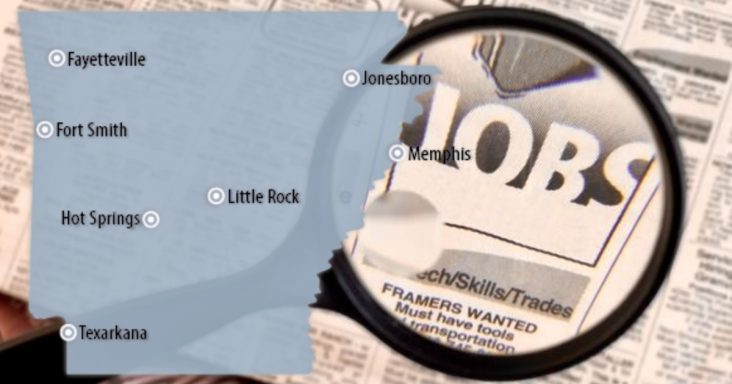
Major jobs data revisions with the seven metro areas in or connected to Arkansas show lower historic nonfarm job numbers in the major metro areas. The January report shows continued job gains in Northwest Arkansas, and a job decline in the Fort Smith metro.
The report, posted Thursday (April 16) by the U.S. Bureau of Labor Statistics (BLS), shows that five of the seven metro areas posted year-over-year job gains in January. Northwest Arkansas had the lowest jobless rate at 4%, and Hot Springs had the highest rate at 5.2%.
Central Arkansas – Little Rock, North Little Rock and Conway – had 392,000 nonfarm jobs in January, up 1,500 jobs, or 0.4%, compared with January 2025. The metro had 18,405 unemployed, up 34.8% from 13,656 in January 2025. The region set a nonfarm jobs record of 397,400 in December 2025 based on the data revision.
Northwest Arkansas, the state’s second largest metro area, had an estimated 303,500 nonfarm jobs in January, up 7,300 jobs, or 2.5%, compared with January 2025. The metro had 12,632 unemployed, up 35.6% from 9,316 in January 2025. The region set a nonfarm jobs record of 307,400 in October 2025 based on the data revision.
The Fort Smith metro, Arkansas’ third largest metro had an estimated 101,000 nonfarm jobs in January, down 200 jobs, or 0.2%, compared with 101,200 jobs in January 2025. Regional employment remains below the peak of 108,700 in September 2007. The metro had 5,070 unemployed, up 31.7% from 3,850 in January 2025.
The Jonesboro metro had an estimated 64,500 nonfarm jobs in January, up 900 jobs, or 1.4%, compared with January 2025. The metro had 3,210 unemployed, up 28.6% from 2,496 in January 2025. The region set a nonfarm jobs record of 65,500 in December 2025 based on the data revision.
Dr. Michael Pakko, chief economist and state economic forecaster with the Arkansas Economic Development Institute at the University of Arkansas at Little Rock, noted the data revision changes in a recent Arkansas Economist report.
“This year, there was also a refinement of the methodology for estimating non-covered employment,” Pakko noted. “The impact of that modification was then back-cast all the way to the beginning of the data series, 1990. For observations over the past several years, this revision had the effect of lowering the entire path of the data, but presumably leaves the short-run growth rates and fluctuations intact. In that sense, the shift in series levels had no significant economic effect.”
The numbers also reflect significant revisions to the data and counties included in the estimates. In 2025, McDonald County, Mo., was removed from the Northwest Arkansas metro, LeFlore County, Okla., was removed from the Fort Smith metro, and Pine Bluff is no longer reported as a metropolitan statistical area.
ARKANSAS, NATIONAL NUMBERS
Arkansas’ jobless rate in January was 4.4%, up from 3.8% in January 2024, according to the BLS. Total nonfarm employment – seasonally adjusted – was an estimated 1,346,200 in January, up 11,600 jobs, or 0.87%, compared with 1,334,600 in January 2024. The January nonfarm jobs number was a new record for the state.
The number of unemployed was 63,636, up 17.6% compared with January 2024. The January number of unemployed was the highest since February 2021.
Unemployment rates were higher in January than a year earlier in 252 of the 387 metropolitan areas, lower in 101 areas, and unchanged in 34 areas. A total of 15 areas had jobless rates of less than 3% and 14 areas had rates of at least 8%. Nonfarm payroll employment increased over the year in 9 metro areas, decreased in 6 areas, and was essentially unchanged in 372 areas. The national unemployment rate in January was 4.7%, not seasonally adjusted, up from 4.4% a year earlier.
In January, Urban Honolulu, Hawaii, had the lowest unemployment rate at 2.1%. El Centro, Calif., had the highest rate at 18.6%. A total of 212 areas had January jobless rates below the U.S. rate of 4.7%, 164 areas had rates above it, and 11 areas had rates equal to that of the nation.
ARKANSAS METRO JOBS DATA
Following are labor market data for the seven metro areas.
• Northwest Arkansas
Nonfarm Employment
January 2026: 303,500
January 2025: 296,200
Unemployed
January 2026: 12,632
January 2025: 9,316
Jobless rate
January 2026: 4%
January 2025: 3%
• Fort Smith metro (Arkansas-Oklahoma)
Nonfarm Employment
January 2026: 101,000
January 2025: 101,200
Unemployed
January 2026: 5,070
January 2025: 3,850
Jobless rate
January 2026: 5%
January 2025: 3.8%
• Hot Springs
Nonfarm Employment
January 2026: 40,700
January 2025: 40,100
Unemployed
January 2026: 2,307
January 2025: 1,733
Jobless rate
January 2026: 5.2%
January 2025: 4%
• Jonesboro
Nonfarm Employment
January 2026: 64,500
January 2025: 63,600
Unemployed
January 2026: 3,210
January 2025: 2,496
Jobless rate
January 2026: 4.8%
January 2025: 3.8%
• Central Arkansas (Little Rock-North Little Rock-Conway)
Nonfarm Employment
January 2026: 392,000
January 2025: 390,500
Unemployed
January 2026: 18,405
January 2025: 13,656
Jobless rate
January 2026: 4.7%
January 2025: 3.6%
• Memphis/West Memphis (Tennessee-Arkansas)
Nonfarm Employment
January 2026: 650,600
January 2025: 652,900
Unemployed
January 2026: 28,137
January 2025: 28,225
Jobless rate
January 2026: 4.5%
January 2025: 4.5%
• Texarkana (Arkansas-Texas)
Nonfarm Employment
January 2026: 59,600
January 2025: 59,500
Unemployed
January 2026: 3,096
January 2025: 2,647
Jobless rate
January 2026: 5%
January 2025: 4.2%