
‘Amazing’ progress made on proposed Butterfield Trail monument in downtown Fort Smith
by March 19, 2026 3:26 pm 1,071 views
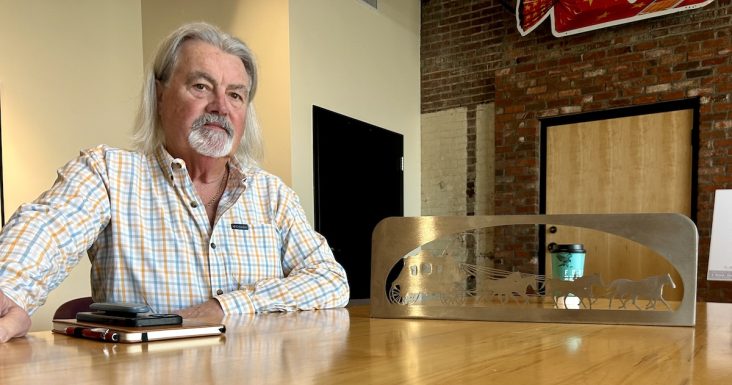
Phil White, a member of the Central Business Improvement District Commission, shows a display that might be used to craft a large Butterfield Stagecoach Trail monument in downtown Fort Smith.
In less than a month, or about the time it once took to deliver mail from Fort Smith to California and back, an idea to build a large Butterfield Trail monument in downtown Fort Smith has not only morphed into a real plan, but much of the cost is covered and a location has been selected.
Jim Spears, the retired Fort Smith municipal judge who helped lead the effort to place the large Bass Reeves statue in downtown Fort Smith, shared during a Feb. 19 meeting the Central Business Improvement District (CBID) his vision of a Butterfield Stagecoach statue. Spears’ vision was for a silhouette of a stagecoach with a horse and rider to be etched out of a large steel plate and placed on a base. CBID commissioner Phil White, who has experience with downtown development projects, agreed to help move the idea forward.
The Butterfield line was approximately 3,553 miles of trails in Arizona, Arkansas, California, Missouri, New Mexico, Oklahoma, Tennessee and Texas. Fort Smith was the connection point for the Butterfield routes leading to Memphis and St. Louis.
“In 1858, Fort Smith became a hub of the Overland Mail,” notes a National Park Service report. “The first Butterfield Mail stagecoach passed through Fort Smith in September on route to El Paso and then to California. This was a 15-day trip. The Concord stages came across the Arkansas by flatboat at Van Buren then carried passengers and mail on to Fort Smith. On the trip westward to California, mud wagons were used.”
White reported during Thursday’s (March 19) CBID meeting that “amazing things” happened the same day Spears shared his vision. After leaving the Feb. 19 CBID meeting, White visited a manager at Fort Smith-based Midwest Automation, a full-service machine and custom fabrication shop, to learn more about the process of creating an image out of steel.
After hearing White explain the monument concept, the Midwest manager showed White a small cutout he had made years ago that matched what White had described.
“That was it,” White said Thursday. “I took a picture of this and texted it to Judge Spears. He started crying over the phone. He said, ‘Phil that’s it. That’s exactly what I’ve been dreaming about.’ This was within a few hours. This was meant to be.”
More pieces begin falling together in just a few days. Companies and individuals agreed to donate personal and corporate time to design, engineer and produce a monument. The city of Fort Smith agreed to make a place for the monument on the north side of Garrison Avenue, which will be opposite of the Reeves statue on the south side.
“People were working together,” White said. “Within a few days this thing was put together. Amazing things happened.”
He said the work is estimated to cost about $250,000, but because people donated materials, labor and cash, there will only be “a few thousand dollars” to raise, “and we can probably get that donated.” He said the initial plan is that the monument will show the stagecoach traveling west. He said the Butterfield Trail monument and Reeves statue will be “quite a welcome for anyone coming over the (Garrison Avenue) bridge” into downtown Fort Smith.
“They’re taking the mail over the river. And you’ve got Bass Reeves on one side and you’ve got the stagecoach on the other side,” White said, adding that when it becomes a reality “it will be a real credit to Judge Spears and his vision for this.”
“So by our next meeting (in April), this thing will be installed?” joked CBID member Bill Hanna after White’s report.
White said it’s possible the monument could be installed this summer.
Downtown Fort Smith also has a Gen. William O. Darby statue on the east end of Garrison Avenue, statues in Gateway Park at Garrison and Rogers Avenues, and the statue of a Native American lawman at the U.S. Marshals Museum.