
UAFS ceremonially opens advanced manufacturing lab, workforce center
by May 4, 2026 6:17 pm 704 views
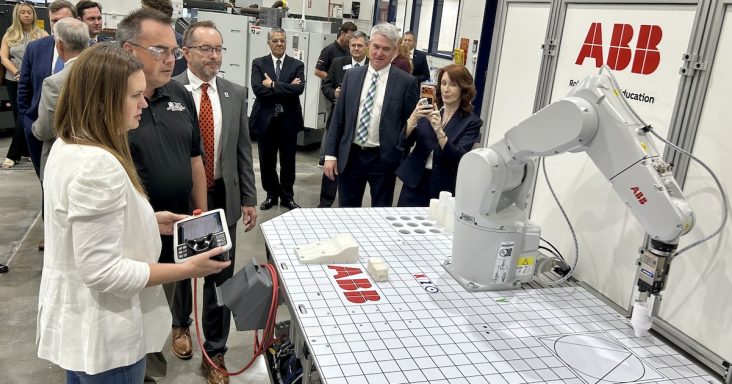
Gov. Sarah Sanders (left) puts a manufacturing robot through a test run during a tour of the University of Arkansas at Fort Smith’s manufacturing lab. Watching (from left) are Garry Cude, UAFS instructor, and Kendall Ross, UAFS associate vice chancellor of Economic and Workforce Development.
An almost $7 million facility ceremonially opened Monday (May 4) at the University of Arkansas at Fort Smith (UAFS) is designed to help the Fort Smith metro recruit, retain and grow advanced manufacturing jobs, according to UAFS Chancellor Dr. Terisa Riley.
Several hundred academic, business, and government officials gathered Monday at the UAFS to open an advanced manufacturing lab and workforce development center. Programs were designed through a collaboration with UAFS faculty, state education officials, and with industry input, Riley said.
“We make sure that we are listening, loud and clear, to you as employers to make sure that we know our students are ready for you, for the work, and for the wonderful life they can live right here in the River Valley,” Riley said.
Gov. Sarah Sanders, who toured the facility Monday, said partnering with industry is her preference for workforce readiness programs.
“(W)orkforce readiness has been one of my administration’s number one priorities, and this facility represents a key piece of that,” Sanders said Monday. “Part of why I love it so much is because this wasn’t a huge top-down government-first strategy that brought this project here. Instead, this was the school and the business community in Fort Smith coming together and making it a reality.”
The UAFS received more than $5.7 million from Arkansas’ Higher Industry Readiness through Educational Development (HIRED) program. The HIRED grants are intended to provide funding for state and regional industry-driven partnerships and data-driven education and workforce training programs. Funding for the grants comes from Arkansas Workforce Initiative grant funding and federal American Rescue Plan Act (ARPA) funds. No member of Arkansas’ Congressional delegation voted for ARPA.
Zurich, Switzerland-based ABB, which bought Baldor Electric Co. in 2011, donated $1 million to support the lab. As of April 2025, ABB employed approximately 1,165 people in Fort Smith and had 250 employees at its Ozark production plant. ABB has a motor production facility in Westville, Okla., that had 351 employees in early 2025.
According to UAFS, the advanced manufacturing lab “will support longer-term workforce development through for-credit pathways, including the new Bachelor of Science in Advanced Manufacturing Engineering program, stackable certificates, and early college pathways for high school students.”
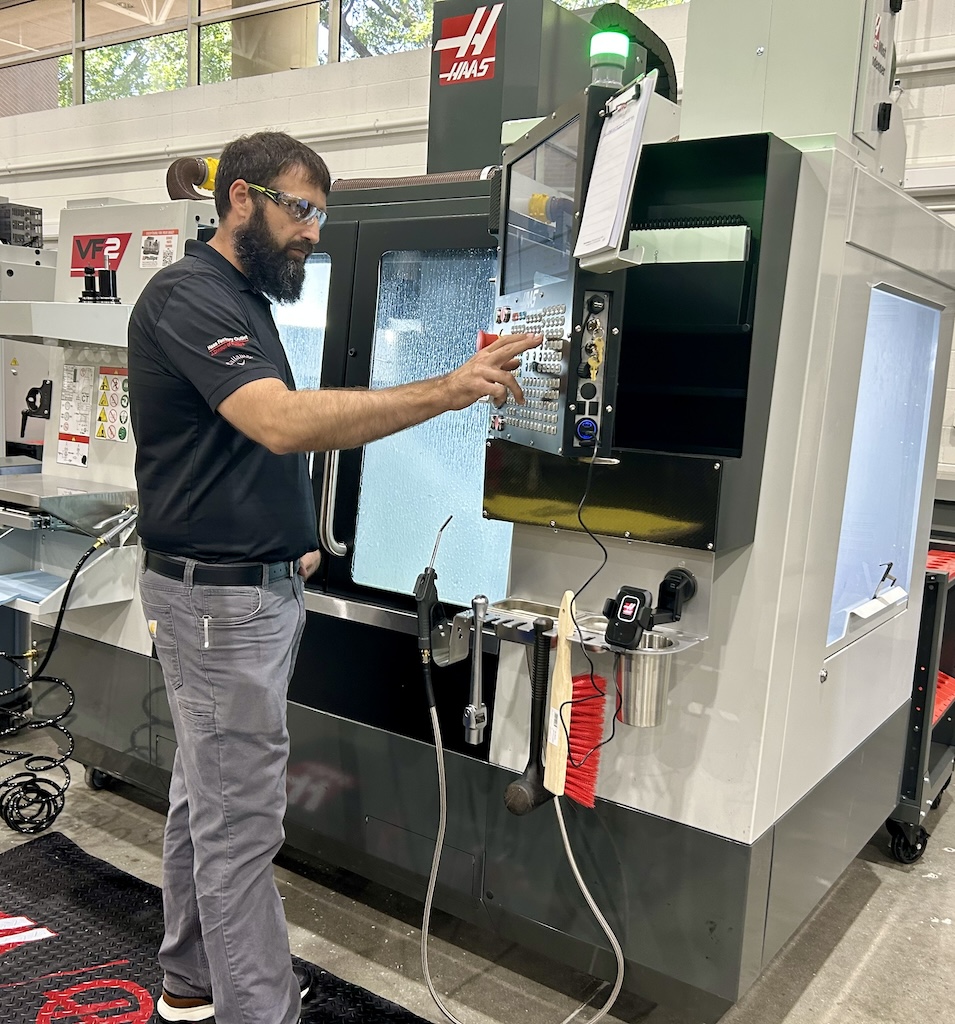
Equipment in the lab and workforce development center includes FAS-200 automated assembly systems, ABB Cobot FlexTrainers, and RTS-200 robotics training systems. The systems, according to ABB and UAFS, are similar or the same as what is used in many advanced manufacturing facilities. The equipment is also “flexible” in that it can adapt as technology changes.
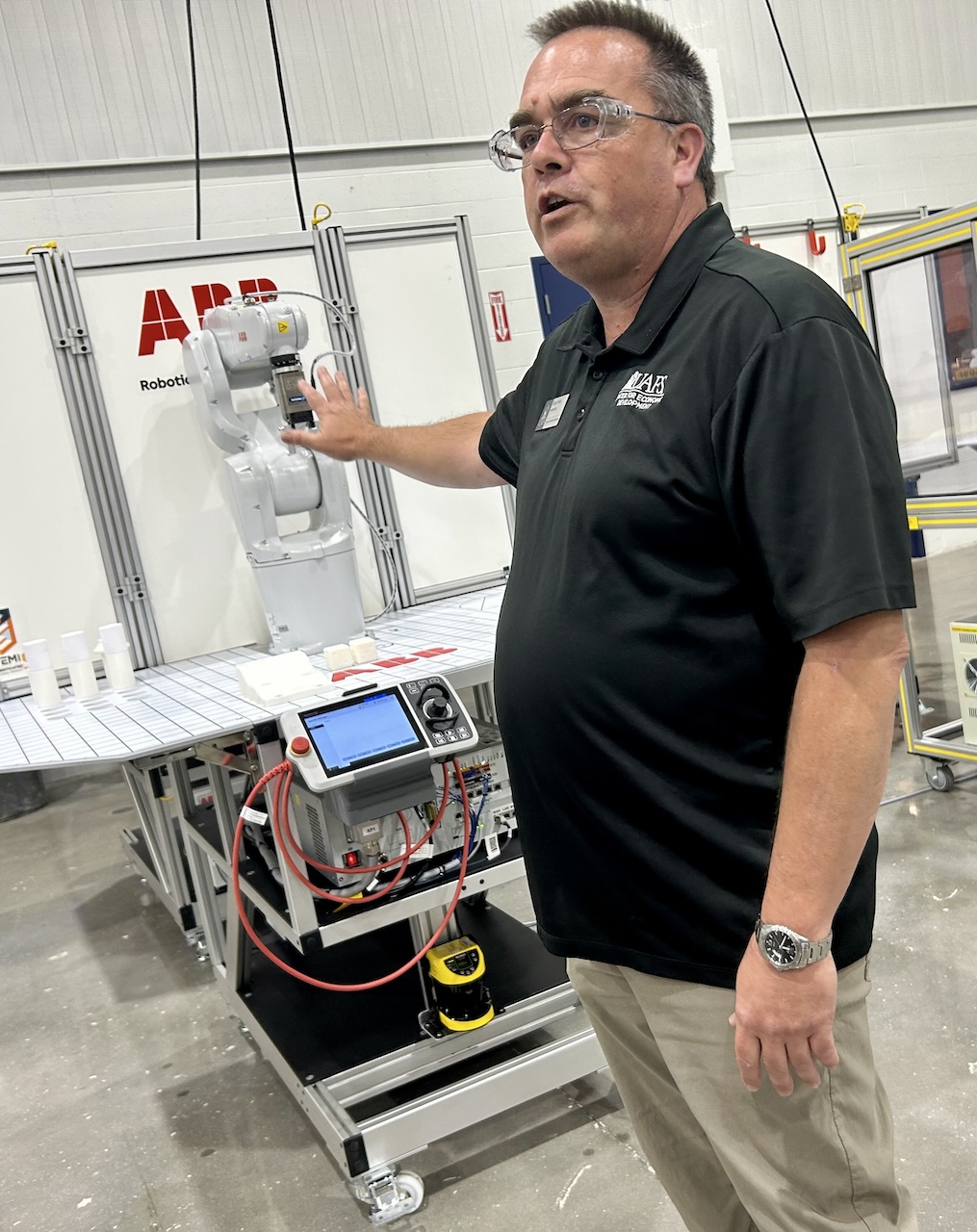
“We have facility members who are constantly reading in their disciplines and staying connected within the disciplines, and talking to employers about what their needs are,” Riley said. “And, ultimately, most of the equipment you see here has AI embedded in it.”
Kendall Ross, UAFS associate vice chancellor of Economic and Workforce Development, said manufacturing jobs are about 17.5% of Fort Smith metro employment, and “employers continue to face shortages of skilled workers needed for production, maintenance, automation, engineering, and technology integration.”
Ross said manufacturing employment has declined in recent years, with much of the training focused on helping with turnover than new job creation. The estimated number of Fort Smith metro manufacturing jobs was 17,700, down from 17,900 in February 2025. Peak employment in the sector was 29,200 in June 1999.
“Right now the demand is flat,” Ross said. “Let’s be real clear, the demand is really flat. So we’re preparing for two years from now, or one year, or 6, or whatever it is. … So certainly in this area right here, we are going to be feeding turnover. There are going to be a lot of (baby) boomers that are retiring.”
He said the UAFS manufacturing academy, part of the workforce development center and set to start later this year, will help train people for initial employment in the manufacturing sector. Riley has said $1.7 million in grant proceeds would be used to establish the academy.
“Our goal there is to take people who are unemployed, underemployed, and train them for 100 hours … for them to become production operators and assemblers in a manufacturing facility,” Ross said.
Other aspects of the workforce development center includes apprenticeship expansion and technical “upskilling.”