
Ruling requires removal of Ten Commandments monument from Arkansas Capitol grounds
by April 1, 2026 2:20 pm 721 views

Citing violation of the Establishment Clause of the U.S. Constitution, a federal judge has ruled that a Ten Commandments monument must be removed from the Arkansas Capitol grounds. The decision comes almost eight years after lawsuits were filed seeking to remove the monument.
U.S. District Judge Kristine Baker issued an opinion and an order Tuesday (March 31) saying the monument is a constitutional violation and ordered Arkansas Secretary of State Cole Jester to remove the monument. Removal of the monument is pending any appeals.
Jeff LeMaster, communications director for Arkansas Attorney General Tim Griffin, said the office is “reviewing the decision and considering our options.”
In June 2017, the first Ten Commandments monument on the Capitol grounds was placed between the Arkansas Supreme Court and offices of the State Department of Education. The 6,000-pound monument is 44 inches wide and 78 inches tall, and is a replica of one erected in Texas, Oklahoma and other states.
In late June, Michael Tate Reed of Van Buren ran over the newly erected monument and was later arrested by Little Rock police and charged with defacing an object of public interest, criminal trespass and mischief. An identical replacement monument would be erected.
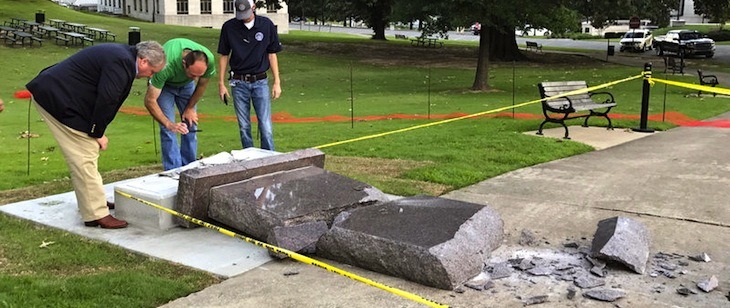
In May 2018, the Arkansas Civil Liberties Union, on behalf of several plaintiffs, filed a lawsuit seeking to remove the monument. Plaintiffs in the case included Anne Orsi, an agnostic atheist; Rabbi Eugene Levy; Gale Stewart, an ordained elder in the Presbyterian Church (U.S.A.); and Teresa Gryder, a Wiccan.
The American Humanist Association (AHA), and the Freedom From Religion Foundation also filed complaints alleging the monument is a violation of the Establishment Clause of the First Amendment of the U.S. Constitution and should be removed.
In her ruling, Baker, the chief judge in Arkansas’ Eastern U.S. District, said the actions by legislators and state officials to install the monument and then make it difficult for other monuments to be installed creates an unconstitutional favoring of the Christian religion.
“The Court’s review of the Display Act passed by the General Assembly, together with the other evidence in the record, conveys a message that the Christian religion is favored, and the Display Act is coercive in violation of the Establishment Clause,” Baker noted.
Baker also noted: “Based on the undisputed record evidence as a whole, this Court concludes in the context of this case, that (1) the primary purpose of the Display Act was to promote the Ten Commandments, and (2) the effect of the Display Act was to advance one religion over others and over nonadherence, not to comment about the development of law in history. By placing the Ten Commandments Monument as required by the Display Act, Secretary Jester failed to avoid excessive government entanglement with religion.” (Link here for a PDF of Baker’s 148-page opinion and order.)
Arkansas ACLU Executive Director Holly Dickson praised the ruling.
“This ruling is a powerful reaffirmation of a simple, essential principle: the government has no business mandating or meddling in American’s religious beliefs,” Dickson said. “Our Constitution protects every person’s right to believe — or not believe — without government interference. When the state elevates one set of religious beliefs above others, it undermines that promise and sends a message that some Arkansans matter more than others.”
Arkansas Family Council President Jerry Cox said Baker’s ruling goes against legal precedent.
“This is a bad decision that goes against 20 years of U.S. Supreme Court precedent,” Cox said in a statement. “Arkansas’ monument of the Ten Commandments is identical to a monument the U.S. Supreme Court ruled constitutional at the Texas State Capitol Building in 2005. Arkansas’ General Assembly authorized this monument in 2015 to honor the historical impact the Ten Commandments has had on our nation, and the monument was paid for with private donations. The U.S. Supreme Court uses a ‘longstanding history and tradition’ test to determine if displays like this one are constitutional. We firmly believe that Arkansas’ Ten Commandments monument passes this test.”
In June 2015 the Oklahoma Supreme Court ruled that the state’s display of a Ten Commandments monument on the Capitol lawn violated the Oklahoma Constitution. That monument was eventually removed.