
Fort Smith named a finalist in the Tunnel Vision challenge
by March 6, 2026 12:54 pm 1,320 views
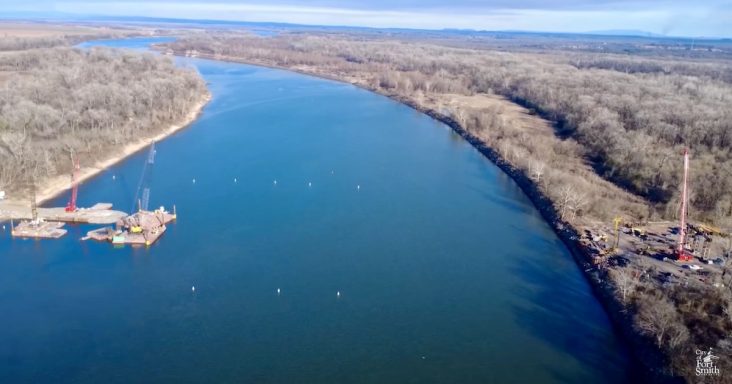
Image courtesy of the city of Fort Smith showing the area where the water transmission line would cross under the Arkansas River. Work shown is construction of the Interstate 49 river bridge by Tulsa-based Manhattan Construction Group.
From the “You don’t know until you ask” category, the city of Fort Smith is one of 16 finalists in a challenge that could result in a 12-foot-diameter tunnel built under the Arkansas River to help complete work on 48-inch water transmission line.
The city was selected as a finalist among 487 applicants, according to The Boring Company, which is conducting the Tunnel Vision Challenge. The company will build for the chosen recipient a 1-mile tunnel that would be 12-feet in diameter for an organization, individual or government.
The Fort Smith Board of Directors on Feb. 3 approved the application. The challenge winner will be announced March 23, according to the Boring Company.
“Fort Smith’s proposal would construct a 1.5-mile, 12-foot-diameter tunnel approximately 70 feet beneath the Arkansas River and federal levee, creating a protected casing for a 48-inch water transmission line connecting the Lake Fort Smith Water Treatment Plant to communities south of the river,” according to the city. “The crossing represents the most technically challenging segment of a 30-mile regional transmission system currently under development. Six miles of the pipeline have already been completed.”
The existing Arkansas River water line crossing in north Fort Smith in the Midland Bridge area, was constructed in 1954 using hand tunneling methods.
The city is working to build a 48-inch water transmission line extending 33.56 miles from the Lake Fort Smith Water Treatment Plant in Mountainburg to Fort Smith. Water from the new line would service the area south of Zero Street in Fort Smith and provide system redundancy.
Once complete, the new line would add 30 million gallons of water a day in delivery capacity and support a total system capacity of up to 60 million gallons a day, according to the city. Fort Smith’s water system provides water to more than 30 cities and water user groups in five counties in Arkansas and Oklahoma.
The existing 27-inch transmission line between Lake Fort Smith and Fort Smith was constructed in 1935 and 1936. The line carries about 35% of water from Lake Fort Smith. The 36-inch Lake Fort Smith transmission line was built in the 1950s and 1960s and carries 65% of the water from Lake Fort Smith.
There are five phases to build the 48-inch transmission line. The first phase of 6 miles has been completed. The planned phase 4 is 2.1 miles and would cross the Arkansas River near the Interstate 49 bridge now under construction north of Barling.
Funding for the line continues to be a challenge. The city has an estimated price tag ranging between $328 million and $585 million for the entire project.
Link here for a city of Fort Smith-produced video about the planned Arkansas River crossing.
Following are the other announced Tunnel Vision finalists.
- Ketchikan Airport Connector, a Loop tunnel in Ketchikan, Alaska
- Ball Arena Tunnel, a pedestrian tunnel in Denver
- Kansas City Chiefs Tunnel, a pedestrian tunnel in Kansas City, Kan.
- NOLA Loop, a Loop tunnel in New Orleans
- Ravens Loop, a Loop tunnel in Baltimore
- Buffalo Bills Tunnel, a pedestrian tunnel in Orchard Park, N.Y.
- The Canal Underline, a pedestrian tunnel in Panama City, Panama
- Bastrop Pedestrian Tunnel in Bastrop, Texas
- Magnolia Loop, a Loop tunnel in Waco, Texas
- Morgan’s Wonderland Tunnel, a pedestrian tunnel in San Antonio
- University Hills Loop, a Loop tunnel in Dallas
- The Woodlands Loop, a Loop tunnel in The Woodlands, Texas
- The Vol Loop, a proposed Loop project in Knoxville, Tenn.
- The Mountain Mile Loop, a proposed loop in Gatlinburg, Tenn.
- Utility tunnel project, Hendersonville, Tenn.