
Arkansas rice acres planted drop to lowest level in 50 years
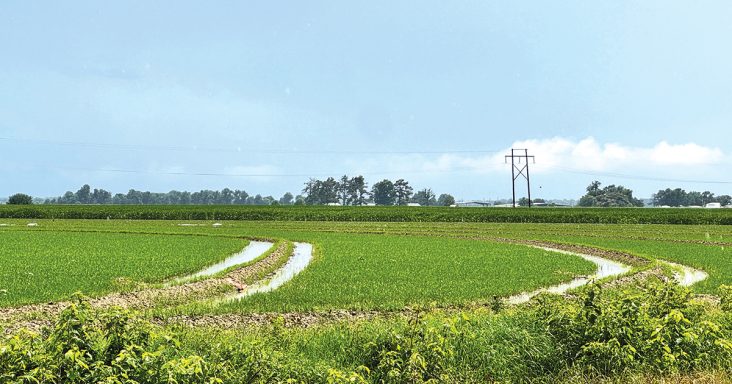
Rice fields are irrigated June 7 near Palestine in St. Francis County. (Courtesy University of Arkansas Division of Agriculture)
Rice, one of the Natural State’s signature crops, has taken a massive acreage dip this growing season and if a plethora of dynamics don’t change, that dip could become permanent.
Arkansas rice acres have dropped this year to their lowest levels in 50 years, according to the U.S. Department of Agriculture (USDA). The state has 851,000 acres planted, according to the USDA’s National Agricultural Statistics Service.
Jarrod Hardke, rice extension agronomist, told Talk Business & Politics the bleak outlook for this year’s rice crop might extend to the next growing season and beyond.
“Total rice acres in the state came up short of the 1 million acres in the March intentions,” he said. “The total dipped to 851,000 acres, the lowest acreage since the age of disco. We had 840,000 to 850,000 acres in ’76 and ’77. For those who didn’t book inputs earlier this year, we wondered if the price spikes in fertilizer and fuel would have some impact on corn and rice acres. Based on the Acreage report, that had no influence on corn acres.”
“Rice? Possibly,” said Scott Stiles, extension economics program associate for the University of Arkansas Division of Agriculture.
Rice prices have slightly improved since the spring, but even that bump made little difference when producers were making decisions about how many acres to plant, Stiles said.
“We’ve seen some improvement in rice prices this spring, but the better part of the rally occurred in May and beyond,” he said. “This year, essentially 90% of the rice acres were planted by May 1. From the outset this year, rice margins were nil, and the spike in fuel and fertilizer this spring only compounded that situation.”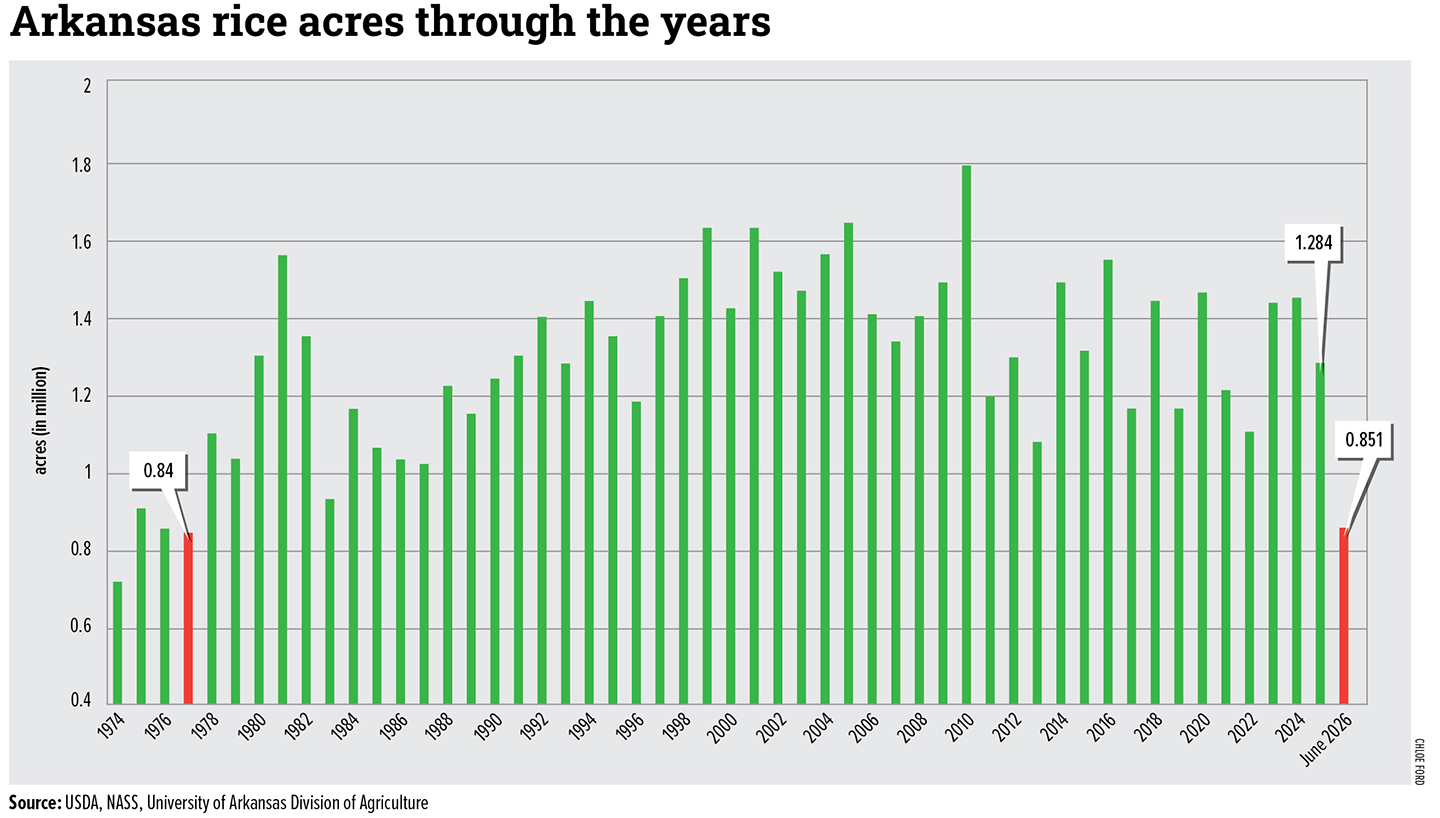
Hardke said stakeholders within the sector actually thought the acreage numbers might be lower. Farmers planted about 730,000 long grain acres and about 120,000 medium grain acres.
“I think it’s possible there are even fewer long-grain acres, but medium-grain acres came in close to expectation,” he said.
There were two drivers this year for Arkansas farmers debating their crop mix. The first was dry early conditions, which helped speed planting.
“Some of those acres ended up as rice,” Hardke said.
A multitude of factors came together to drive the overall acreage to its lowest level in nearly half a century. Producers had large crops during the last several years and it led to oversupply, Hardke said. International markets have been saturated with rice production increases from India and South America. The U.S. attack on Iran that began in March caused diesel and fertilizer prices to skyrocket and that led to a dip in acres.
There is at least one glimmer of hope, Hardke said. Rice stock supplies are projected to dwindle by next spring which means there could be more demand. But, that could be offset by more international market growth, Hardke said. The state’s rice acres weren’t a surprise, but the corn acres projected were way off, Stiles said.
“In March, NASS had our corn acres at 590,000, which we thought was too low,” he said. “In fact, today’s number was 830,000 acres and slightly above last year. That is hard to explain.”
Extension wheat and feed grains agronomist Jason Kelley said farmers “had an exceptionally dry March and April, which allowed corn to be planted on time without rain delays, giving us one of our best planting windows in several years.”
“There was concern that high nitrogen prices may have reduced corn acres, which they may have to some degree, but I think many planting decisions were already made when nitrogen prices started increasing,” Kelley said. “This year’s 830,000 acres is approximately 100,000 acres above the 10-year average planting.”
About 3.2 million soybean acres were planted, up from the 3.1 million acres forecast in the Prospective Plantings report.
“Soybean prices rallied throughout the spring months and peaked in May just above $12,” Stiles said. “That was a price level we hadn’t seen in two years. There have been decent marketing opportunities, as well as better margins and lower production costs that favored soybeans heavily this year.”
Jeremy Ross, extension soybean agronomist for the Division of Agriculture, said the Acreage report “is much closer to the actual acreage than the previous estimate.”
“Soybean growers have soybean planted in just about every corner where they can plant row crops,” he said. “With more soybean acres in the state, my calls on production problems have been more than over the past few years. Now soybean growers are hoping for the rest of the summer to have mild temperatures and some rainfall to help maximize yields.”
Cotton acres also surprised many industry watchers.
“The report has us at 470,000 acres, and that number is a pleasant surprise,” said Zachary Treadway, extension cotton and peanut agronomist for the Division of Agriculture. “The National Cotton Council predicted 325,000, and USDA predicted 470,000 in late winter/early spring. After a market uptick in May, among several other factors that boded well for cotton, I did believe we would see more than the 325,000 acres, but I did not predict we would actually achieve that 470,000-acre mark. The 470,000-acre mark is a decrease of 50,000 acres from 2025, but with all things considered, that is a very respectable mark and kudos to our Arkansas cotton producers.”
Stiles said “a surprising price rally above 80 cents per pound in cotton kept acres more stable than expected.
“With the later planting and much of the crop going in the ground in May, the recent pullback in urea prices was well-timed,” Stiles said. “As we begin to see Farm Service Agency certified acres in August, we may even see cotton acres tick a little higher.”
Arkansas’ peanut acreage took a dive, falling to 31,000 acres, down 17,000 acres from 2025.
“This decline is in line with a nationwide decrease in peanut acres and is Arkansas’ lowest acreage since it planted 26,000 acres in 2018,” Treadway said. “While I knew a decrease in acreage was inevitable, I was a little surprised by the magnitude. I will be interested to see if there is any adjustment to that number in future reports.”