
Fort Smith board to review plans for police training facility, new precinct

An almost $10 million phased plan and estimated costs to redevelop a former auto dealership into a Fort Smith Police Department (FSPD) training facility and precinct space will be reviewed Tuesday (July 28) by the Fort Smith Board of Directors.
Questions about how to use the property, or possibly even list it for sale and abandon the FSPD plan, have swirled around the property soon after it was acquired by the city.
The Fort Smith board approved spending $2.85 million to buy the former Crain-Kia dealership in south Fort Smith in March 2024. The initial plan was to use the property for a police precinct and consolidated maintenance facility. Located at 8200 U.S. Highway 71 S., the more than 4.4-acre property at the former car dealership has three structures. Initially, two structures were to be used for a FSPD precinct and training facility. A third structure, which was an auto service center for the dealership, was to become a consolidated maintenance facility for all city vehicles.
During a March 2026 board study session, the board consensus was to review design and costs for a plan that would develop only two of the three buildings, and do the work in two phases. The estimated cost for both phases, according to Fort Smith-based MAHG Architecture, is $9.925 million.
“Phase 1 includes the primary training facility components plus renovation of the third building on the property to provide covered parking for department vehicles and specialized equipment,” noted a memo from Andrew Richards, the city’s chief financial officer. “Phase 2 covers the main police precinct operations. The updated estimated cost of such a project reflecting current construction realities is $9.925 million and is detailed on attached pages.”
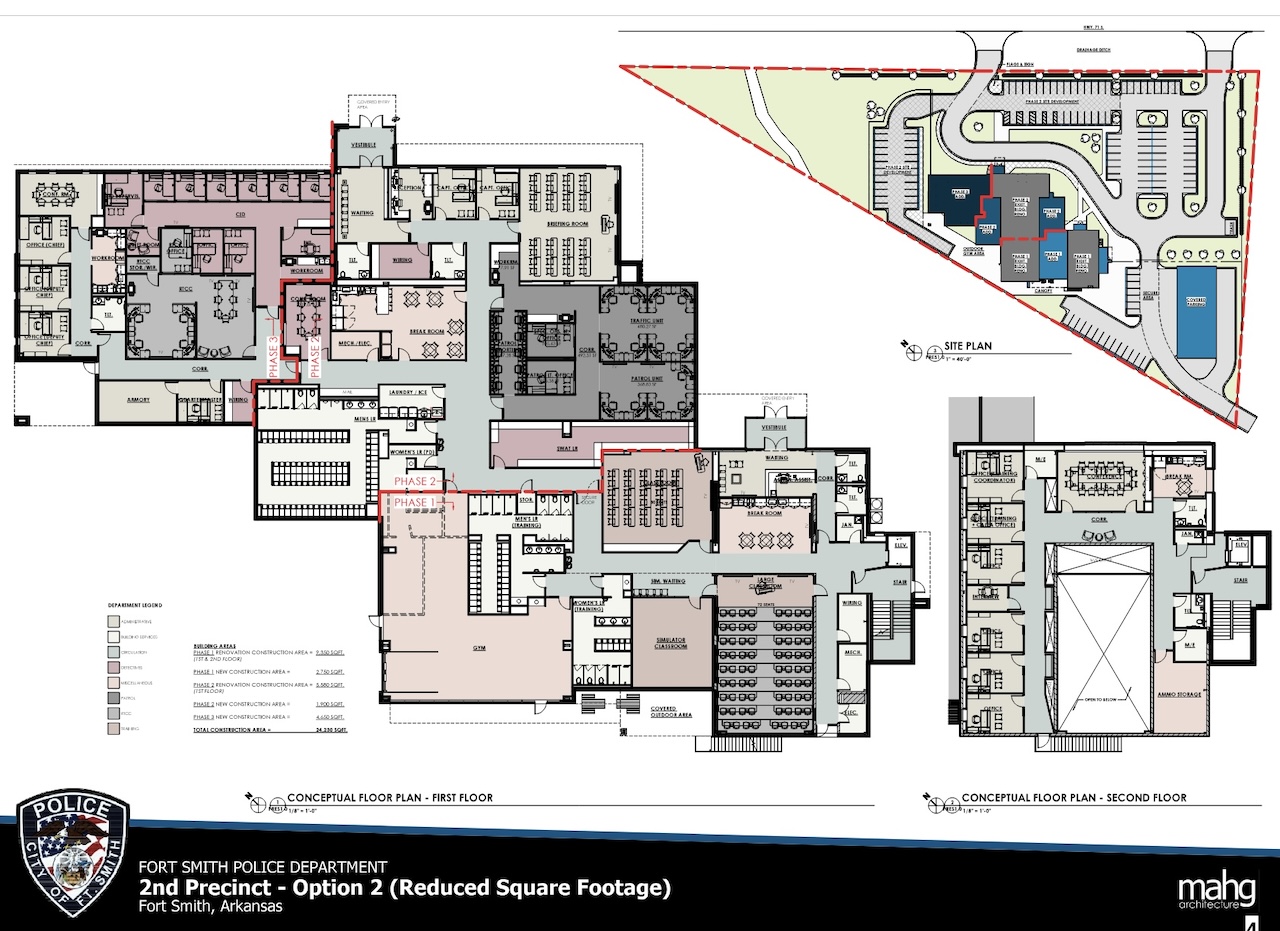
According to the board agenda, Richards will present funding options for the work. Specifically, he will outline a $10 million bond issue with a 20-year finance term based on a 4.5% interest rate. That option would have an estimated $753,000 annual debt-service payment. The debt service payment would come from the FSPD operating budget, Richards said.
“The existing Sales and Use Tax for Police Department Operating and Capital can be used for Police Department operating expenses to account for the reduced general fund revenue available by dedicating a portion of it to capital debt service,” Richards advised. “These funds can be used for funding personnel and operating expenses in the Police Department to offset the reduction of franchise fee revenue that has historically been available for these purposes.”
STRATEGIC PRIORITIES
Also, the board is expected to review 2027 strategic priorities developed during a June 27 all-day board strategy session facilitated by Dr. Micki Voelkel, professor of leadership and management with the Center for Economic Development at the University of Arkansas at Fort Smith.
The top three strengths identified by the board and Acting City Administrator Jeff Dingman were the foreign military pilot training center at Ebbing Air National Guard Base in Fort Smith, the region’s education and military institutions, and the region’s geographic location that can serve as a national business hub. A close contender for the top three was recent improvements in the city’s parks, trails and greenways.
The top three weaknesses identified by the group were a lack of funds to address water system infrastructure needs, competing priorities for the funding by the city’s general fund, and homelessness, primarily in the downtown area.
The top three opportunities identified were capitalizing on the foreign pilot training center, growth of manufacturing, and leveraging growth around the completion of Interstate 49, and benefitting from the presence of the University of Arkansas at Fort Smith, Arkansas Colleges of Health Education, Ebbing, and the economic growth in Northwest Arkansas.
The top three threats to city and regional success are negative public perceptions, economic competition with Northwest Arkansas and other regions, and a decline in healthcare services.