
New Trail of Tears marker planned at the Fort Smith National Historic Site
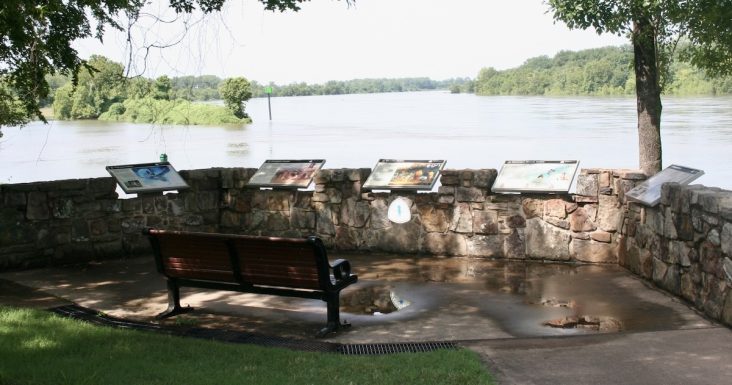
Pictured is the Trail of Tears marker at the Fort Smith National Historic Site that was destroyed by flood waters in 2019.
A Trail of Tears marker at the Fort Smith National Historic Site will soon have a new overlook noting the migration of Native American tribes in the 1830s. The work, approved and funded by the National Park Service, is expected to be complete in May 2027.
The Arkansas River flood of 2019 that hit the Fort Smith area washed away the previous installation at the site. Built in 1998, the original overlook, which included historical markers showcasing the history of the Cherokee, Choctaw, Chickasaw, Muscogee, and Seminole Tribes, was located along the river trail near the intersection of the Arkansas and Poteau Rivers.
According to the National Park Service, the Trail of Tears National Historic Trail acknowledges the removal of Native American tribes from their land in Alabama, Georgia, North Carolina, and Tennessee and relocated them to what is now known as Oklahoma. That period in history is a dark one.
“The impact to the Cherokee was devastating,” the service’s website said. “Hundreds of Cherokee died during their trip west, and thousands more perished from the consequences of relocation.”
The trail covers 2,200 miles of land and water routes and passes through Alabama, Arkansas, Georgia, Illinois, Kentucky, Missouri, North Carolina, Oklahoma, and Tennessee. According to Dr. J. Adam Beeco, the Fort Smith National Historic Site superintendent, most Native Americans traveled by water along the Arkansas River; however, others traveled by land through the area.
“Much like the original overlook, the new overlook will help tell the stories of the Trail of Tears of the Cherokee, Choctaw, Chickasaw, Muscogee, and Seminole Tribes,” noted a statement from Beeco. “A portion of each of these tribes traveled through Fort Smith on their way to Indian Territory (now Oklahoma) during the 19th century. Most traveled by water, up the Arkansas River, but some people traveled through Fort Smith on foot as well. The Commissary building and Fort I facilities are known to have stored goods for Tribes on their passage through during the 1830’s.”
The overlook’s new site will be slightly downstream from the original location but along the river trail, Beeco said, with the new design built to be more flood resistant.
Fort Smith-based Steve Beam Construction won the project bid, which will include minor earthworks, interpretive panels, a mural, and walkways, Beeco said. The work is projected to cost $508,850. The trail will be closed during the summer, he said, but plans are to reopen the trail this fall followed by periodic closures through the winter and spring. Construction will be completed by mid-May 2027.
In addition to the Fort Smith National Historic Site, other partners include the National Park Services’ National Trails Office, the Trail of Tears National Historic Trail, and the Native American tribes associated with the trail.
The National Historical Site also plans to replace windows at the visitor center, including the jail and courthouse windows. Beeco said visitors likely won’t experience closures during that time. He also said plans are ongoing to address foundation leaks at the visitor center.