
Evidence testing in West Memphis Three case could be completed by end of July
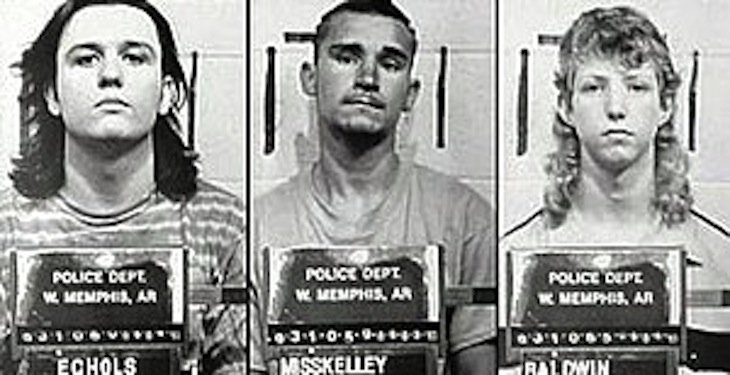
Damien Echols, Jason Baldwin and Jessie Misskelley Jr., were convicted of the murders of three 8-year-old boys in West Memphis in 1993.
Evidence in the West Memphis Three case still hasn’t been processed, but there is hope that it will be tested by mid-summer, spokesman Lonnie Soury told Talk Business & Politics. Ligatures, hairs, and possibly other evidence is at Bode Technology, a DNA lab based in Virginia.
The ligatures, hairs and other evidence has been in the lab since last fall.
“Hopefully, the testing will be done by the end of July and we can finally get some answers,” Soury said.
Soury is the spokesman for Damien Echols, one of the three men that was convicted in the killings of three Cub Scouts in West Memphis on May 5, 1993. The 8-year-old boys – Michael Moore, Christopher Byers, and Stevie Branch – were riding their bikes in their West Memphis neighborhood when they vanished. Their nude, hog-tied bodies were found in a drainage ditch in a wooded area, known as Robin Hood Hills, not far from their homes the next day. Police and prosecutors developed an unproven theory that the boys were killed in a Satanic or occult ceremony.
Echols, along with two other teen co-defendants, Jason Baldwin and Jessie Misskelley, were convicted in 1994 of killing the boys. Misskelley gave several error-riddled confessions that led to the arrests and subsequent incarcerations.
He said the boys were tied with ropes when they were tied with their own shoelaces. He said the attack happened in the morning when the boys were in school. Misskelley, who suffers from a low IQ and learning disabilities, told investigators that two of the boys were sexually assaulted.
State Medical Examiners Dr. Frank Perretti and Dr. William Sturner confirmed during the defendant’s post-conviction relief hearings in 2009 that no semen was recovered from the victims or their clothing. Both testified that there was no anal bruising or tearing and it would be a physical impossibility for the boys to be sexually assaulted in that manner without leaving physical evidence.
Famed forensic pathologists Dr. Werner Spitz, Dr. Michael Baden, Dr. Richard Souviron and Dr. Janice Ophoven testified that there was no evidence of a sexual assault, and there would be evidence if it occurred.
After their convictions, a documentary “Paradise Lost – the child murders at Robin Hood Hills” was released and it started an international furor. The three men, now dubbed “The West Memphis Three” languished in prison for years as their appeals slogged through the state court system.
In 2007, hairs that were recovered from the crime scene were DNA using methods not available during the 1990s and not one of the hairs matched the West Memphis Three. A hair found in the ligature that bound Moore was an almost certain match for Branch’s stepfather Terry Hobbs and a hair for Hobb’s alibi witness, David Jacoby was found on a tree stump next to where the bodies were found.
When asked by TB&P if he was involved with the murders, Hobbs said he was not involved. Jacoby has stated repeatedly that he was not with Hobbs when the boys vanished.
On Aug. 19, 2011, they were released after agreeing to Alford pleas which are essentially no contest pleas. The internationally famous case stayed out of the news for the most part during the next decade but re-emerged in 2020 when Echols asked prosecutors to do advanced touch DNA testing on the ligatures that bound the boys.
Prosecutors fought the testing and those efforts slogged through the court system until April 2024 when the Arkansas Supreme Court that the testing should move forward. Before that ruling, Hobbs told TB&P that he “hoped a judge would do the right thing and order all the evidence in the case destroyed.”
The evidence is expected to be M-Vac DNA or touch DNA tested. M-Vac is a microbiological “vacuum” that can retrieve DNA more precisely than traditional DNA swabbing. The victims were “hogtied” ankle-to-wrist with their own shoelaces, and the hope is that the boys’ killer or killers left skin cells in the ligatures when they were tied.