
The Compass Report: Relative declines seen in Arkansas metro economies
by June 14, 2026 11:37 am 1,320 views

Although job numbers were up broadly, rising jobless rates, declines in manufacturing and construction jobs, and moderation in building activity resulted in lower grades among the four Arkansas metro economies measured by The Compass Report.
The Compass Report is a partnership between the University of Arkansas at Fort Smith (UAFS) and Talk Business & Politics. First National Bank of Fort Smith is a sponsor of the statewide report.
Kendall Ross, UAFS associate vice chancellor of Economic and Workforce Development, is responsible for data collection and written analysis for the report.
The report measures four leading and four current economic indicators to provide a grade for a regional economy. The eight categories measured to determine The Compass Report grade in the Central Arkansas, Fort Smith and Northwest Arkansas areas are total nonfarm jobs, unemployment rate, building permits, sales tax revenue, manufacturing jobs, service sector jobs, construction jobs, tourism jobs and concentration of manufacturing jobs. Because the data is not available, construction and tourism jobs are not included in the Jonesboro metro grade.
A key factor in understanding the report is in understanding the “grading” approach used to measure the current and leading economic indicators. For example, a grade of “C” reflects no change in economic activity. The grades “B” or “A” indicate improvement above the historical average, and “D” and “F” indicate a decline in economic activity compared to the historical average.
‘POTENTIAL PROBLEM’
Ross said economic conditions in the four metro areas were similar to first quarter conditions statewide.
“The state’s first quarter performance reflected a balance of continued job growth in some areas and persistent weakness in key labor market and production-related sectors,” Ross noted in the report. “The statewide unemployment rate increased to 4.3% in March, and the number of unemployed individuals rose significantly compared to March 2025. Manufacturing and construction employment were both lower year-over-year, limiting the effect of gains in total employment and hospitality.”
Greg Kaza, an economist and executive director of the Arkansas Policy Foundation, said the broad job declines, especially in manufacturing, points to business cycle concerns.
“There is a potential problem when jobs decline year-over-year, or gains are reported in service sectors such as hospitality, not goods-producing areas such as construction and manufacturing that tend to lead business cycles,” Kaza noted in his analysis. “Northwest Arkansas reported a healthy increase in non-farm employment between March 2025 and March 2026. Jonesboro also reported modest job gains. Fort Smith and Central Arkansas reported job losses in the same period, a development that bears watching given building permit valuations declined in both areas, along with construction activity.”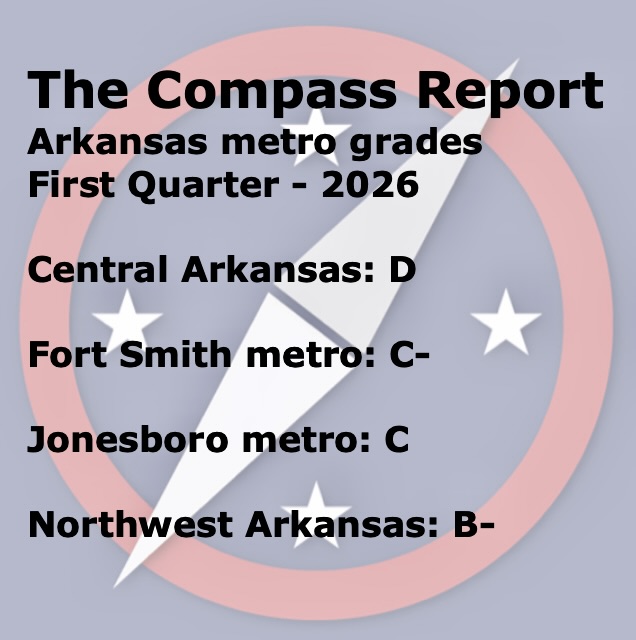
TOP TAKEAWAYS
Following are some of the key takeaways from Ross included in The Compass Report.
Central Arkansas
Central Arkansas faced softer economic conditions in the first quarter of 2026, resulting in an overall grade of D. Non-farm employment showed limited movement compared to the same period in 2025. Employment was slightly higher in January and February but declined year-over-year in March, falling from 394,200 in March 2025 to 393,800 in March 2026.
Northwest Arkansas
Northwest Arkansas continued to show economic strength in the first quarter of 2026, earning an overall grade of B-. Non-farm employment increased year-over-year throughout the quarter, rising from 299,500 in March 2025 to 306,400 in March 2026. This continued job growth reflects the region’s ongoing economic momentum.

Fort Smith metro
The Fort Smith Metro experienced mixed economic conditions in the first quarter of 2026, resulting in an overall grade of C-. Non-farm employment declined year-over-year throughout the quarter, falling from 102,200 in March 2025 to 101,300 in March 2026. This softening in total employment contributed to a weaker current employment grade for the region.
Jonesboro metro
The Jonesboro metro experienced modest economic growth in the first quarter of 2026, resulting in an overall grade of C. Non-farm employment increased year-over-year in each month of the quarter, rising from 64,300 in March 2025 to 64,600 in March 2026. The gains were moderate but consistent, contributing to a stronger current employment grade for the region.
DATA AND MORE ANALYSIS
Link here for the first quarter 2026 raw data gathered by the University of Arkansas at Fort Smith Center for Economic Development.
Link here for the quarterly narrative. Also, link here for the previous reports.