
Fort Smith Board hears new plan for Bass Reeves Legacy Loop project

Photo of Bass Reeves and his monument in downtown Fort Smith.
The Bass Reeves Legacy Loop in Fort Smith is, possibly, back in the works, but with a significantly modified plan that meets new criteria following changes by the Trump administration. The Fort Smith Board of Directors on Tuesday (June 9) discussed costs, routes and other issues with city staff.
Funding for the loop was initially awarded in the final days of the Biden Administration through the Rebuilding America’s Infrastructure with Sustainability and Equity (RAISE) program. A few weeks later, the incoming Trump Administration began cancelling or delaying Biden projects. The program was later changed to the Better Utilizing Investments to Leverage Development (BUILD), and the project was back on.
The loop was initially 14-miles long, and included 8.8 miles of new trails giving a route to schools, parks, jobs, medical care and essential services. The city in January 2025 said 20% of Fort Smith residents would live within a half mile of the loop. The loop would connect eight schools in order to allow students to more safely walk or ride bikes to schools.
City staff began working with the Federal Highway Administration (FHWA) in August 2025, and would hire Halff Associates in September to work on a revised project scope, said Dr. Sara Deuster, the city’s director of Parks and Recreation. Deuster, who was tasked to manage the project through the process, said the original project scope needed to be revised. She said staff from several city departments had numerous meetings to develop a practical, affordable plan.
“There were several months of discussion,” Deuster said, adding that it wasn’t just a meeting or two to tweak the initial plan.
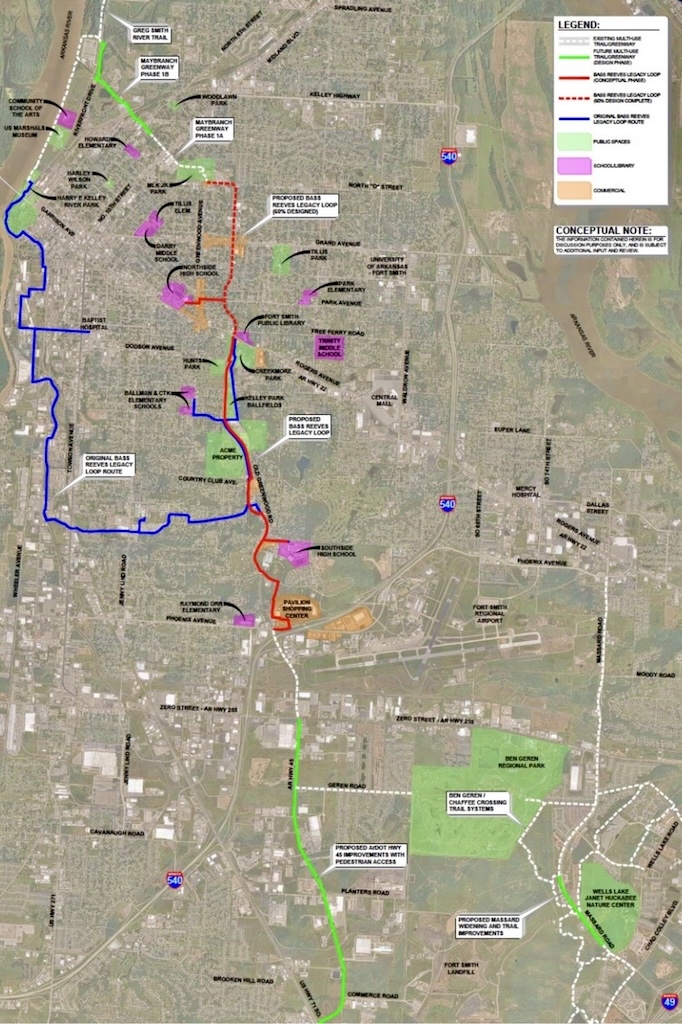
She said the focus of the meetings was to determine if a feasible plan could be possible, to determine accurate costs, to “take a step back and find a solution” to meet the original goals of the loop project,” and to present an affordable plan to the board. Deuster told the board that moving forward on a plan allows the city to “capitalize on almost $25 million in funds that we otherwise would not have.”
Issues with the original plan included potential negative impacts to some homeowners, numerous railroad crossings, uncertain property acquisition costs, and the overall cost estimate. Unaccounted for costs in the original application included permit fees, environmental studies, and higher costs since the plan was crafted in 2023 and first submitted in early 2024, according to Deuster. For example, trail lighting costs increased more than $1.3 million, and concrete greenway and amenity costs rose more than $3.7 million.
The initial plan of around $25 million was now around $40.7 million. Deuster said a revised plan, designed to meet the new federal criteria, is estimated to cost $29.385 million, with $24.987 million in federal dollars and $4.398 million from the city’s 0.125% sales tax portion for parks and recreation capital projects. Deuster said the cost projection of almost $30 million includes a 10% cost-increase estimate. She also said the new trail route, if built, will be a “spine in the center of the city that connects us north and south.”
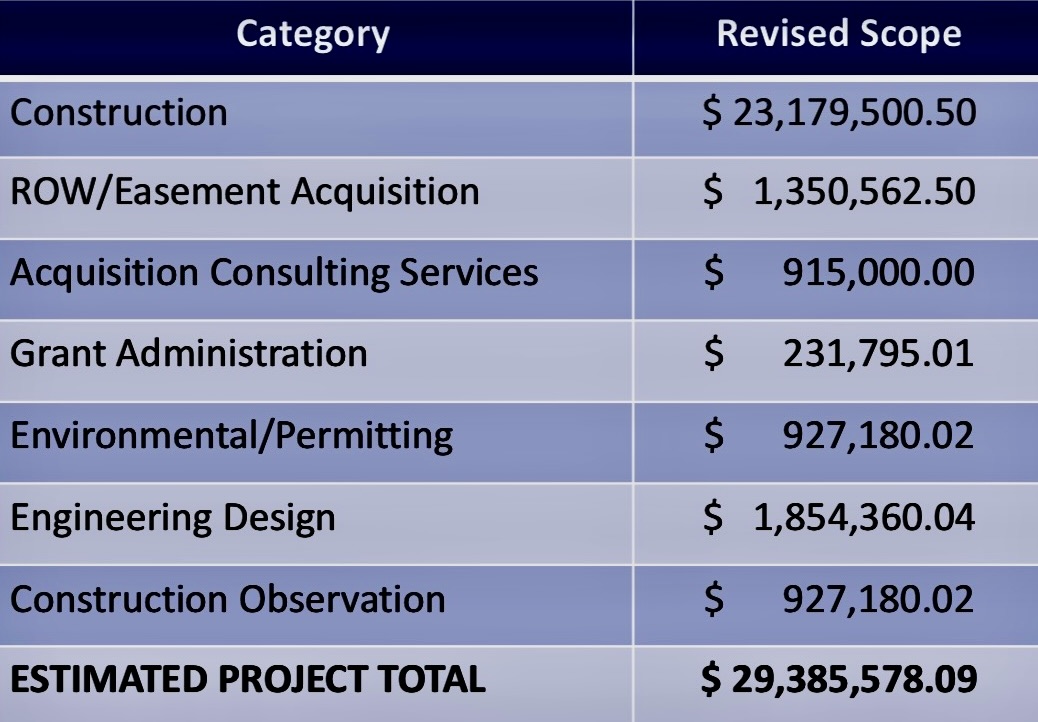
Following are key differences in the two plans.
• The initial plan had 8.8 miles of new trails, with the new plan having 5.5 miles.
• There were 17 railroad crossings in the initial plan, with the revised plan having no railroad crossings.
• A tunnel under Rogers Avenue was proposed in the initial plan, with no tunnel in the revised plan.
Deuster said city staff will need a decision from the board on whether to proceed with the project, noting that federal officials have been positive in their feedback of the new plan. If the board decides to proceed, the city will work to hire a professional services firm to help with the project, and will continue to work with federal officials on the scope change. Deuster also said the board will vote on a final plan approved by the FHWA. If a plan is approved, construction is expected to begin in late 2029, with completion in 2032. She said planning and design “takes a significant amount of time.”
The board consensus was for Deuster to continue pursuing the new plan.
BASS REEVES HISTORY
Reeves was a U.S. Deputy Marshal under U.S. Federal Judge Isaac C. Parker. Reeves was born a slave in Texas in 1838 and died in Muskogee, Okla., on Jan. 12, 1910. Reeves was an African-American and illiterate, but captured more outlaws than anyone else, according to the book, “Black Gun, Silver Star: The Life and Legend of Frontier Marshal Bass Reeves,” written by Art Burton.
Burton wrote that Reeves was an expert tracker and detective, and was able to memorize the warrants for every lawbreaker he was to arrest and bring to trial. Reeves was the first African-American inducted into the Great Westerners Hall of the National Cowboy Hall of Fame in Oklahoma City in 1992.
A 25-foot tall monument of Bass Reeves was unveiled in downtown Fort Smith in May 2012. It was created by sculptor Harold T. Holden. The larger-than-life statue of Reeves also includes his horse, Blaze, and his trusty dog, named simply “Dog.”