
Then and Now: Dr. Josh Roller builds bariatric surgery hub
by February 18, 2026 2:04 pm 805 views
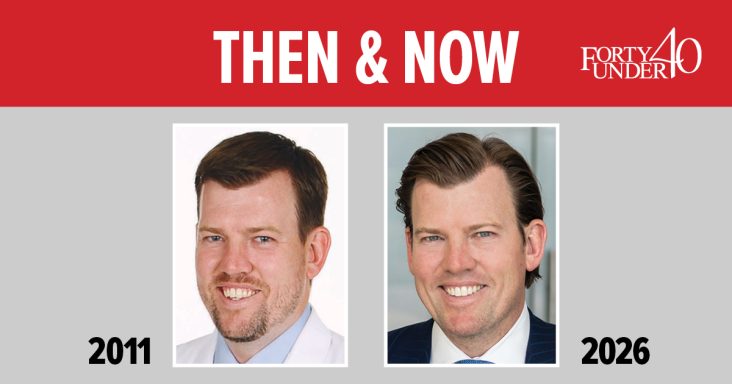
When Dr. Josh Roller arrived in Northwest Arkansas in 2007, bariatric surgery was viewed with skepticism. Nearly two decades later, Roller has performed more than 13,000 weight-loss surgeries, and built a 100-employee practice spanning three cities.
He also opened Arkansas’ first accredited bariatric ambulatory surgery center — transforming Fayetteville into a hub for minimally invasive weight loss surgery, drawing patients from 49 states and from across the world.
From Tulsa, Okla., Roller attended medical school at the University of Oklahoma. After residency at the University of Texas Southwestern Medical School, he completed a fellowship in minimally invasive bariatric and advanced laparoscopic surgery at Duke University Medical Center.
He and his wife, Kristin, also a physician, planned to return to Tulsa, but when a Northwest Arkansas hospital called, they decided to visit as a backup plan.
“We changed five and a half years of planning in less than 24 hours and decided to come to Fayetteville,” Roller said. The opportunity to start his own program, “do something unique and revolve around patients,” was appealing, as were the opportunities “to impact change with the Fortune 500 companies here.”
Roller was the first laparoscopic surgeon in the region, with his practice consisting of Kristin as bariatric medicine doctor and four employees. He’d done 1,100 surgeries in 2011 when he was named to the Northwest Arkansas Business Journal’s Forty Under 40 class.
Patients typically lose half of their weight with the surgery having a 90% to 95% cure rate for diabetes, 85% rate for high blood pressure, 85% rate for sleep apnea and can alleviate knee, back and hip pain, Roller said.
“Surgery helps patients get their lives back, their health back, their confidence back, and they can do amazing things,” he said. “That’s extremely rewarding for me. When you help somebody lose 100, 200, 300 pounds, they’re really happy. It’s like you’ve given them a new life.”
Roller takes his job “very personally. From day one I’ve put my patients first. Sometimes that ruffles people’s feathers. But at the end of the day, I feel like I’m responsible for that patient. I want to know that if I had surgery, that the surgeon is looking out for me if I’m on that table asleep. That’s the biggest burden we bear as surgeons — that you’re in charge of someone’s life, and it’s a tremendous responsibility and one that you should never take for granted.”
Roller “loves operating. It’s my happy place in the OR and wouldn’t trade that for the world.”
When he started his practice, Roller couldn’t get insurance companies to cover the surgery, so he went directly to Walmart, J.B. Hunt, Tyson Foods and Simmons Foods, showing the benefits to each company. The surgery improves employees’ health and saves companies money by avoiding a $50,000 hip or knee replacement,” he said. “An average diabetic costs about $13,500 a year, and we can make it go away 90% to 95% of the time.” Each company now covers the surgery.
Roller helped get the state law passed, effective this year, requiring insurance companies to cover weight loss surgery in Arkansas.
“My goal is to help people realize obesity is a chronic disease,” Roller said. “It isn’t just a personal weakness or failure; it’s a disease that we can help in a way that diet and exercise can’t. It’s the most effective long-term solution for weight loss.
“We’re only impacting like 1% of the population right now, so I definitely want to grow to be able to help everybody that needs help,” he said.
Potential expansion includes central Arkansas and Bentonville. Roller trains surgeons from across the country, including eight Australian surgeons, in the “modified duodenal switch” procedure.
“Surgeons are trained to not be patient people, because you’re always fighting for your patient. You’re always wanting it now, now, now. And that didn’t come naturally to me. But as you become leader of a bunch of people and grow a practice to 100 people, you learn to be more calm, deliberate and patient.” He’s also learned to listen, he said.
He is on the Arkansas State Medical Board and supports EverHope (formerly Northwest Arkansas Children’s Shelter) through his Roller Foundation.