
Researchers working on modernization of poultry processing
by November 2, 2025 10:00 am 705 views
Dr. Jeyam Subbiah was at the grocery store and wanted to grab some chicken. It was during the COVID-19 pandemic, and the shelves were empty. He was stunned.
Tyson Foods, the largest chicken producer in the country is headquartered in Springdale. Many of the chickens used in the company’s production come from farms all over the state.
“I thought to myself, ‘How is this possible here?’” Subbiah told Talk Business & Politics. He is associate vice chancellor for research development in the Division of Research & Innovation at the University of Arkansas, as well as professor of food science and director of the Center for Scalable & Intelligent Automation in Poultry Processing.
One of the main reasons for the chicken shortage during the early days of the pandemic was that many laborers in the poultry production industry got ill from COVID, and it greatly stunted output. Subbiah started to wonder if robotics, virtual reality and artificial intelligence could be used to close labor and sanitation gaps.
“While the pandemic amplified the problem, the labor shortage in the poultry industry is a persistent challenge,” he said. “The jobs are physically demanding. It’s cold. It’s humid. The tasks are repetitive and potentially risky, and the turnover rate in the first 90 days can be as high as 50%.”

Robotics technology has been used in other industrial settings to integrate human assistance with virtual reality headsets and artificial intelligence connected to robotic arms in the poultry processing facility. Humans are still better at deboning chickens than robots, but virtual reality could allow workers to use robotic arms to perform the same tasks, and they wouldn’t have to be inside the plant.
“The poultry plant of the future can enable remote work and allow the robot to collaborate with the human and use that as a database to develop AI algorithms,” Subbiah said.
Another major challenge for poultry processors is maintaining food safety, including sanitization and finding and removing foreign materials like plastics and bone chips in the packaged meat, Subbiah said.
In 2023, Subbiah became the director of a four-year, $5 million grant from the U.S. Department of Agriculture’s National Institute of Food and Agriculture to develop the Center for Scalable and Intelligent Automation in Poultry Processing. The center has a team of partners at the Georgia Institute of Technology, University of Nebraska-Lincoln and Fort Valley State University in Georgia. The experiment station is the research arm of the University of Arkansas System Division of Agriculture.
Subbiah and his fellow researchers have shown promising results in adapting the technologies to poultry processing. Through their research they’ve been able to teach volunteer poultry processing employees to use virtual reality headsets and controllers to remotely assist robotic end effectors, or the robotic “hands.” With the equipment connected to the internet, an operator remotely guides the robotic arm at a processing facility to place chicken carcasses on cones for further processing.

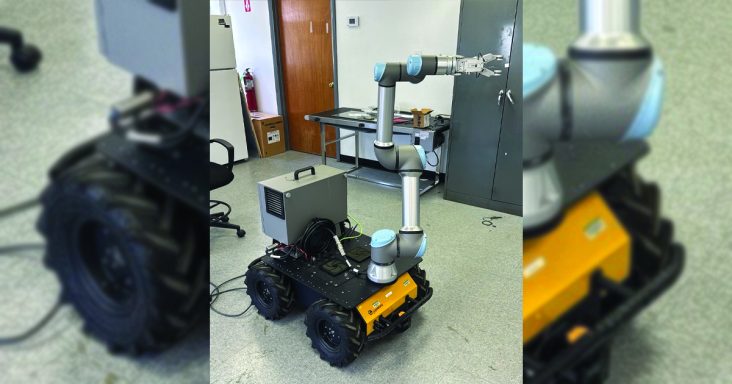
They’ve been able to improve the accuracy of robotic deboning machines with artificial intelligence and program an autonomous vehicle with a robotic arm to assess the effectiveness of sanitation, he said. The research team was also able to develop a method for detecting small bits of plastic that sometimes get inside packaged meat. They bought an inexpensive thermal imaging camera to detect foreign materials in packaged meat.
Traditionally, the whole line has to be shut down if plastic is suspected in any of the packaged meat, Subbiah said. Plastic doesn’t conduct heat well, but chicken has water in it so it does. The thermal camera can detect small bits of plastic and the whole line doesn’t have to be shut down, he said.
Another problem with chicken is a condition called “woody breast.” The condition causes the meat to be hard and rubbery, and it can be difficult to detect. Dongyi Wang, an assistant professor in the biological and agricultural engineering department for the experiment station, has worked to develop a noninvasive method of hyperspectral imaging to detect woody breast with an accuracy of 98%. Wang, who has an appointment in food science, led development of the autonomous vehicle to detect pathogens in a processing facility.
“Adapting the technologies may be possible for processing of other meat species such as goats and sheep,” Subbiah said.
Robotic deboning lines are also under development, he said. Human laborers can debone about 35 chickens per minute, while their robotic counterparts can only do about half of that, he said. The team recently tested a robotic line and it performed nearly as well as humans. More testing was slated to be done in Georgia.
Robotics, AI, and virtual reality could really impact what the poultry plant of the future looks like. It could allow workers to work remotely, improve the sanitation levels inside a plant, could create a more efficient production process and it might minimize labor shortage problems that plague the industry.
But, changes like this will take some time, Subbiah said.
“We want to think futuristically,” he added. “We want to make significant changes.”