
Fed economist talks ag sector woes, consumer challenges
by March 11, 2026 12:29 pm 427 views

While there is growing uncertainty amid geopolitical conflicts, Arkansas businesses responding to the St. Louis Federal Reserve Bank Beige Book inquiries in mid-to-late February indicated more optimism than in the previous quarter.
The report does not include recent tariff uncertainty following the U.S. Supreme Court ruling, or the spike in gasoline prices following the U.S. and Israeli strike on Iran, which has resulted in higher oil prices and stock market losses.
Charles Gascon, economist and assistant vice president at the St Louis Federal Reserve Bank, said while the Beige Book data does not include geopolitical risks now in play, economists can model for shocks to the economy by using recent behavior and historical data.
“Something that we’ve been hearing over many, many months now has been that businesses, as well as consumers, are facing higher costs of things like insurance and utilities,” Gascon said in a recent interview. “That’s taking up a greater share of their budgets, and leading to their non-discretionary purchases making up a bigger chunk of the budgets. They have been pulling back on some of those more discretionary purchases for the better part of last year.”
He said businesses continue to report that consumers remain price sensitive, causing them to hold back on price increases. With the recent geopolitical and tariff uncertainty, Gascon said businesses may pull back on capital spending and hiring. Gascon said employers will err on the side of caution during uncertain times. He said they don’t want to bring on employees they might have to let go if the economy worsens.

Karin Kimbrough, chief economist at LinkedIn, said hiring in terms of job offers are 7% lower than a year ago.
“Hiring has dropped off pretty meaningfully over the past year,” Gascon said. “The labor supply has come down as well, and a lot of investment is concentrated in a few core sectors, data center, construction being a big one, and then a lot of hiring taking place in the healthcare side of the economy.”
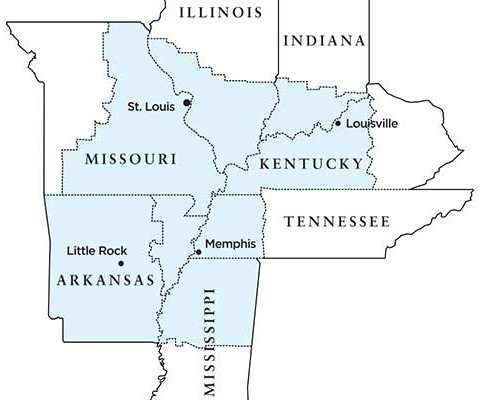
In the recent Beige Book, an Arkansas construction company reported strong growth in the industrial and infrastructure sectors. Over the broader region, commercial real estate firms in Missouri reported a strong overall market with good retail occupancy rates, but there is a surplus of office and retail space. In Memphis, a contact noted expanding development plans for aviation and logistics facilities.
The districts’ banking sector across Arkansas and the 8th Federal Reserve District reports a slight tightening of credit standards and a small uptick in delinquencies. A banker in Arkansas reported slow deposit and loan growth, but strong loan quality; yet, they also noted consumer stress and overdraft issues.
AGRI TROUBLES
Agriculture remains the state’s biggest industry, adding around $16 billion to the state’s economy annually, according to the Aransas Farm Bureau. An Arkansas agribusiness noted in the Beige Book that weather uncertainty and rising input costs were making it harder to secure crop loans, which could leave ground unplanted and reduce overall production. Gascon said agri lenders and other agri contacts said farm income remains stressed.
“Farmers typically try to sell their crop at certain target prices to profit,” he said. “We hear more reports that farmers are selling crops to maintain liquidity, so they can pay off a bill, not necessarily at the prices they need to get. Agri lenders are reporting that farmers are increasing lines of credit to bridge financing as we get into the planting season.”
Arkansas led the nation for Chapter 12 farm bankruptcies in 2025 with 33 filings, more than double the number recorded in 2024, according to the American Farm Bureau report. Gascon said land values are still holding up for farmers. He said stable land values can provide farmers a bridge through the current tough market.
The Land Network reports 421 farm and ranch properties covering more than 82,000 acres for sale in Arkansas as of March 4. The median sale price totaled around $7,400 per acre. Arkansas Farm Bureau reports cropland prices averaged $3,700 in 2024.
CONSUMER IMPACTS
Gascon said rising fuel prices show up first for consumers who have to buy gasoline to get to work, but the greater impacts on global supply chains take longer to work their way through the economy
“It’s still really early to tell what the magnitude of the price increase is going to look like and how long it’s going to last,” he said. “But if you look back to 2020, 2021, and 2022, when Russia invaded Ukraine, in those price shocks, prices came back down pretty quickly. But again, there is a long pass through of what these ultimately cost as they work their way through the system.”
When asked about the resiliency of consumers with respect to their capacity to spend, Gascon said they are spending more on necessities.
“So the resiliency is not necessarily a sign of kind of a healthy consumer, because we also see credit card delinquency rates are moving up, auto loan delinquency rates are moving up, and people are trading down to lower price products,” said Gascon.
He said wage growth has averaged between 3% and 4% year over year, which is slightly ahead of the key inflation rates.