
Water system needs, budget priorities part of Fort Smith Board strategy session
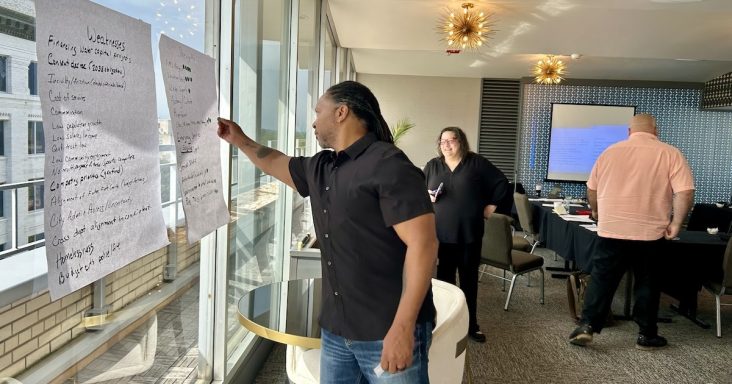
Fort Smith Director André Good places a sticker on a list of city strengths, while Dr. Micki Voelkel, professor of leadership and management with the Center for Economic Development at the University of Arkansas at Fort Smith, observes. The Fort Smith Board of Directors and city staff on Friday (June 26) participated in a strategy session.
Taking advantage of the foreign pilot training center, funding water infrastructure needs, and addressing public perceptions were some of the top topics discussed Friday (June 26) during a Fort Smith Board of Director’s all-day strategy session.
The session was conducted by Dr. Micki Voelkel, professor of leadership and management with the Center for Economic Development at the University of Arkansas at Fort Smith, and was held in the Regions Bank building, at 524 Garrison Ave.
Voelkel challenged board members and city staff to discuss how to use strengths to address weaknesses, use strengths to maximize opportunities, and use all areas to address threats.
The top three strengths identified by the board and Acting City Administrator Jeff Dingman were the foreign military pilot training center at Ebbing Air National Guard Base in Fort Smith, the region’s education and military institutions, and the region’s geographic location that can serve as a national business hub. A close contender for the top three was recent improvements in the city’s parks, trails and greenways.
The top three weaknesses identified by the group were a lack of funds to address water system infrastructure needs, competing priorities for the funding by the city’s general fund, and homelessness, primarily in the downtown area.
The top three opportunities identified were capitalization of the foreign pilot training center, growth of manufacturing, and leveraging growth around the completion of Interstate 49, and benefitting from the presence of the University of Arkansas at Fort Smith, Arkansas Colleges of Health Education, Ebbing, and the economic growth in Northwest Arkansas.
The top three threats to city and regional success are negative public perceptions, economic competition with Northwest Arkansas and other regions, and a decline in healthcare services.
Baptist Health-Fort Smith has announced 260 hospital staff, nursing and physician cuts since late March. Services cut or reduced include labor and delivery operation, obstetric services, clinic admin, pharmacy, radiology, case coordination, facilities maintenance, and sterile processing.
PILOT TRAINING CENTER
Discussions on the strengths, weaknesses, opportunities, threats often revolved around the foreign military pilot training center. Ebbing Air National Guard Base, co-located with the Fort Smith Regional Airport, was selected in March 2023 by the U.S. Air Force to be the Foreign Military Sales (FMS) program pilot training center supporting F-35 fighter planes purchased by Singapore, Poland, Finland, Germany, Switzerland, Czechia, Greece, and Romania. Planes from Poland and Finland were the first to train at Ebbing, with German pilots expected to arrive in late 2026.
When discussing the training center being considered a city strength. Director Christina Catsavis said the center is “not something we do,” because it’s ultimately funded and governed by the Department of Defense. She said the board may focus more on creating “strong partnerships” around the center. Director André Good said he believes it’s a strength from the bigger “we” of a city and region and not a city government function. Director Neal Martin agreed.
“The FMS, it’s a strength for the city, and so how can I capitalize on that for the city,” Martin said.
Voelkel reminded board members to consider a strength as not necessarily something with which the city has authority, but something on which the city can use for other development opportunities.
WATER CONTRACTS, NEEDS
Board members also had an impromptu discussion with Dingman about water contract and water rates with the 13 cities and water associations that buy water from the city.
The directors encouraged Dingman and city staff to find ways contract water users would provide more funding for the city’s signifiant water system infrastructure needs. Fort Smith engineers and utility leadership have in recent years warned the board of critical funding needs for aging infrastructure.
While there are many, complex and expensive system needs, priority needs include upgrades at the Lake Fort Smith water treatment plant in Mountainburg, Lee Creek water treatment plant upgrades, completion of a new water transmission line from Lake Fort Smith to the eastern side of Fort Smith, aging distribution lines in the city, and modern water meters for all customer categories.
Jimmie Johnson, deputy director of engineering, has told the board that in the past five years the water system has had five major crises.
Dingman said city staff and attorneys are in the process of developing new contracts and rate plans for the 13 outside water users. He also challenged board to make decisions on where to focus water projects, because that will drive decisions on how much revenue is needed.
“We need to get on board with some of these water projects,” Dingman said, adding that waiting for state or federal grants “will not get it done for us.”
He also said the city “cannot continue without a water rate increase,” if they are to address water system neads, noting that a revenue increase is needed “in a substantial way, not an incremental way.” Director Kevin Settle said the board often delays decisions on water system funding, especially ahead of an election cycle. He said as some point the board will be forced to “make some tough decisions.”