
Research could help with state’s muscadine production
by June 3, 2026 9:00 am 190 views
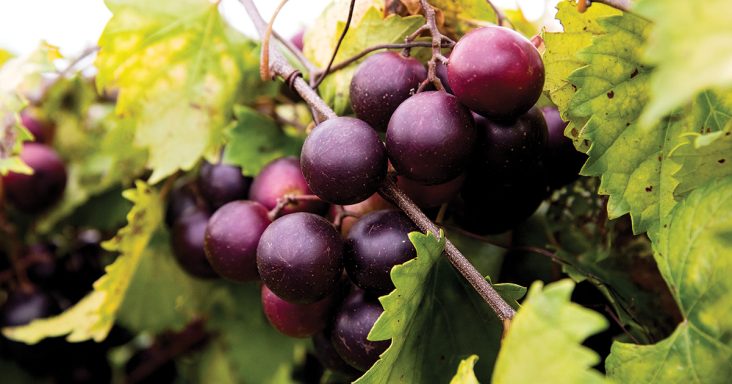
Muscadine grapes on breeding vines at the Fruit Research Station at Clarksville.
Genetics may help grape breeders determine what will be seedless and self-pollinating even years before vines bear fruit. The approach will save time and resources in the pursuit of creating flavorful new grape varieties, including the major challenge of developing seedless muscadines on self-pollinating vines.
Margaret Worthington, associate professor of horticulture and director of the Fruit Breeding Program for the Arkansas Agricultural Experiment Station, joined colleagues at Cornell University, the United States Department of Agriculture (USDA), Gardens Alive! and E&J Gallo Winery in publishing a study validating a system for predicting flower sex type and seedlessness in muscadines and other grapes.
The researchers made their predictions using a genotyping platform that tests muscadine plant DNA for genetic markers — like signposts in the DNA pointing to specific traits. The same genetic markers, which are publicly available, can also be used by wine and table grape breeders.
“This is a resource to the global breeding community,” Worthington said.
Scientists discovered and published the genetic mutations causing seedlessness and male sterility in grapes a few years ago. In this new study, low-cost diagnostic markers targeting those mutations were developed and validated in more than 900 Vitis-Muscadinia hybrid grapes from the Arkansas Fruit Breeding Program and about 200 cultivated and wild grapes.
Isabella Vaughn, a graduate student in the department of horticulture, was the first author.
“She did a great job,” Worthington said of Vaughn. “She scored a lot of plants, coordinated a lot of logistics and helped us to start using the markers in our program.”
KASP, short for Kompetitive allele-specific PCR, is a proprietary but common and cost-effective genotyping platform used to detect specific genetic traits, according to the research. Researchers collected leaf samples from the plants, conducted the DNA testing, and then compared predictions from the DNA testing with what was directly observed on the plants. Worthington and her team predicted flower sex and seedlessness with 100% and 99.7% accuracy, respectively.
“We took leaf samples from mature vines with fruit for the validation,” Worthington said. “The DNA will stay the same regardless of plant age. So, this is proof that it will work for young seedlings, too. We started culling seedlings in 2024 in our applied program and this will be our third year using the markers.”
Over the past 100 years, fruit breeders have sought to create fertile crosses of muscadines — a native North American grape — with Vitis vinifera, the species behind most commercial table and wine grapes.
Muscadines are prized for their disease resistance, adaptability to the southeastern United States and distinctive flavors. But combining the two has proven difficult. Chromosomal differences and compatibility barriers often prevent viable, fertile hybrids, Worthington said.
“Muscadines are in a different subgenus of grape than Vitis,” she said. “They’re related, but not that closely related. It’s like a horse and a donkey.”
Like horses and donkeys producing sterile mules, crosses between these grapes often result in infertile offspring.
Muscadines are not widely consumed outside of the southern U.S., but Worthington said seedlessness is key to expanding their appeal, especially for fresh markets and kids.
“What we really want is to make something that has a good size, a dry stem scar so that it can be easily picked, good post-harvest qualities and a really good texture, while keeping that muscadine flavor,” Worthington said.
Beyond seedlessness, Worthington also seeks “perfect-flowered” vines for growers to allow for self-pollination and more consistent fruit production. Wild grape species, including muscadines, are typically dioecious, meaning individual vines produce either male or female flowers. Female flowers require pollen from a nearby male plant to produce fruit. In muscadines, the discovery of two perfect-flowered selections by chance in the mid-20th century provided the foundation for all perfect-flowered cultivars of muscadines now grown.
While crosses between perfect-flowered parents might seem an ideal map to get to that seedless, perfect-flowered muscadine, Worthington said, they are not always practical in breeding programs. Muscadines have very small flowers, which makes removing the male parts from perfect-flowered plants and making controlled crosses extremely difficult, Worthington said. The preferred method, to avoid having to do a costly and difficult embryo rescue, is to make crosses between seeded females and seedless perfect-flowered vines.
“The ones we want to keep, we’ll put out in the vineyard at the Fruit Research Station in Clarksville (Johnson County) and then we’ll look at those and see how it goes,” Worthington said. “Not everything we keep is going to be good, but the markers tell us if it’s perfect-flowered and if it is seedless. It doesn’t tell us if it tastes good and has a thin skin and it’s productive.”
Arkansas produces about 1% of the country’s grapes, according to the USDA. Up to 1,500 acres are grown in the state annually with a value of about $2.5 million.