
J.B. Hunt Q2 earnings jump 40%, revenue up 19%
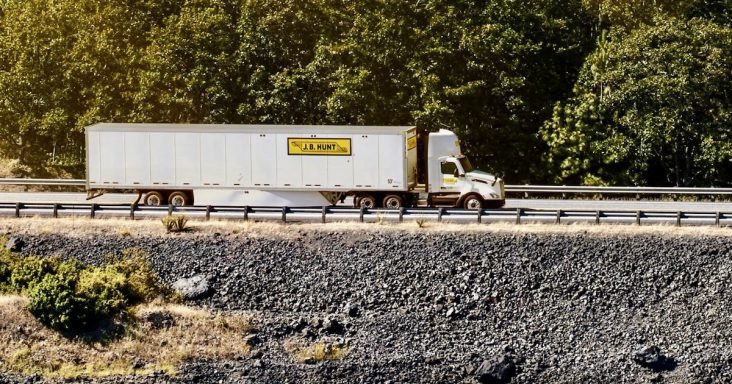
J.B. Hunt Transport Services Inc., a Lowell-based transportation services provider, posted double-digit gains in earnings and revenue in the second quarter amid an improving freight market. The company’s after-hours stock price exceeded its 52-week high.
After the markets closed Wednesday (July 15), J.B. Hunt reported earnings increased by 40.7% to $181.03 million, or $1.91 per share, from $128.62 million, or $1.31 per share, in the same period last year. Revenue rose by 19.4% to $3.49 billion from $2.92 billion.
J.B. Hunt beat the earnings estimate of $1.73 per share, based on a consensus of 20 analysts. The company also beat the revenue estimate of $3.25 billion.
In an earnings report, analysts Bascome Majors, Brady Lierz, Reed Seay and senior associate Joe Enderlin, all of Little Rock-based Stephens Inc., attributed the beat to “better-than-expected results in (intermodal) and partially offset by weaker (truckload) results. We view Hunt’s 2Q as clearing a high bar, with closely watched intermodal volumes accelerating to +10% (year over year), upside in dedicated, ICS/brokerage inflecting back to operating profitability on +49% top line growth and (+0.5 percentage points quarter over quarter) improvement in gross margin; partially offset by slightly lagging results in (truckload)” attributed to the cost of third-party capacity and Final Mile.
Stephens analysts maintained an overweight (buy) rating on J.B. Hunt stock.
Shares of J.B. Hunt (NASDAQ: JBHT) closed Wednesday at $276.28, down $4.59 or 1.63%. The after-hours stock price was $297.15, up $20.87, or 7.55%, and would have been a 52-week high if the market had been open. In the past 52 weeks, the stock has ranged between $130.12 and $294.98.
“I’m grateful for our people and their continued focus on delivering operational excellence around service, safety and cost discipline in this dynamic environment,” said Shelley Simpson, president and CEO. “Our second quarter results reflect the strength of executing our strategy, as we leveraged our investments in our people, technology and capacity to drive growth and improve profitability. As market conditions continue to evolve, we remain focused on creating long-term value for our shareholders, delivering valuable solutions to our customers while maintaining discipline around returns on our capital.”
In the company’s earnings call, Simpson said the freight market has changed.
“Capacity has tightened across the industry as safety-focused enforcement and broader supply pressures continue to affect available truckload capacity,” she said. “We saw that tightening build throughout the quarter, including a noticeable step change around the annual road check event in early May that has persisted.”
Simpson said the “market tightness is being driven primarily by supply conditions. We didn’t spend the last four years waiting for the cycle to turn. We spent the last four years preparing for it.”
Chief Financial Officer Brad Delco discussed the company’s cost-cutting initiative announced in mid-2025. He said over the past year, the company has removed more than $135 million in structural costs. Nick Hobbs, chief operating officer and president of Highway and Final Mile Services, said as the driver market has tightened, the company has offered sign-on bonuses in several markets and driver wage increases in select markets. Hobbs also noted an 11% improvement in the company’s safety performance through the second half of the year compared with the same period in 2025.
Through the first half of 2026, J.B. Hunt’s earnings rose by 30.9% to $322.58 million, or $3.39 per share, from $246.36 million, or $2.48 per share, in the same period last year. Revenue rose by 12% to $6.55 billion from $5.84 billion.
Following are the second-quarter operating income and revenue by business segment compared with the same period last year.
Intermodal
Operating income increased by 57.6% to $150.86 million from $95.74 million. The segment’s income comprised 58% of J.B. Hunt’s total income, up from 49% in the same period last year.
Revenue rose by 21.96% to $1.75 billion from $1.43 billion. The segment accounted for half of the company’s revenue in the second quarter, up from 49% in the same period last year.
Dedicated
Operating income rose by 9.4% to $102.47 million from $93.68 million. The segment’s income comprised 40% of the company’s total income, down from 47% in the same period last year.
Revenue increased by 8.7% to $920.71 million from $846.75 million. The segment accounted for 26% of the company’s revenue, down from 29% in the same period last year.
Brokerage
Operating income was $1.69 million compared to a loss of $3.55 million. Revenue rose by 49.3% to $388.49 million from $260.24 million.
Final Mile Services
Operating income fell by 30.5% to $5.55 million from $7.99 million. Revenue declined by 5.98% to $198.03 million from $210.62 million.
Truckload
The segment posted a loss of $1.33 million compared to income of $3.36 million. Revenue increased by 35.4% to $239.65 million from $176.96 million.