
Medal of Honor recipient highlights Wings of Honor event
by May 3, 2026 10:00 am 371 views
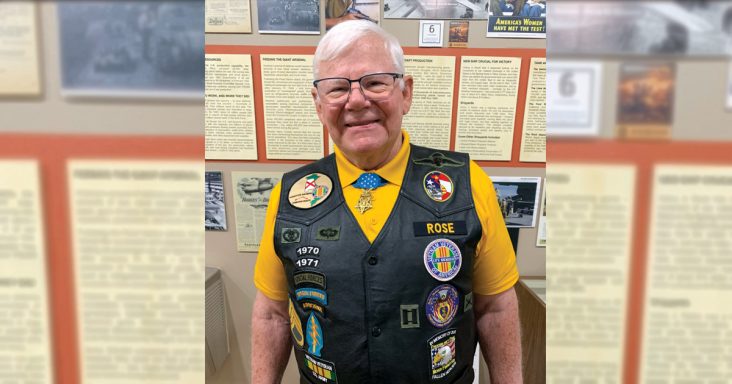
Green Beret combat medic Gary “Mike” Rose treated up to 70 men during Operation Tailwind during the Vietnam War. For his actions, Rose became a Medal of Honor recipient in 2017.
The U.S. Army was deep into enemy territory in the country of Laos on Sept. 11, 1970. During the next 96 hours, soldiers endured relentless attacks from a larger enemy force. Rockets exploded, and bullets rained through the air.
Injured and dead soldiers littered the jungle battlefield. One man, Green Beret combat medic Gary “Mike” Rose was doing everything he could to save lives. He continuously exposed himself to enemy fire to administer aid.
Soldiers injured on the battlefield need fluids to stay alive and Rose set up a field IV unit. A mortar struck the IV unit, and he had to act quickly to save one man’s life. He established the line in the man, then sat on the IV bag to protect it.
A rocket landed just meters from Rose, injuring his head, hand and crippling his foot. Despite the injuries, he continued to work on the injured and dying.
As the engagement came to a close, Rose was on the last helicopter leaving the field. Enemy combatants overwhelmed the position. The helicopter’s gunner was shot and he had to administer instant, life-saving aid. Moments later the helicopter was shot down, and despite further injuries, Rose pulled men from the wreckage to await another helicopter.
Rose treated up to 70 men during Operation Tailwind and only three reportedly died.
For his actions, Rose became a Medal of Honor recipient in 2017, he told Talk Business & Politics. Rose was the keynote speaker at the Wings of Honor Museum event on April 18 noting the 84th anniversary of the Walnut Ridge Army Air Forces Basic Flying School site selection as a pilot training center on the outset of World War II.
“This is not my medal. I’m just a caretaker,” he said.
The Medal of Honor, sometimes referred to as the Congressional Medal of Honor, was created in 1861 to be the highest honor a military member could achieve. It was originally a Navy award, but later all branches of the military were included, according to the Congressional Medal of Honor Society.
There have been more than 3,500 Medal of Honor honorees, and out of those only one, Dr. Mary E. Walker, has been a woman. She was a field doctor during the Civil War and repeatedly crossed enemy lines to treat sick and injured soldiers and civilians. About 600 have been given posthumously.
In Northeast Arkansas, one of the most well-known Medal of Honor recipients was Daniel “Nicky” Bacon from Caraway. Bacon was one of three Medal of Honor recipients from Arkansas during the Vietnam War, and when he died in 2010, he was the last living Arkansan to have received the honor, according to numerous published reports.
Bacon served a stint in Vietnam and was elevated to the rank of staff sergeant in 1967. He deployed with a group of men that he trained as their squad leader even though he didn’t have to return to the war-torn country.
On Aug. 26, 1968, Bacon’s company had been ordered to aid the First Cavalry Division near the city of Tam Ky in South Vietnam. As the company moved through the countryside, North Vietnamese units began to assail them from a nearby village. Bombs exploded. Bullets whirled. Men began to die.
Bacon organized his men and began to advance on an enemy position, according to the Medal of Honor citation. At one point he destroyed a hostile bunker with grenades. His platoon leader was hit, and Bacon dragged him to safety. Bacon assumed command of the platoon and led his men to attack the machine gun position that injured his commander. He killed the enemy gun crew in what the citation noted was a “single-handed effort.”
“I was just having a hell of a time. … It was just hell for a while,” Bacon said during an interview years before his death in 2010.
When another platoon leader was wounded on the battlefield, Bacon took command of that platoon. He killed four enemy combatants after assuming command, and he also destroyed an anti-tank weapon blocking American tanks from joining the fight. During a fierce firefight, Bacon exposed himself to gunfire by climbing onto a tank as he directed American operations.
“As a result of Sgt. Bacon’s extraordinary efforts, his company was able to move forward, eliminate the enemy positions, and rescue men trapped at the front. Sgt. Bacon’s bravery at the risk of his life was in the highest traditions of the military service and reflects great credit upon himself, his unit, and the U.S.,” his citation noted.
He received the Medal of Honor from then President Richard Nixon on Nov. 24, 1970, one day before Bacon’s 24th birthday. He attempted to return for a third tour in Vietnam but was denied. During his speech, Rose noted that the Wings of Honor Museum like all others is like a “school room.” The museum opened in 1999 and celebrates the history of the airfield.
Construction on the pilot school began in late summer in 1942. At its peak, there were more than 5,000 people living on or near the school, meaning it was larger than nearby Pocahontas or Walnut Ridge, according to information at the museum. An estimated 5,310 men entered pilot training. At least 4,641 pilots were certified. It was reported that 42 pilots lost their lives during training.
The federal government bought more than 3,000 acres to be used by the pilot school. It had three runways that span about 5,000 feet. The land acquisition and construction cost almost $10 million, or $160 million in today’s dollars, Johnson said.
After the war, up to 10,000 aircraft were brought back to the airfield. Many were disassembled, and some were even buried in the ground on the property, according to local legends. German prisoners of war were also brought to the base.
The museum is filled with artifacts from that era including the airfield beacon light, siren from the fire station, and it has two BT-13s, the aircraft used to train pilots. The museum moved to its location in the mid-2000s. There were expansions in 2013 and 2015. The museum recently opened an exhibit honoring the 42 pilots who died while training at the base, said Terrance Ward, museum board of directors president.
“84 years ago, this place was picked, and it changed Walnut Ridge and Lawrence County forever,” Ward said.