
‘Covered Buttons’ tells a story of the push for better women’s health
by May 31, 2026 10:00 am 366 views
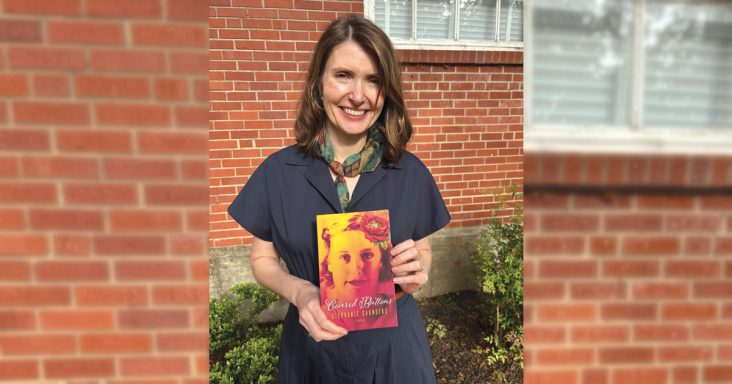
Dr. Stephanie Saunders is the author of “Covered Buttons,” a historically accurate novel that traces the life of Thea, a 17-year-old who loses her mother during the birth of her brother.
Dr. Stephanie Saunders didn’t have a lot of access to books growing up in Salem, a small hamlet tucked in the Ozark’s foothills in Fulton County. She spent countless hours listening to stories from her grandmother about the life and culture of the hills in which she was born and raised.
Saunders eventually left the area, went to college and received a doctorate in Spanish. She’s lived in places like Chile and Spain and has read more books in Spanish than she ever has in English she told Talk Business & Politics.
“A friend and I entered into a three-day novel writing contest,” she said. “I never submitted (what she wrote) but I was hooked.”
The long-time professor now works at Lyon College in Batesville. About 13 years ago she began writing a book about the culture in the Ozarks region and it was set in the 1930s. The original premise centered on fruit picking, something her relatives had to do, and as she did more historical research it morphed into a book centered on the birth-control movement during that epoch.
The book “Covered Buttons” was born.
It’s a historically accurate novel that traces the life of Thea, a 17-year-old who loses her mother during the birth of her brother. Her father remarries, and she has a kinship with her stepmother and her mother, Betsy. During the timeframe in the novel, contraceptives for women and even information about them was hard to find, Saunders said. For many years, it was illegal in the country for any information about contraceptives to be sent through the mail.
“There was a time when women would be mailing (doctor’s clinics) asking for help. They had no access to information back then,” she said.
Activist Hilda Cornish was convinced that the ability to limit family size could be crucial to a family’s financial survival during the Great Depression. In February 1931, Cornish established the Little Rock Birth Control Clinic, the first such service in Arkansas, according to the Encyclopedia of Arkansas. Services were provided at a minimal fee for any married woman whose family made less than $75 per month. Establishment of this clinic was met with public resistance; one woman wrote, “I am not interested in the advice and supplies you are peddling. Women should not stoop to such practices.”
The historical saga is one of the main themes in the book, Saunders said. In it, the grandmother Betsy runs an “underground” aid campaign for poor women in rural Arkansas seeking birth control health.
Efforts to spread contraceptive health and information may have started almost a century ago, but it still remains a significant challenge in the Natural State said Dr. Nirvana Manning, a professor at the University of Arkansas for Medical Science (UAMS) and an OB-GYN. She said Arkansas ranks 50th in the country for maternal mortality and the state ranks among the worst in terms of dealing with women’s reproductive health.
“When the statistics came out it was very sobering,” she said.
About 92% of all maternal deaths are preventable, she said. Mental health and substance abuse are among the key factors in post-partum, maternal health, she added. Arkansas has a high teen pregnancy rate with 23.8 births per thousand females from ages 15-19, according to the U.S. Centers For Disease Control (CDC). Only Mississippi has a higher teen birth rate.
To combat these problems, the state legislature passed the Arkansas Healthy Moms Healthy Babies Act and dedicated $45 million toward this program. It provides prenatal care, remote patient monitoring for those who live in rural areas not close to medical facilities, and it helps to support Local Health Units within the Arkansas Department of Health’s network of facilities that are in all of the state’s 75 counties.
It also provides doula healthcare worker coverage and provides a messaging service for mothers to ask questions about their healthcare. Manning said providing proper healthcare in rural Arkansas is a challenge. There are too few hospitals, nurses, doctors and other health care professionals who live in the more sparsely populated parts of the state.
The Local Health Units are a good start, she said, and the goal is to create up to eight “hubs” with larger medical facilities where patient medical histories can be funneled if the patient needs more advanced care at a hub. The hubs will be positioned around the state and Manning liked them to being the “center of spokes on a wheel.”
The Arkansas Center for Women and Infants Health also provides a number of resources to help mothers.
“We partner with healthcare providers, public health agencies, and community organizations to improve health outcomes for women and infants across the state. Our work addresses issues affecting pregnancy, postpartum, and infancy to ensure that Arkansans have the resources they need for healthy pregnancies, safe births, and thriving infants,” the organization stated.
However, Arkansas is the only state in the nation to not extend postpartum Medicaid coverage from 60 days to a full year. Up to 45% of women in Arkansas lose coverage after 60 days, according to Arkansas Advocates for Children and Families. Gov. Sarah Sanders has rejected calls to extend the coverage.
More than 13 years ago Saunders didn’t set out to write a book about women’s reproductive health. But, the vast amount of research she did led her down that path.
There are other themes in “Covered Buttons” about Ozark mountain culture — music, food, culture, art, clothes and others. Her book has one higher purpose in her mind, she said.
“Empowering women,” she said.