
Swarm Aero wants to make, deploy drones in Fayetteville
by April 22, 2026 4:26 pm 2,197 views
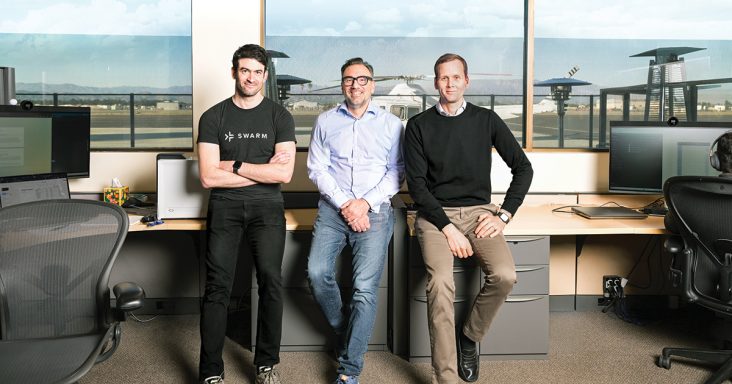
(from left) Danny Goodman, Swarm Aero CEO and co-founder, Peter Kalogiannis, chief engineer and co-founder, and Oliver Palmer, CRO and co-founder
Oxnard, Calif.-based drone company Swarm Aero recently opened an 80,000-square-foot Advanced Manufacturing Center at Drake Field in Fayetteville to build and deploy large drones, or uncrewed aerial vehicles (UAVs), for defense purposes.
However, the company’s business license is in limbo after Fayetteville Board of Adjustments approved an appeal that could result in its revocation. The appeal was of the staff determination that the business use is manufacturing. After residents spoke against the center, the board voted 3-1 to approve the appeal that its use exceeded what was noted on the business license that was issued in February.
On April 15, Swarm Aero filed notice to appeal the board’s decision to the city council. Peter Kalogiannis, co-founder and chief engineer at Swarm Aero, provided the following statement:
“We took this action at the encouragement of several community leaders in Fayetteville and after a thorough review of the zoning ordinances. We want to thank the Fayetteville city staff and Mayor (Molly) Rawn for their fairness and professionalism throughout this process.
“We respect the concerns raised at the Board of Adjustment’s hearing last week. We view this appeal process as an opportunity to have an open and transparent dialogue about our aircraft manufacturing facility with the community we hope to call home.
“We chose Fayetteville for a great many reasons. The community’s strong commitment to education at all levels will provide us with a highly educated, skilled workforce as we continue to grow as an aviation manufacturer. The partnership with the University of Arkansas presents an opportunity to help develop a generation of aerospace engineers in this exciting and emerging technology sector. The quality of life unique to Fayetteville makes it the type of community where we want to live, work, and raise our families.
“We understand that questions about emerging technologies are both natural and important. We remain committed to listening, providing transparency, and ensuring that our presence contributes positively to the broader Fayetteville community.”
Swarm Aero recently announced its $35 million series A financing led by Two Sigma Ventures and Silent Ventures with participation from multiple seed investors. Swarm plans to use the $59 million in capital it has raised for drone development and deployment. A lot of this will go toward hiring and building the advanced manufacturing center at 3660 S. School Ave. in Fayetteville.
Danny Goodman, CEO and co-founder of Swarm Aero, said he didn’t have a breakdown of how much would be invested into the Fayetteville site, “but it’s in the millions this year.” The number will grow as production scales there.
“Before we fly, much of the design work and engineering nexus is in our California headquarters,” he said. “As we scale up manufacturing, Fayetteville quickly becomes by far our largest office.”
Many factors went into selecting the site for the advanced manufacturing center.
“We looked at 20 states and evaluated a bunch of factors: the workforce, the local partners, access to an appropriate airport,” Goodman said. “And Arkansas was the best of all of those … There is a well-trained labor force in the area. The University of Arkansas graduates 7,000 students a year.”
He said the company’s drones self-deploy, so it needed a site at an airport to manufacture them.
“We’re building a very long-range aircraft,” he said. “It’s designed to self-deploy around the world in these long, one-way trips … There is not, it turns out, all that many smaller airports in the U.S. that have space for significant expansion. Smaller is good because we need to be able to … not interrupt the traffic pattern as we deploy the aircraft that we build.”
GROWTH PLANS
Goodman said the Fayetteville site has space to expand as production scales.
“The existence of the space as well as supportive government partners and airport partners to help us work with them and the community is a huge draw,” he said. “So all in Arkansas … won our internal analysis.”
The site is the first of its kind for the company, he said, and is large enough to “scale as our pilot manufacturing plant. So we will go beyond it to reach the full capacity. Our design capacity for the aircraft is that we can produce 1,000 a year. That facility won’t be able to produce 1,000, but it will make a meaningful start. And we get there in phases.”
While the design capacity is to produce 1,000 drones annually, Goodman said the number it will manufacture will depend on customer demand. But production will be at least in the hundreds per year. He expects the first drones to fly within the next two years.
“We’ve completed the preliminary design,” he said. “We’re making our first large parts. We have integrated subsections — over $100 million of supply locked down … We’re deep in that process, but we have not flown yet.”
The work underway at the Fayetteville site includes research and development of high-rate manufacturing techniques.
“Let’s prove our ability to manufacture airframe parts at high rate,” he said. “Perhaps the newest part of what we’re doing is making composite airframe parts that we can make at high rate and low cost. We already have advanced composite machines on order for the Arkansas facility to help us satisfy some contracts that we have with our government partners.”
The Fayetteville site will make test parts from carbon composites. Then, it will make aircraft parts that will be transported across the country for assembly. After the first drone flies, an end-to-end assembly line will be established at the Fayetteville site, enabling drones to be manufactured there.
“And that gets us through mid-rate production, and then we open more space to go to high-rate production,” he said.
As production scales, Swarm Aero expects to hire hundreds of engineers and technicians in Northwest Arkansas and expand beyond the existing 80,000-square-foot site. Goodman said within two years after the first drone flight, “we expect our production to scale significantly.”
The company has 60 employees and is expected to reach 100 by the end of this year, he said. It’s hiring for the Fayetteville site, which has about 15 employees. Over the next decade, it’s expected to create hundreds of high-skill aerospace jobs. People and machines will assemble the drones, he said, a “man-machine partnership, robotics and hand assembly.”
SWARM SOFTWARE
The company has developed software, Legion, that will allow a small team of people to control a large number of drones. Traditional military software requires up to four people to control one drone.
“There’s already an operator shortage, and the coordination problem of getting many drones to work together quickly becomes superhuman once you get beyond a small number of drones,” Goodman said. “And so our design goal was to significantly reduce the operator headcount required to control large swarms. And we’ve done that.”
The company’s software would allow teams of 10 to 100 people to control 1,000 drones simultaneously.
“It allows one human or small teams of humans to issue commands to swarms of drones rather than to individual drones, and the software then translates those swarm level objectives into tasks for the individual drones that it allows people to divide and conquer in the same way that we do today,” he said. “What defines whether it’s 10 humans or 100 humans controlling 1,000 drones is how intense the applications are.”
He noted that surveillance of a large area wouldn’t be as intensive as tracking multiple moving targets. More drone operators would be needed to do the latter.
DRONE DETAILS
According to the company, the drones will be the size of a business jet and smaller than many of the jets that operate at Drake Field.
Goodman said the company’s aim is for the drones to meet the U.S. Air Force category of certification requirements for unpiloted aircraft that cost between $1 million and $10 million. He added that he can’t disclose the company’s price points, but that’s the category in which the company will seek for its large drones.
“The advantage of a large drone over a small drone is that we have legs, so to speak,” he said. “Small drones, like we see so effectively used in Ukraine and the Middle East, they either need to base in harm’s way close to the fight or get a ride into the fight with … being carried by humans. Ukraine has incurred hundreds of thousands of casualties. That would be politically impossible for the U.S. to do unless a war was on our soil, and so we wouldn’t be able to protect our allies. They can deploy from billion-dollar boats or refuel with tankers. Those are also vulnerable in today’s contested environment.”
Large drones can take off from a base in relative safety and cross large, contested environments to reach “any theater globally,” he said. “The United States has the largest international set of military bases anywhere, and so it lets us protect our allies anywhere in the world.”
Uses, or missions, for the drones include those that don’t involve munitions such as transporting sensors, radios, electronics and other cargo to U.S. bases. The drones could also transport weapons.
“A large drone with long range also has a high payload capacity, and so we can carry basically a payload or a munition of any conventional type,” he said.
The company aims to make large drones that will allow the United States to defend itself and its allies without putting pilots in harm’s way. Goodman said the company’s focus has been supplying drones to the U.S. military so far. The company has had conversations with a “few Democratic allied governments. That will spool up later, but our main focus right now is the U.S.”