
Northwest Arkansas ranks 9th-fastest growing U.S. metro, first time in top 10 since at least 2020
by April 3, 2026 7:27 pm 3,355 views

Northwest Arkansas has risen to the ninth fastest-growing metro area in the United States, according to new population estimates from the U.S. Census Bureau. It’s the first time since at least 2020 that the metro area ranked among the top 10 fastest-growing U.S. metros, a state demographer said.
On March 26, the Census Bureau released the population estimates for the 387 metro areas and 3,144 counties in the United States. The new estimates are as of July 1, 2025.
Alison Wright, data center division head of the Arkansas Economic Development Institute (AEDI), said the new population estimates for Arkansas are trending in the same way they’ve been in recent years, and she’s not seeing many surprises in them. The same top counties are continuing to grow the most, with Benton County still the state’s fastest-growing county. Northwest Arkansas, or the Fayetteville-Springdale-Rogers metro area, also remains the state’s fastest-growing metro.
“What I found interesting was the ranking of the Fayetteville-Springdale-Rogers MSA, and so it was in the top 10 across the country of MSAs,” Wright said. “That’s just a testament to they’ve continued to grow and grow over these years, and so it’s really showing up even across the country that it’s in percent growth. It’s really high compared to other MSAs.”
The population of Northwest Arkansas, or the Fayetteville-Springdale-Rogers metro, rose by 2.4% to 622,177 in 2025 from 607,433 in 2024. The metro had the 27th largest numeric growth, adding 14,744 people, and is the 94th most populous metro in the United States, up two positions from 2024.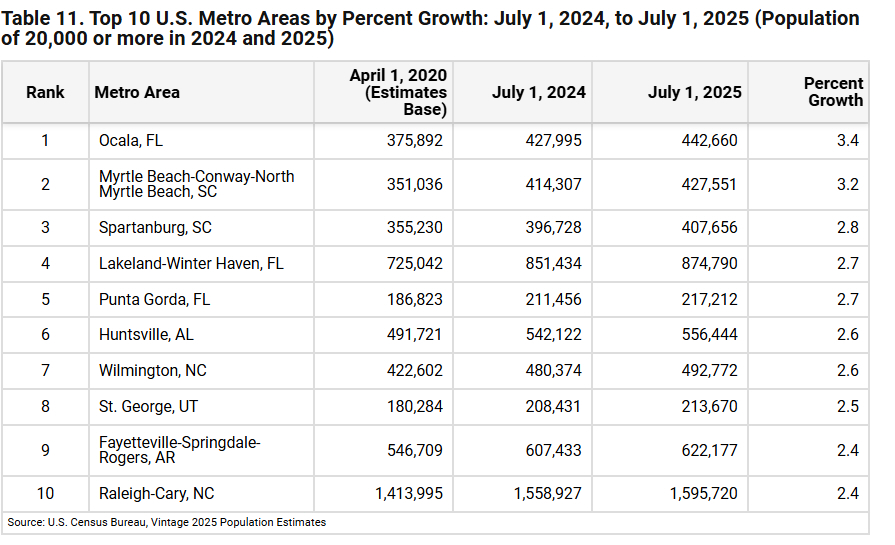
The metro area’s population is up from the 22nd fastest growth rate and the 50th largest numeric growth in 2024. The growth rate was also up from 18th in 2023 and from 24th in 2022. The numeric growth was up from 32nd in 2023 and 30th in 2022.
OTHER METRO AREAS
Wright said the population of all the state’s metro areas increased, except for the Hot Springs metro area, which comprises Garland County. Those with population increases all had a positive natural change, which is more births than deaths. They also had positive net migration, meaning more people moved in than out. A key component of the population change in the largest metros, such as Northwest Arkansas, has been domestic migration, which is people moving in from other areas of the state or the nation.
Excluding metro areas deriving most of their population from surrounding states, Wright said the Little Rock metro area is the most populous in Arkansas and the 80th most populous in the United States. The population of the metro area, which includes North Little Rock and Conway, rose by 0.6% to 777,607 from 772,588. It had the 75th largest numeric growth, added 5,019 people, and was the 140th fastest-growing metro area in the United States.
The population of the Fort Smith metro area increased by 0.5% to 234,140 from 232,976. It added 1,164 people and is the 204th most populous metro area in the United States.
The population in the Jonesboro metro area increased by 0.5% to 139,440 from 138,696. It added 744 people and is the 304th most populous metro area in the United States.
NATIONAL NUMBERS
According to the Census Bureau, 310 of the 387 U.S. metro areas had slower population growth between 2024 and 2025 than in the previous year. The majority of the nation’s 3,144 counties also experienced slower population growth. These shifts were largely attributed to lower levels of net international migration.
“The nation’s largest counties like those in the New York metro area are often international migration hubs, gaining large numbers of international migrants and losing people that move to other parts of the country via domestic migration,” said George M. Hayward, a Census Bureau demographer. “With fewer gains from international migration, these types of counties saw their population growth diminish or even turn into loss.”
Overall, U.S. metro areas experienced a population increase of 0.6%, or 1.7 million people, from 2024 to 2025. The most populous metro area is the New York metro with 20.11 million people. The fastest-growing metro area is Ocala, Fla., with a 3.4% growth rate. Its population is 442,660. The metro with the most numeric growth is Houston, adding 126,720 people. Its population is 7.9 million.
COUNTY DATA
Wright said that over the past three years, the top 10 most populous counties have remained the same. They continue to have positive natural change and positive net migration. However, excluding Pulaski and Craighead counties, at least 60% of their population growth can be attributed to net migration instead of natural change.
The state’s most populous county and the 188th most populous county in the United States, Pulaski County, added 1,217 people and grew by 0.3% to a population of 404,611. Wright said about 53% of Pulaski County’s population growth was attributed to net migration, while 47% was from natural change. The majority of its net migration comprised international migration, or people moving in from outside the United States.
Wright said most of Craighead County’s population increase was mostly attributed to a positive natural change. It had a small net migration. The county added 579 people and grew by 0.5% to a population of 116,957.
Another top 10 most populous county in Arkansas, Saline County, had more deaths than births, or a negative natural change, between 2024 and 2025. She said all of the county’s population growth was attributed to net migration. Saline County added 1,519 people and grew by 1.2% to a population of 133,288.
She noted that Madison County had the second-fastest growth rate in Arkansas between 2024 and 2025. Its population rose by 1.9% to 18,410 from 18,062. Benton, Madison and Washington counties comprise the Northwest Arkansas metro, and the three counties have the top growth rates in the state, Wright said.
“That’s why that MSA is really standing out compared to some of the others. Because if you’re looking at the Little Rock metro, you have some counties that are really growing and then some counties that are [growing] slowly, and so that’s why you don’t see as much of a big jump like you do because you’re really hitting it hard with those three in Fayetteville-Springdale-Rogers.”
Benton and Washington counties added the most people in the state between 2024 and 2025. Benton County, the state’s second-most populous county, added 10,553 people and grew by 3.3% to a population of 332,554. Benton County is the 31st fastest-growing county and had the 30th-largest population gain in the United States. That’s up from the 76th-fastest growth rate and the 82nd-largest numeric growth in 2024. Washington County added 3,843 and grew by 1.4% to 271,213. Wright said the majority of Washington County’s net migration could be attributed to international migration, like Pulaski County.
Sebastian County added 318 people and grew by 0.2% to a population of 130,641. Faulkner County added 1,812 people and grew by 1.4% to a population of 133,979.
Nationwide, the most populous county is Los Angeles County, Calif., with 9.69 million people. Cook County, Ill., is second with 5.19 million people. For counties with at least 20,000 people, the fastest-growing county is Jasper County, S.C., with a 6% growth rate. Its population is 38,533. The county with the most numeric growth was Harris County, Texas, adding 48,695 people. Its population is 5.04 million.
Following are the state and metro area population estimates as of July 1.
Arkansas:
2025: 3.11 million
2024: 3.09 million
2023: 3.06 million
2022: 3.04 million
2021: 3.02 million
2020: 3.01 million
Little Rock metro:
2025: 777,607
2024: 772,588
2023: 765,621
2022: 758,829
2021: 751,980
2020: 748,989
Northwest Arkansas (Fayetteville-Springdale-Rogers metro):
2025: 622,177
2024: 607,433
2023: 591,086
2022: 578,071
2021: 562,819
2020: 549,908
Fort Smith metro:
2025: 234,140
2024: 232,976
2023: 230,965
2022: 230,000
2021: 228,123
2020: 227,210
Jonesboro metro:
2025: 139,440
2024: 138,696
2023: 136,618
2022: 135,232
2021: 134,378
2020: 134,577
Following are the estimates for the Arkansas counties with more than 50,000 people.
Pulaski:
2025: 404,611
2024: 403,394
2023: 401,297
2022: 400,246
2021: 398,104
2020: 399,252
Benton:
2025: 332,554
2024: 322,001
2023: 311,656
2022: 303,380
2021: 294,169
2020: 286,597
Washington:
2025: 271,213
2024: 267,370
2023: 261,613
2022: 257,206
2021: 251,689
2020: 246,756
Faulkner:
2025: 133,979
2024: 132,167
2023: 130,104
2022: 127,693
2021: 125,630
2020: 123,830
Saline:
2025: 133,288
2024: 131,769
2023: 129,667
2022: 127,485
2021: 125,391
2020: 123,830
Sebastian:
2025: 130,641
2024: 130,323
2023: 129,074
2022: 129,163
2021: 128,221
2020: 127,807
Craighead:
2025: 116,957
2024: 116,378
2023: 114,216
2022: 112,808
2021: 111,720
2020: 111,624
Garland:
2025: 99,695
2024: 99,910
2023: 99,772
2022: 99,975
2021: 100,318
2020: 100,259
White:
2025: 80,085
2024: 79,128
2023: 78,473
2022: 77,637
2021: 77,072
2020: 76,854
Lonoke:
2025: 76,664
2024: 76,390
2023: 75,957
2022: 75,226
2021: 74,754
2020: 74,065
Pope:
2025: 64,976
2024: 64,666
2023: 64,709
2022: 64,025
2021: 63,742
2020: 63,414
Jefferson:
2025: 62,987
2024: 63,605
2023: 63,497
2022: 64,278
2021: 65,599
2020: 66,825
Crawford:
2025: 62,657
2024: 62,256
2023: 61,675
2022: 61,068
2021: 60,410
2020: 60,164
In May, the Census Bureau plans to release city population estimates as of July 1, 2025.