
Sen. Boozman sees bipartisan effort forthcoming on health care
by December 14, 2025 8:57 am 1,820 views
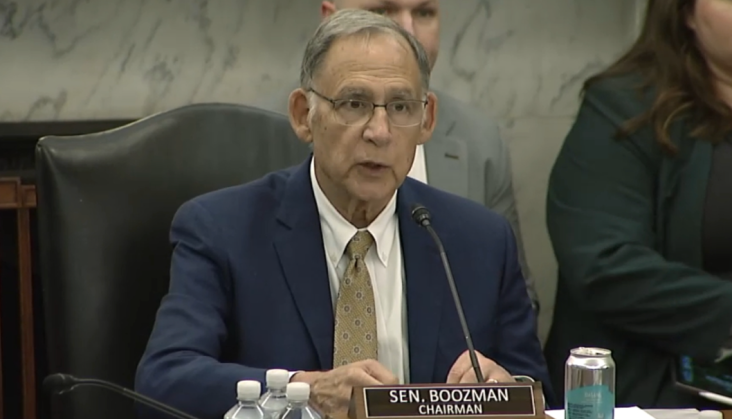
U.S. Sen. John Boozman, R-Ark., was busier than normal this week with votes on health care and steering agricultural policy with President Donald Trump and the White House.
Boozman voted against a bill to extend subsidies in the health care exchanges of the Affordable Care Act, while voting to approve a GOP-led measure to boost health savings accounts as an alternative to the expiring subsidies. Both bills only received 51 votes and needed 60 votes for passage.
So what’s next?
“I think the next step is that we’ll come back and work in a very bipartisan way to try and figure out a path forward. And that path to me is: what do we do to lower costs in the future?” said Boozman. “Right now, we’re talking about continuing the Obamacare subsidy that was put in place during the COVID years because of very special circumstances. Now as we try and withdraw that, we find that in doing so, there’s groups that would be disadvantaged significantly. So we’ve got to take care of that.
“I think probably what you do is you go ahead and extend those for awhile and then in the meantime work on concrete steps that would actually lower costs for the future. Because the reality is that we can’t keep going in the same direction and it’s not only the Obamacare plan that’s not working, but also all Arkansans regardless of what insurance that they’ve got. Generally it’s [Blue Cross] Blue Shield, but their premiums are going up significantly. This is just a huge problem for not only Arkansas but throughout the country,” he added.
Boozman said he would support an extension of the Affordable Care Act subsidies if reforms are put in place to weed out fraud and abuse and if changes can be made to reduce the sharp rise in insurance premiums.
“I’m agreeable for an extension if along with that we have some reform because with any business, any entity that is going to be around very long, it simply has to be such that the costs don’t continue to skyrocket like they are now. I don’t get the feeling though that the regular insurance that you get from your employer or whoever has gone up because we’re not doing the Obamacare subsidies. Those don’t have anything to do with each other. So again, Obamacare doesn’t work and not only have the subsidies gone up, but the premiums are going up and have been for a long time. We need more competition,” said Boozman.
This week, Boozman appeared with President Trump at the White House to lay out initial plans for a $12 billion bailout package for American farmers. Low commodity prices, rising input costs, weather-related incidents, and tariffs and trade policy have torpedoed the agricultural economy. The $12 billion is a band-aid for now, but Boozman doubts it will be enough to help repair the damage done.
“To be honest, I don’t know. I suspect it’s not [enough]. And if you watched me in the White House in the cabinet room across from the president, as I visited with him and visited with him later on, I left the door open that this is great. And I think the president is genuinely concerned about the farm community in rural America. They’ve been good to him. He understands that and he understands that food security is national security. But I did leave the door open that Congress would be willing to step in, I believe, if we need additional funding,” he said.
Boozman is unsure of what specific paths may come next. He’s hoping farmers can hold on until the benefits of the One Big Beautiful Bill Act positively impact agriculture.
“I think kind of a continuation of this step and what we’re trying to do is have a bridge. When we did reconciliation, we were able to significantly do a generational increase in the risk management tools that farmers have. Things like crop insurance and PLC [price loss coverage]. That’s all great, but you don’t get it until October of the next year. So they [farmers] will get a significant check then. But how do you get to then? That’s what this is all about with the $12 billion. We need to figure out if we need additional funding. If that’s the case, again, Congress will step up,” said Boozman.
As chairman of the Senate Agriculture Committee, Boozman has great influence over farm policy. He said opening new markets due to the change in agricultural production is essential.
“It [farming] doesn’t look any better in the future. So we’ve got to figure out how we can change that. That’s going to involve really aggressively trying to get new markets. The United States is no longer the big dog that everybody looks to. Production has increased dramatically all over the world. So that’s the problem,” he said. “China used to be a reliable market – now as an adversary, and you don’t know if they’re going to cut us off when they’re mad. It’s kind of like going back to the Cold War in those days when Russia used to do the same thing. So we’ve got to really identify how we can just change things dramatically so that our farmers can make a living.”
Listen to Sen. Boozman’s full interview at this link.