
Fort Smith begins to gather citizen input for ACME property use plan
by December 15, 2025 11:56 am 3,179 views
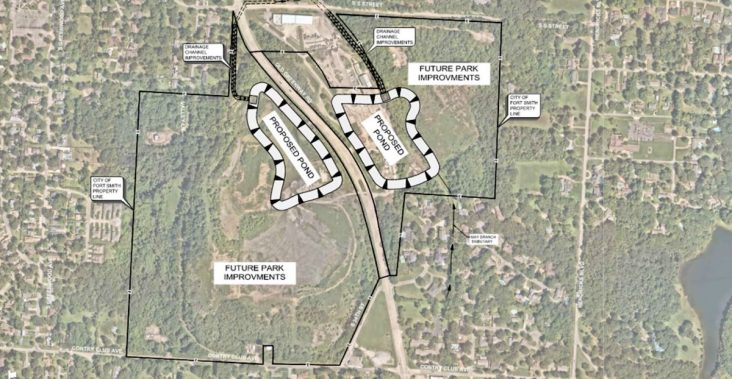
Part of an early possible use outline of the former ACME Brick Yard property in Fort Smith.
Flood mitigation is the primary focus of planning for former ACME Brick Yard property in Fort Smith, but ideas and designs for “recreational amenities” may also be part of the property’s master plan, according to Scott Crawford.
Crawford, a landscape architect and parks and open space principal with Des Moines, Iowa-based RDG Planning and Design, will be part of a public open house on Tuesday (Dec. 16) at 121 Riverfront Drive. The open house will be held between 4 and 6:30 p.m. The process is being billed as “Reimagine ACME.”
“Stop by anytime to learn about the project, explore early ideas, and share your input,” noted a statement from the city of Fort Smith. “Your feedback will help guide decisions about recreation, environmental features, stormwater solutions, and the overall identity of this important public space.”
The Fort Smith Board of Directors approved the $2.288 million purchase of 111.31 acres formerly utilized by ACME Brick Company in October 2023. Plans at the time were to use the property for flood mitigation and park amenities such as trails and bike paths.
Richardson, Texas-based Halff Associates was hired as the engineer for the flood – storm water – mitigation design, and Des Moines, Iowa-based RDG Planning and Design were selected for park master planning.
During a Jan. 14 study session, Acting Fort Smith City Administrator Jeff Dingman said a master plan that determines priorities is preferred because it allows for the best use of funds for long-term planning and construction on the property. He also said the planning will include operational procedures that could have revenue generating options.
In a recent interview, Crawford said the top priority of the process is to develop and implement a flood mitigation plan on the property, which is divided into two parts by Old Greenwood Road. The property location is south of the Kelley Park Ballfields and north of Country Club Avenue. Crawford said the flood mitigation, also known as storm-water retention ponds, could include trails and other recreational amenities around the ponds.
He said the second “guiding principle” among six such principles is to include designs that provide users an “inspirational experience.” The third principle is to ensure “operational resilience and low maintenance” so that whatever plan is developed will not be expensive to maintain.
The fourth principle is to capitalize on the “geography of place” in the heart of Fort Smith with unique “vistas” that are “inspiring,” Crawford said. The fifth guiding principle is to seek universal accessibility for all who want to visit what is built. Crawford said a variety of trail types – walking, biking, mountain, etc. – could be incorporated into the plan.
The sixth principle includes considering parts of the property suitable for public-private partnerships or solely for private use, Crawford said. He said such parcels could be available for sale back to the city. Part of this effort, Crawford said, is to think about “informed private development” that allows for short-term and long-term economic impact.
After gathering public input, the city will soon after have a place online to gather public input, said Sara Deuster, director of Fort Smith Parks and Recreation. She said the online page will be live for three weeks. She said the open house and online site is key to ensuring the property plan is directed by citizen input.
“This is the citizen’s first opportunity to come out and visit and give us their ideas on how they think this should go, other than the stormwater mitigation,” Duester said. “And then we will have that (online input) to go into it.”
Crawford said, barring any delays, a summary plan will be presented to the city’s Parks and Recreation Commission and the Fort Smith board in January. After that, there will be an estimated seven-month process that will include refining concepts, determining a range of development costs, and possibly developing a phasing plan, he said.
A plan for final review could be available as early as August, according to Crawford.