
‘Forever cuts,’ deficit trends focus of Fort Smith board’s 2026 budget review
by November 17, 2025 5:02 pm 1,351 views
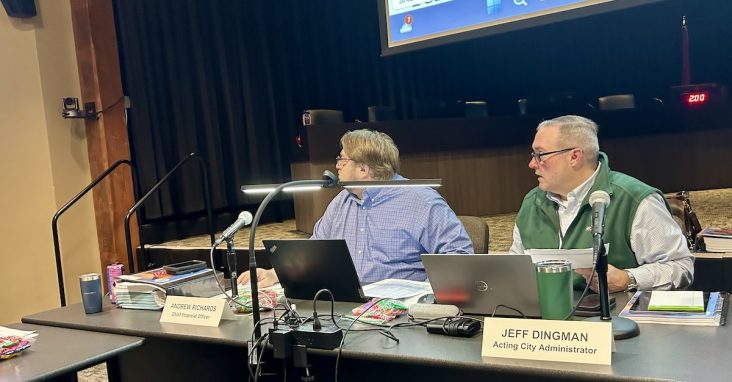
(from left) Fort Smith Financial Officer Andy Richards and Acting City Administrator prepare Monday (Nov. 17) to begin a hearing on the proposed 2026 city budget.
Working to address a “structurally imbalanced general fund budget” was the focus Monday (Nov. 17) of an around six-hour discussion by the Fort Smith Board of Directors and city staff about the city’s 2026 budget.
In 2024, the general fund budget posted a $6.47 million deficit and is projected to end 2025 with a $15.56 million deficit. The city’s fund balance was $35.472 million at the end of 2024. It is projected to be $19.911 million at the end of 2025 and down to $11.818 million at the end of 2026.
The proposed 2026 budget as presented to the board projects an $8.092 million deficit. The proposed budget anticipates $53.695 million in revenue and $61.788 million in expenditures. Of the expenditures, $20.589 million is for the Fort Smith Police Department and $16.227 million is tied to the Fort Smith Fire Department. The proposed 2026 budget shows a $3.658 million decline in estimated revenue and an $11.126 million decline in expenditures.
Andy Richards, the city’s financial officer, began the discussion by noting that the operational budget, the day-to-day cost to manage the city, is estimated to be $4.846 million, with the remainder of the estimated $8.092 — around $3.2 million — is from capital project requests. He said the key goal is to address the operational budget deficit.
“If you equate this $4.8 million (deficit) that we’ve proposed, basically what you are doing is you’re burning up your fund balance, you’re bleeding money to the tune of about $14,000 a day out of the general fund,” Richards said.
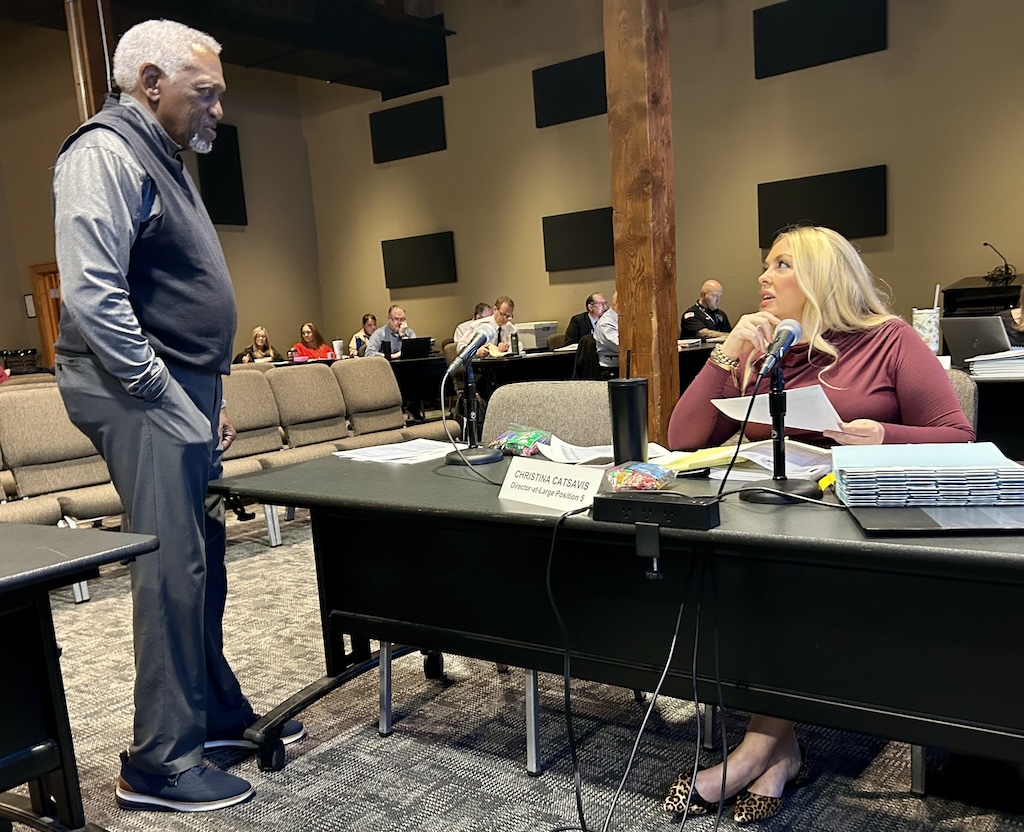
Continuing, Richards said the city needs to “by and large” fund the city’s operational budget with current year revenues. The recent trend of operational budget deficits are unsustainable, and the directors need to consider “forever cuts” that will not be part of future budgets.
“But this situation is that we have a structurally imbalanced general fund budget,” Richards said, adding later in the discussion that the deficit needs to be resolved sooner rather than later because “this is not sustainable, not even in the near term.”
The largest part of the budget, around $37.2 million, is personnel costs. Those costs have been rising, primarily because of higher insurance, increasing workers comp costs, and other employee benefits. Richards said the “big kicker” has been a 30% increase in 2026 related to health insurance costs.
Acting City Administrator Jeff Dingman proposed $3.8 million in possible budget cuts that were worked out with department heads. Following are some of the bigger cuts Dingman presented to the board.
- Not filling 57 vacant jobs — not including fire and police — would save the city an estimated $545,000 annually.
- Not filling eight vacant police department positions would save an estimated $670,000.
- Not filling six vacant fire department jobs would save an estimated $629,000, and the department identified $275,000 in possible operational expenses that could be cut.
- Reducing the Fort Smith Convention Center annual outlay by $235,000. OVG360, which manages the center, has indicated it may have a naming rights sponsor that will help reduce the city’s annual cost to support center operations.
- Not hiring a deputy prosecuting attorney would save $109,000.
Dingman said not filling vacant positions is not an ideal plan, and it could have a negative impact on providing city services, but he said it is critical to get the operational budget to a position where it is covered by revenues. Director Christina Catsavis agreed, adding that laying off employees “is not something we should be considering at this time.”
After lengthy discussions about the proposed budgets for street maintenance, water and sewer operations, and sanitation/solid waste, Director Jarred Rego said the “twin ideas” the board and city staff need to address are a deficit in the operational budget, and the need to address the city’s revenue situation.
“I just think we’ve talked a lot on the expense reduction side,” Rego said. “I don’t think we’ve talked commensurately about the ways, either presented or unpresented, that we’d like see more revenue come into the community.”
Rego said the board needs to have “meaningful conversations about how our public safety needs are funded in general across the board, what additional revenue, yes, to include types of taxation that might be required …”
Dingman said part of discussions with city staff has been to look at possible fees — such as impact fees — and rates that would help the city cover the cost of providing services. He said some rates for city services do not cover the cost of providing the service. He also reminded the board that the city has a 1-cent sales tax remaining under state law to generate revenue.
“Not that I’m advocating for that at this point, but I’m just saying technically that is available,” Dingman said.
Next steps for the city staff include making adjustments to personnel budgets based on ideas proposed, including not hiring for vacant positions, and looking at operating cost reductions with the water and sewer budget. Specifically, Director Kevin Settle requested more detailed information behind the increase in personnel costs in recent years.
The board is set to review and possibly approve the modified 2026 budget on Dec. 2.