
The Supply Side: Walmart tests dark store in Fayetteville for speedy delivery
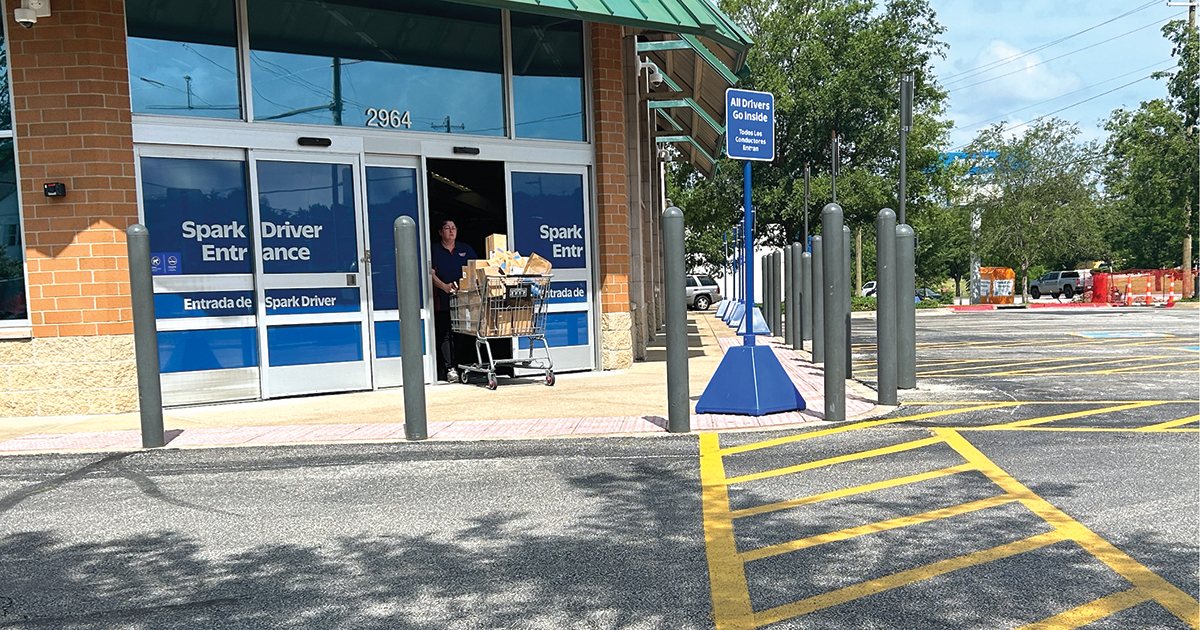
Walmart continues to strategize around faster deliveries for online orders, most recently testing dark-store fulfillment locations known as Spark Delivery Depots. One of those recently opened in a shuttered Walgreens store at 2964 W. Martin Luther King Blvd. in Fayetteville.
Walmart’s depots are closed to the public, and they support Spark drivers fulfilling orders for faster delivery. Walmart began testing 30-minute deliveries last year, and now the service is available in dozens of markets for a $10 express fee.
Walmart began testing the dark-store delivery hub concept last year in Dallas. Last month, the Fayetteville location opened, and there are others planned for Poughkeepsie, N.Y., and Carlstadt, N.J., with other cities still in the planning stages.
Walmart’s depots average about 20,000 square feet and are typically located in former drugstore sites or other vacant retail spaces. The store is tethered to management at a nearby supercenter, according to multiple media reports.
The retail giant has remained quiet about its tests but released the following statement: “Walmart Depot modernizes local retail service- bringing convenience, access, and economic value to the community while remaining consistent with the spirit and intent of retail and light-industrial zoning.”
Walmart U.S. grew its e-commerce business to just under $100 billion last year, up 25% from the prior year, led by growth in store-fulfilled and marketplace orders. Retail consultant David Happe applauded Walmart’s use of smaller depots, saying they make sense given the need for speed and consumers’ willingness to pay for it.
“Walmart already has the logistics in place with its 4,600 stores located within 10 miles of 90% of households,” he said. “That’s something Amazon and others cannot replicate.”
He said 80% of sales come from about 20% of the items in a 180,000-square-foot supercenter. The sprawling stores take longer to walk and fulfill orders than a smaller depot footprint.
“I am a Walmart+ member, and I recently ordered a 12-pack of Sparkle paper towels from Walmart,” Happe said. “And they were delivered the next day, but imagine if they were located in a depot much closer to my house, the picking time would be much less, and so would the delivery distance and time.”
Using closed retail space is a cheap option for Walmart to rent or even acquire, and they can easily be stocked with the most heavily purchased goods for delivery drivers to quickly pick and deliver, he said.
Happe said shuttered Walgreens and Rite Aid stores are perfect because they are typically located close to neighborhoods. Walmart can stock the smaller stores with inventory for delivery drivers, who often have to shop crowded aisles with personal shoppers for Walmart and customers shopping inside the stores.
While the depot in Fayetteville is located across the street from a Walmart Supercenter, the company said that is not always the case.
“Even if the delivery depot is not located directly across the street from a supercenter, I think these nodes will work in conjunction with the stores, because the nodes aren’t going to carry everything,” Happe said. “The depots are going to have those hot demand items, but there’s still going to be backfill to do, and most of the rest of the items are going to be sitting at a Walmart store.”
He said the store’s inventory can be low when there are a lot of online orders for customers wanting express delivery. Walmart is also using its stores to meet more online orders for general merchandise. When inventory is already deployed closer to the customer, it saves money and time.
“This strategy is perfect for Walmart, which is set up to win the last mile,” he said. “It does not work for Amazon, which has to ship or fulfill orders from its distribution centers given that it does not have the massive store footprint of Walmart.”
He is not surprised Walmart has remained mostly silent on this effort.
“It’s really a masterful strategy for them, and they are trying to perfect the model at this juncture, I suspect,” Happe said. “But I foresee this becoming more widespread from 20 to 40 depots before they really begin to talk about it.”
Walmart CEO John Furner noted in the company’s recent annual report that the business model continues to evolve.
“We have re-imagined the role of stores as part of an end-to-end commerce solution that creates flexibility for customers, and our U.S. eCommerce business is now profitable,” Furner noted.
An increase in express deliveries for added fees is a major reason the e-commerce business has turned cash positive, according to John David Rainey, Walmart’s chief financial officer. More than 36% of deliveries from stores arrived in three hours or less during the first quarter ending April 30, with quicker speeds fueling customer engagement, Rainey said. He said Walmart can reach about 60% of the U.S. population in 30 minutes or less, and customer satisfaction with delivery has reached record highs.
Happe said Walmart’s need for speed is aimed directly at Amazon, which is not as punctual with delivery as it used to be. Amazon has to fulfill orders from its warehouses, which are further away from consumer homes, and the last-mile costs are higher.
Happe, who is also a seller on Walmart.com and Amazon, said Walmart has specific requirements for when items are delivered, but Amazon does not seem to care if the delivery is made on time, which has changed in recent years.
Editor’s note: The Supply Side section of Talk Business & Politics focuses on the companies, organizations, issues and individuals engaged in providing products and services to retailers. The Supply Side is managed by Talk Business & Politics.