
Simulator provides ‘better perspective’ about challenges faced by those in poverty
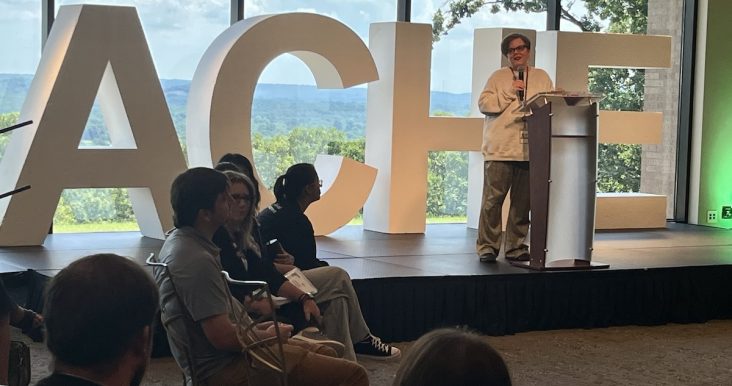
Dr. Melissa Stephens, associate dean of clinical medicine at the ACHE Arkansas College of Osteopathic Medicine, leads the Community Action Poverty Simulation.
Thanks to an interactive poverty simulation exercise conducted by the Arkansas Colleges of Health Education (ACHE) in Fort Smith on Wednesday (June 3), 28 people from the regional community had the opportunity to experience first-hand the daily challenges low-income families face.
Developed by the Missouri Community Action Network, the Community Action Poverty Simulation was created years ago after a mother who struggled to care for her family shared the idea. The exercise uses roleplay to give participants the opportunity to learn about real-life barriers families face involving transportation, daycare, and work. The event was held at ACHE’s Research Institute Health & Wellness Center.
“Our objective was really to raise some awareness and help individuals understand some of those barriers and challenges being faced by individuals living in poverty, as well as help them know how to better advocate to provide services to meet their needs,” said Dr. Melissa Stephens, associate dean of clinical medicine at the ACHE Arkansas College of Osteopathic Medicine, and facilitator of the simulation.
Nearly 30 employees from ACHe and the osteopathic program participated, role playing as representatives from various community services, programs, and institutions such as a bank, community health clinic, social services office, employment office, law enforcement, and homeless shelter.
During the nearly three-hour program, both sets of participants were given scripts to act out challenges and interactions.
“You may have the desire to go get a job or even to go to work, but if you have no transportation to get there, that’s a barrier that you may face,” Stephens said.
Other challenges included navigating application processes to obtain social services or having enough money even with a job to pay for car maintenance and other expenses. People may be aware of programs available, but they may not realize the steps it takes to apply and receive the benefits, Stephens said.
This is the first time the simulation has been conducted in the Fort Smith area in recent years, Stephens said, and she always finds it interesting to watch people role play during the scenarios.
“A lot of people think they know how they would react in some of these circumstances, but oftentimes people when they’re faced with some of these things act and behave in ways that they would not expect of themselves,” she said.
Fort Smith Police Chief Danny Baker participated in today’s program. Role playing as a father of five who was out of work and whose unemployment insurance ran out, Baker initially thought the hypothetical issues would be easier to manage than they were. However, various roadblocks popped up in the process. Baker said he was “arrested” and placed in the fictional jail because he left his fictitious child home alone to go to the bank to get money from savings to pay the mortgage.
“It was a good opportunity for me to get a better perspective about the challenges that people face,” he said.
Finding the experience beneficial, Baker said it was important for him to recognize that investing in people and looking for the best solution is worth the time.
“This just helped me renew my commitment as a public servant and as the chief of police here in Fort Smith to really take the time to invest in people and learn their stories when we can and encourage our officers to do the same – to do the policing thing with humanity,” he said.
“There’s a lot of noise out there right now,” Baker said. “There’s a lot of conflicting ideas about how we need to improve Fort Smith and how we need to improve society, but this just solidifies my commitment to do what I said I would do and that was to take care of people.”
During the debrief session, participants’ comments included the fact that many people do not know about community resources, language often is a barrier to receiving services, and the public does not realize how prevalent poverty is in society.
Natalia Alarcon, a lead advocate with the Hamilton Center for Child Advocacy, said the simulation was a reminder that just because a family is not homeless does not mean they are not living in poverty. Saige Small, a treatment coordinator for Crawford County Mental Health Court working for the Guidance Center, said the experience gave her the opportunity to put herself in her clients’ shoes.
For Angie Mahuron, the multi-disciplinary team coordinator and a forensic interviewer with the Hamilton Center, it was a reminder.
“It reminded me of why I do what I do, and sometimes when you’re working in this line you can get jaded working as long as you do,” Mahuron said. “You just kind of forget some of those things, like the struggles that people face.”
Mahuron’s role was as an 85-year-old woman who was recently evicted from her home and was living at the shelter.
“If they have that one person that can believe in them, it might change their situation,” Mahuron said. “It might make them want to actually change it and do something about whatever their situation might be.”