
EPA provides $1.9 million to UA assistant professor for water quality study
by March 12, 2026 8:21 pm 362 views
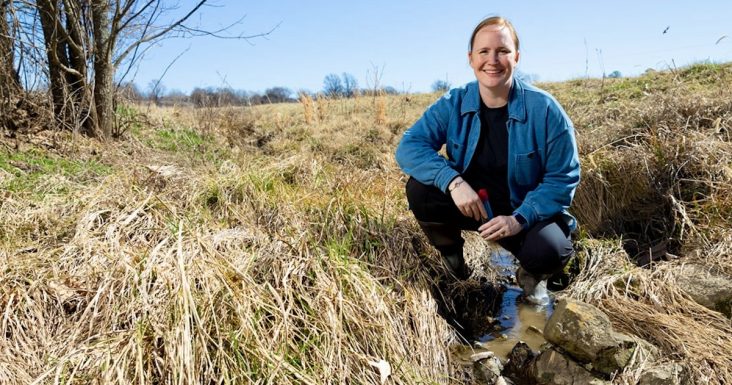
Shannon Speir, an assistant professor of crop, soil and environmental sciences at the University of Arkansas
The U.S. Environmental Protection Agency (EPA) has awarded nearly $1.9 million to Shannon Speir, an assistant professor of crop, soil, and environmental sciences at the University of Arkansas (UA), to study how adding biochar to poultry litter may help improve water quality, the UA announced Thursday (March 12).
Biochar is created when organic material, such as forest residue or agricultural waste, is burned in low-oxygen, high-heat kilns. The resulting charcoal is known to improve soil quality by enhancing its ability to absorb moisture, resist drought and retain nutrients.
The first phase of the three-year grant will be spent in the lab experimenting with biochar and poultry litter mixes and assessing biochar’s role in nutrient leaching and retention. Adding biochar to poultry litter, which is recycled as fertilizer for crops, can reduce the amount of nutrients like phosphorus and nitrogen that are washed into streams, rivers and lakes.
“Arkansas is the third-largest poultry-producing state in the nation,” Speir said, “which means we have an enormous waste stream and an enormous opportunity. Our research asks whether we can transform that litter using biochar to create a resource that actively protects local water quality and builds a more sustainable agricultural system in the region.”
In the next phase of the project, Speir and her team will work in the Brush Creek watershed, which covers a broad valley east of Springdale and Fayetteville and is part of the larger Beaver Lake watershed. The researchers will establish a new Discovery Farm, as part of the Arkansas Discovery Farm Program, in which farm operators volunteer to assist in water quality studies for five to seven years. Researchers will conduct edge-of-field monitoring at the transition point where runoff leaves agricultural land and enters waterways.
For the next two years, the researchers will monitor runoff at the edge-of-field and watershed scale. They anticipate a 15%-25% reduction in nitrate loss and a 5%-10% reduction in phosphorus loss. Several fields will receive biochar treatments, while a control field will be maintained without biochar.
The last component of the project will include recruiting additional volunteer farms to apply biochar to their fields, documenting water-quality impacts across the Brush Creek watershed, and receiving training and technical assistance on best practices.
“Voluntary conservation plays a key role in providing safe, healthy drinking water to the public and is essential to ensuring access to clean, abundant water resources to future generations,” Speir said. “Farmer-to-farmer training on conservation practices such as biochar can greatly accelerate adoption.”
She said this project is pioneering in its use of biochar amended poultry litter by demonstrating its efficacy at a watershed scale, explicitly linking field-level biochar amendments to measurable improvements in downstream water quality.
Speir’s research partners in the project include the University of Arkansas Division of Agriculture’s Cooperative Extension Service, the UADA Agricultural Experiment Station, the Beaver Watershed Alliance and the Carbon Chicken Project.