
Pilot training school to scale at Drake Field
by June 7, 2026 12:30 pm 1,576 views
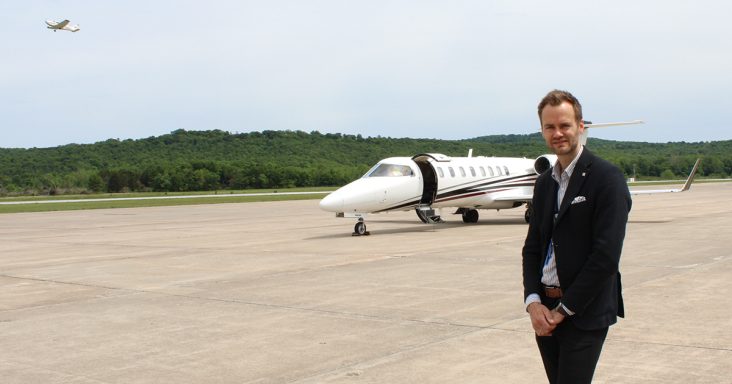
Martin Floor, is CEO of OSM Aviation Academy, which plans to open a flight school at Drake Field in Fayetteville later this year.
Arendal, Norway-based OSM Aviation Academy recently reached a five-year lease agreement to operate a new commercial pilot training school at Drake Field in Fayetteville. It’s expected to become the company’s flagship U.S. training hub, scaling to a capacity of 100 aircraft and 700 graduates annually.
Martin Floor, CEO of OSM Aviation Academy, said this will be the company’s fourth flight school. It has two in Europe and one in Florida. The company’s core business is training pilots, which it has been doing since 1963. It also provides training for specific aircraft types and is looking to establish a program to train aircraft technicians in Fayetteville, along with its flight school here.
“We are one of the biggest flight schools in Europe, and we saw that we had a steady growth of inflow in Europe,” Floor said. “But we also have seen increasing challenges with the framework being able to scale the capacity of all the demand.”
As a result, the company needed to shift the strategy in how it educated its pilots, specifically in Europe, he said. The company also wanted to look at the United States, where it’s much easier to fly. The strategy became meeting demand for pilot training in Europe while also expanding its training in the United States.
“In that strategy change, we wanted to place a big flight training hub here in the United States,” Floor said. “Now, we already have a school in Fort Lauderdale, (Fla.) It’s fantastic to fly there, but it’s also limited because that’s an airport with 2,000 aircraft situated there.”
The large airport has airspace restrictions, is congested and doesn’t offer much room for the company to scale there, he said. “We needed to look somewhere else.”
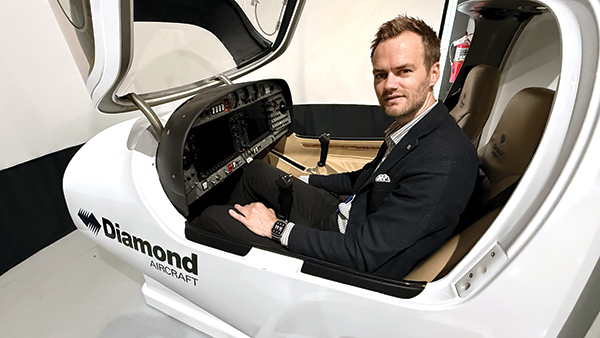
The company looked at multiple states and conducted extensive analysis. He said the company’s owner has ties with Northwest Arkansas and “is very fond of that area, so we started to look specifically in Northwest Arkansas to be part of what we see is tremendous economic growth here and also within the aerospace aviation industry.
“When we saw Drake Field and Fayetteville, that’s when we really fell in love with the place,” Floor said. “We saw that Fayetteville — with the university students, the vibrant city life and the closeness to Drake airport — the combination there is just fantastic. In general, this area has a good climate for year-round flying.”
The airspace is accessible, and there’s not a lot of traffic. Overall, Drake Field “was just a perfect fit for our flight school,” he said.
MULTIPHASE PLAN
OSM Aviation Academy plans to launch its flight school at Drake Field by late this summer or early fall. The goal is to start with 48 students.
The first aircraft is expected to arrive at Drake Field in June. The company plans to have 10 airplanes by the end of this year and 25 by late 2027. It will use the Tecnam P-Mentor, a two-seat, fuel-efficient aircraft that is tailored for flight training. Tecnam is Capua, Italy-based aircraft manufacturer.
The P-Mentor is “very modern,” Floor said. “It can fly what’s called instrument, which means that you can fly in clouds, and you can train both at night and in clouds. It is fully autopilot-equipped” and has a modern glass cockpit with touch screens. “It’s a state-of-the-art training aircraft.”
The company is hiring staff for the school, and the number of employees is expected to grow as it scales. By the end of the year, the school expects to have 80 students. By the end of 2027, the school is expected to reach phase-one capacity with 200 students and 40-50 full-time employees. The second phase will require the company to expand into additional space and possibly make investments. At full buildout in phase two, the program here is expected to support up to 100 aircraft and 700 students graduating annually. The school would have between 250 and 300 employees at full buildout.
Floor said the focus is on ensuring the company has everything it needs to launch operations and reach phase-one capacity. Phase two will be more long-term, more likely a five-year plan. He said establishing a technician training program here would initially support the flight school. But part of this would involve training technicians for the broader market.
According to Boeing, 660,000 new pilots and 710,000 new technicians will be needed globally by 2044.
“What we can contribute to the region is a steady workforce, a highly skilled workforce,” Floor said. “They’re also highly paid… in the field of being a pilot or a technician… We can bring that into the community, and the direct, indirect and induced economic effect of a flight school is big.”
Economic Impact
An economic impact report commissioned by OSM Aviation Academy shows that the flight school operating 25 aircraft would generate between $25 million and $40 million in annual regional economic impact. At a full buildout of 100 aircraft, the report estimates the annual regional economic impact at between $90 million and $140 million. The impact accounts for employment and value creation associated with the flight school; indirect effects such as supplier purchases, housing, logistics and aircraft maintenance; and induced effects from student spending and staff affiliated with the school.
OSM Aviation Academy’s lease agreement with the city of Fayetteville includes an 8,000-square-foot hangar and 3,026 square feet of office space in the airport terminal. The company can extend the lease for an additional five years. According to city records, total rental revenue from the hangar and office space over five years is projected to be $362,029.
Annual fuel sales are expected to be 103,000 gallons with the flight school operating 25 aircraft. This would generate a $103,000 annual profit or $515,000 over the five years. At full buildout with 100 aircraft, the number rises to $412,000 annually.
Floor said the lease includes room to park up to 20 aircraft on the apron outside of the terminal. The hangar also has room for airplanes, but it will be primarily for aircraft maintenance.
‘AIRLINE-READY PILOTS’
Asked what sets OSM Aviation Academy apart from other flight schools, Floor said it trains “airline-ready pilots, which means that we are very professional-focused on tailoring the pilots to the needs of the industry and the airline, specifically the airline industry.
“We have a high focus on selection. We want to get the right candidates into the training. There’s two reasons for that. One is that we want them to have the highest chance of success to be able to complete, and the other is that we have the highest quality of training so that the airlines will be happy with the pilots that we provide for them.”
The selection process includes ability and personality testing. During flight school, the focus is on being professionals. “We’re putting the students in an airline environment,” he said. “They are wearing the uniforms, they are using manuals and the structure of the briefings, and everything we do is very much like an airline. We have different departments, like an airline, so it’s going to be familiar to them when they go into the professional airline industry.” Floor added that the school is not only training pilots to obtain their licenses.
“We are using the testing that we do in the beginning to develop their competencies throughout the training,” he said. “That’s something called competency-based training and assessment. So we build the competency of the pilots, instead of just the skills to get a license. That will ensure they become the best version of themselves, and that will differentiate our pilots from other pilots in the industry.”
The first students who train at the school at Drake Field will be from Europe. They will complete one year of training here before returning to Europe for the final year of the two-year program.
By mid-2027, U.S. students will be able to attend the school. Students here will train for one year. Tuition has yet to be set, but Floor is working on the program’s financial component. The one-year domestic program could become available by mid-2027 or sooner, depending on capacity.
The Federal Aviation Administration requires 1,500 hours of flight time before a pilot can land a job at a major U.S. airline. After flight school, students can work as flight instructors or join a regional or private jet company to gain experience before transitioning to major airlines.
In Europe, students can transition directly to an airline from flight school. Floor said 92% of its pilots get a commercial pilot job within 12 months. He attributed the program’s success to its quality, the selection process, and its collaboration with the airlines.
“We want to do the same here in the U.S. and build the pipeline into the airlines because getting a job is very important for the students because it’s a high-cost program,” he said. “It’s costly to fly because you’re flying a lot of hours in an expensive aircraft with fuel costs and everything. So it’s an investment for the students, and we want to have them succeed as much as possible.”