
Fort Smith Mayor McGill will not seek a third term; notes challenges, opportunities
by March 12, 2026 6:30 pm 750 views
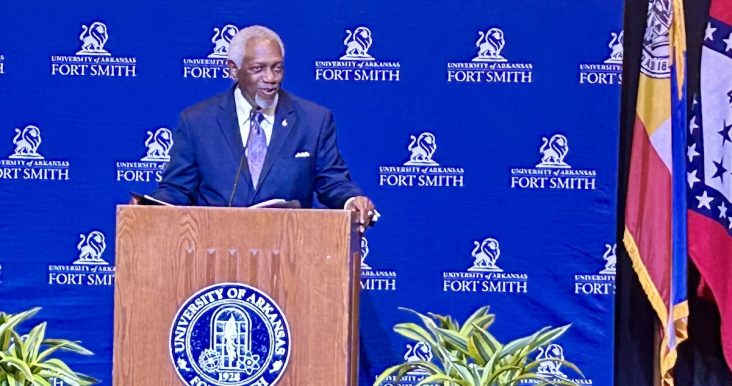
Fort Smith Mayor George McGill speaks during his 2026 State of the City address held Thursday (March 12) at the University of Arkansas at Fort Smith.
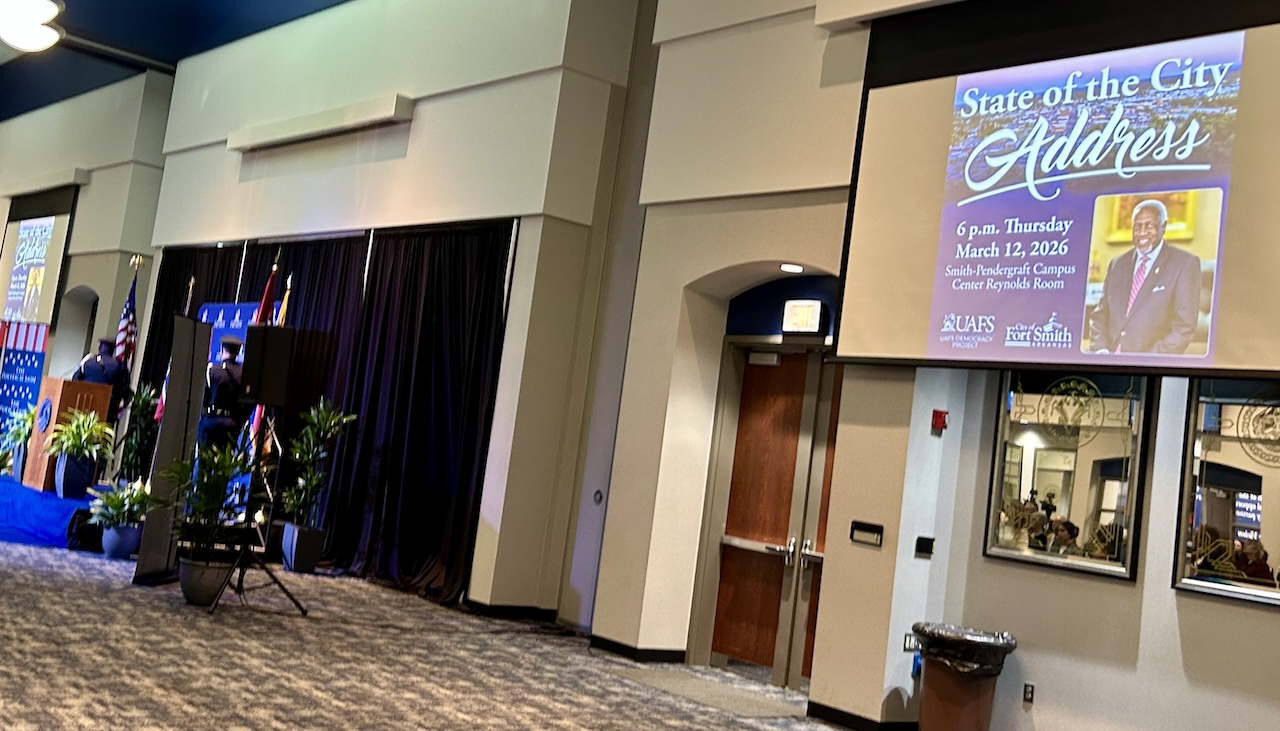
Fort Smith Mayor George McGill on Thursday (March 12) evening said he is not running for reelection after two terms in office. McGill made the announcement as part of his annual State of the City address held at the University of Arkansas at Fort Smith.
McGill was first elected to the city’s top elected position in August 2018 with 57% of the vote in a three-person race. He was sworn into the office in January 2019, making him the first African-American mayor of the city founded in 1817. Prior to being elected mayor, McGill served three terms in the Arkansas House of Representatives, including being assistant speaker pro tem in his term that began in 2017.
His first two years in office were marked by back-to-back challenges — the historic flooding of 2019 and the COVID pandemic that began in early 2020.
In an interview with Talk Business & Politics prior to the annual address, McGill said he is proud of city successes during his two terms in office, and also proud about how “residents responded to a lot of the things we have faced.” In Fort Smith’s form of government where a city administrator is the manager and answers to an elected board of directors, the mayor does not have an executive role. But McGill said the mayor “can set the tone” and bring elected, business and other community leaders together “when we need to work collaboratively to get things accomplished.”
He said the city’s selection as home to the foreign pilot training center, the recent modification of a federal consent decree, and the community’s response to the 2019 flood and COVID are some of the highlights of his mayoral years.
Ebbing Air National Guard Base in Fort Smith was selected in March 2023 by the U.S. Air Force to be the long-term FMS pilot training center supporting F-35 fighter planes purchased by Singapore, Switzerland, Poland, Germany, Finland, and other countries participating in the program. The base also will house and provide training support for Republic of Singapore F-16s. The city was initially selected in 2021, with the record of decision made in 2023.
“It was very competitive, but we were able to win that,” McGill said of the broad federal, state and local effort to lobby for the pilot training center. “Being part of those conversations from the beginning up until now has been very rewarding, and we’ve made quite a name for ourselves and have built a great relationship with the Air Force. I think they are very impressed with how the community really came together and collaborated and how we continue to make them feel welcome.”
A modified agreement to a federal consent decree also was negotiated during McGill’s time in office. After decades of failing to maintain the city sewer system, the U.S. Environmental Protection Agency (EPA) and the U.S. Department of Justice executed a consent decree in 2014 with the city of Fort Smith that required certain improvements to the city’s sewer system.
The recently approved agreement gives the city more time and flexibility to make mandated sewer system improvements. McGill said obtaining the modification included “changing the discussion by all parties” to reach a “collaborative, understanding process around a positive dialogue.”
“They (federal agencies) began to listen to us, we began to listen to them, and over the past two years, we’ve come to a point where we have something that is very doable, and it’s something they are happy with,” McGill said.
McGill also said he was pleasantly surprised by how quick the community rebounded from the historic Arkansas River flood of 2019 and the COVID pandemic. Record flooding along the Arkansas River (McClellan-Kerr Arkansas River Navigation System, or MKARNS) in May and early June 2019 covered more than 2,100 parcels of land and flooded more than 500 homes and businesses in Fort Smith alone.
The floods stopped commercial barge traffic on the Arkansas River at a cost of $23 million a day to the state’s gross domestic product. The river crested May 29, 2019, in the Fort Smith area at 40.26 feet, well above the flood stage of 22 feet and surpassing the all-time highest river level of 38.1 feet set in May 1945.
“The credit goes to everyone in the city, our great city staff, the city residents, and all those who stepped up to help us,” McGill said about recovering from the flood and COVID. “That gave me a clear understanding of who the residents are, how resilient they are, and how they can step up in times of a crisis.”
But challenges remain, McGill said, including significant water system needs — potentially up to $600 million. He said a quick but responsible response to address water infrastructure issues is needed to help the city keep growing.
“If we address our water needs, and that will be a lot, I think we will be well on our way,” McGill said. “The private sector, the medical sector, the nonprofit sectors, they are doing the work, the great work that is required of them. We just have to make sure that (water system) is taken care of, not just for our city, but for this region.”
He also said a focus on affordable housing will be needed by the city and “its many partners.”
He was critical of those in the community who “always want to talk us down,” saying the city has a lot going for it, and constant negativity is not helpful.
“Sometimes we forget that the things we say about ourselves can be used against us,” McGill said. “We need to be mindful of that. … We have so many things that make us attractive, that make us a great city. You know, if we are going to be a premier city, we have to do the things other premier cities around the state and the nation are doing. And that comes with a price tag, and that means the people have to decide what they want to be, what they are wiling to do for the future of our kids and our grandkids.”