
AETN Commission delays decision to leave national PBS
by March 12, 2026 4:05 pm 1,489 views
If Mr. Rogers were still alive, he’d be feeling a lot better about his old neighborhood.
The Arkansas Education Television Network (AETN) Commission voted 4-1 Thursday (March 12) to delay by 180 days its December decision to disaffiliate from the national Public Broadcasting System (PBS). Commissioners plan to use the time to work with their nonprofit foundation, corporate funders, supporters of its programming, and “viewers like you” to close a funding gap.
The board voted at the end of the year to disaffiliate from its national counterpart by July 1, 2026, in order to shave $2.5 million from its budget. At the time, Arkansas TV executive director Carlton Wing said it was the best option to keep the agency afloat. He advocated cutting the national programming from PBS and to focus on more locally-produced productions.
The result of that decision would result in Arkansas’ PBS affiliate, Arkansas TV, not carrying popular programs like “Masterpiece,” Ken Burns’ documentaries, or “Sesame Street.”
Arkansas TV said it received more than 1,500 emails in opposition to its decision to separate from its federal partner, which was devastated with $1.1 billion of funding cuts last year when Congress and President Donald Trump used a budget measure called “rescission” to take back previous funding. It was a 21% federal budget reduction that affected over 1,500 local public radio and television stations.
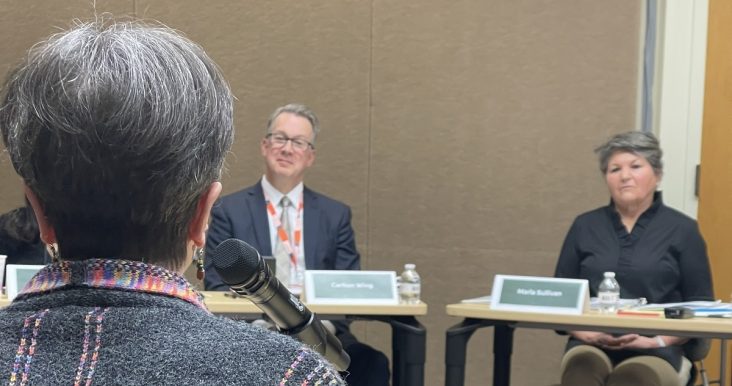
At Thursday’s four-hour board meeting, a side room full of at least 100 opponents of the December decision showed up to ask for a reversal. Eighteen people testified against the December decision and asked the AETN commissioners to reconsider. No one spoke in favor of disaffiliation, and one commissioner suggested she had not seen any correspondence of support.
Here are a few excerpts from testimony from citizens that ranged from Fayetteville to Little Rock:
“It’s not a financial issue, it’s a political and ideological issue.”
“This makes us look like an uneducated, backwoods state.”
“Arkansas PBS needs a long-term solution, not a short-term fix.”
“This budget decision seems like a red herring to me.”
“I’m willing to up my contribution.”
“If we can spend a billion dollars a day on war, we can spend $2.5 million on children.”
After every speaker, the holding room of supporters erupted in applause, audibly loud enough to be heard in the board meeting.
HIGH-PROFILE SUPPORTERS
The commission was also persuaded by comments from Paula Kerger, CEO of PBS. She attended the meeting and explained that there had been too rigid of an interpretation of the rules that govern the national group’s relationship with state counterparts and the steps to disaffiliate.
“We’ll work with you on that,” said Kerger, who also promised to personally help raise money for the state PBS affiliate. After the meeting, she said she had already started reaching out. “I was texting some people already saying it’s time to step up.”
Kerger also said that with cuts it has made at the federal level, she could reduce Arkansas’ cost to affiliate from $2.5 million to $2.1 million.
Former Arkansas First Ladies Gay White and Barbara Pryor spoke for delaying the separation from national PBS. They have helped form and lead a bipartisan group called Friends of Arkansas PBS. Pryor, who was married to former Gov. and Sen. David Pryor, D-Ark., asked the commission for time before following through on its previous decision.
“We can solve the financial part of it, if you’ll give us a chance,” said Pryor, whose husband also served on the National Corporation for Public Broadcasting.
“I know what it is like to make ends meet,” said White, wife of former Gov. Frank White. “I know it’s difficult to make hard choices. My desire is to keep PBS in Arkansas. I’m speaking as a donor.”
BUDGET
About 85% of Arkansas TV’s budget comes from the state. It is a division of the Arkansas Department of Education.
Arkansas is running a $334.4 million surplus. In her balanced $6.8 billion budget presented to legislators for consideration next month, Gov. Sarah Sanders asked for an overall 3% spending increase from last year. Her budget includes:
- $192 million more for her Education Freedom Account program;
- $53.4 million for the new state employee pay plan;
- $6 million to higher education;
- $7 million to drug task forces;
- $5 million to improve Arkansas’ SNAP error rate; and
- $6 million to the 10:33 Initiative, a faith-based solution aimed at moving people off welfare.
The governor and Arkansas lawmakers are also contemplating and expected to enact further income tax cuts later this year.