
Development costs, incentives discussed at NWA Market Insights event
by February 12, 2026 9:23 am 714 views
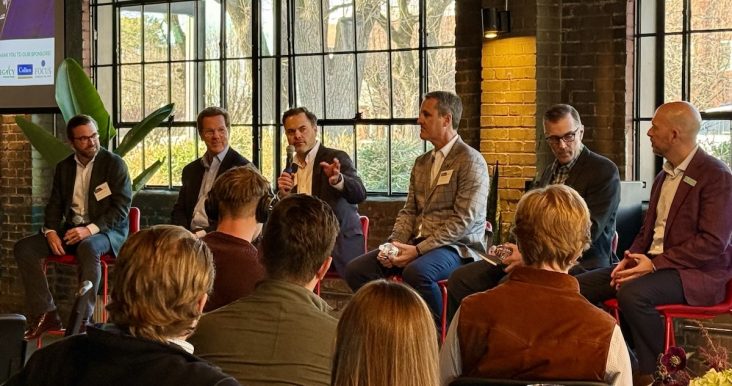
Luke Parsons, senior vice president of commercial lending at Legacy National Bank, speaks Wednesday in a panel discussion about the commercial real estate market in Northwest Arkansas.
Cushman & Wakefield / Sage Partners hosted the 2026 NWA Market Insights event Wednesday in Bentonville that included a discussion of the commercial real estate market and a ballot initiative aimed at spurring development in Arkansas.
Part of the event included release of the firm’s 2025 Market Report, a report that shows the commercial real estate market in Northwest Arkansas remains strong, despite rising supply in some asset classes.
Issue 3 will be on the Nov. 3 general election ballot. If Arkansas voters approve the issue, it could provide incentives for developers to complete projects in the state. It could also help the state better compete with other states offering similar incentives. The incentives, likened to tax increment financing (TIF) districts, would direct new property tax revenue toward bonds to fund projects.
Another component of the incentives would allow the use of city and county sales tax revenue instead of property tax revenue. This incentive was recently used to attract the Kansas City Chiefs to a new stadium in Kansas. Another component of the incentive in the issue would allow for rebates of property or sales taxes for new developments. This incentive has supported economic activity in Texas since 1989.
Panelists were supportive of the incentives.
In the discussion Wednesday, Marshall Saviers, CEO and principal at Cushman & Wakefield / Sage Partners, said Northwest Arkansas has a problem that people want: a supply shortage. He attributed this supply problem to increased financing and new construction over the years, along with the area’s growth. He asked the panelists how they were addressing this problem.
Alan Cole, principal and executive vice president of Colliers Arkansas in Rogers, said commercial real estate demand remains strong, but finding space for tenants has been challenging. He said the new Walmart Home Office is a good example of creating space for tenants, “but it’s not happening on a larger scale because the imbalance of land prices, of the infrastructure costs, and other construction costs that we’re seeing right now and the rents that you can get to try to cover some of those costs from the tenants.”
Cole said the incentives that would become available if Issue 3 were to pass are “really critical. I know of a couple of projects that are hanging out in the balance right now that are going to be reliant upon those mechanisms being put in place for the incentives to make it happen. And there’s some really talented developers that build really high-quality, really beautiful products that this market will be able to absorb and appreciate. And they want to be here.”
Tom Allen, president and principal at Cushman & Wakefield / Sage Partners, said incentives have helped bring retail or entertainment-related projects to other states that people have wanted here. Developers have located the projects in the states with incentives.
“Ninety-nine percent of the time, they got incentives,” Allen said. “And they have looked at us here … They’ll spend their money where they get the biggest return, and if they get incentives, their return is bigger.”
Luke Parsons, senior vice president of commercial lending at Legacy National Bank in Bentonville, said the demand is strong for the tenants, developers and investors to be in the area, but the construction costs for projects are more than they’d like to pay.
Chris Schnurbusch, southeast region president for Crossland Construction in Rogers, said construction costs were stable for about 25 of his 34 years in the industry.
“We hit this spot where everything just took off, and it’s really frustrating for us because we can’t even get our arms around the costs,” he said. “It’s really difficult to tell exactly what materials are going to cost day to day, what labor’s going to cost day-to-day. So it’s become extremely important for us to lean on the relationships that we’ve built over the last 25 or 30 years with our trade partners to help us to navigate these … issues that come up.”
Schnurbusch said Crossland’s projects tend to be larger but are slower to start because they’re often over budget, and the rents and numbers don’t work.