
Pentagon, Lockheed deal to expand missile production in Arkansas
by January 6, 2026 5:16 pm 2,024 views
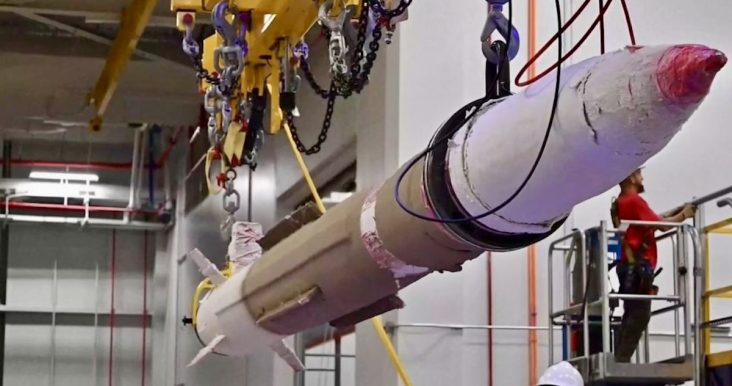
A PAC-3 missile being manufactured in Lockheed’s Camden, Ark., plant.
The Pentagon and Lockheed Martin on Tuesday (Jan. 6) announced a unique seven-year deal to boost production of advanced Patriot-system missiles from around 600 a year to 2,000 a year. The missiles are produced in Camden, Ark.
According to the Lockheed press release, the contract differs from normal weapons procurement deals in that it “provides long-term demand certainty, enabling industry investment, increasing production rates and driving operational efficiencies. It incorporates a collaborative financing approach designed to preserve initial cash neutrality, allowing industry to invest confidently to meet required production levels.”
No details were provided on the value of the expanded deal, but the cost for the PAC-3 (Patriot Advanced Capability) Missile Segment Enhancement interceptor missiles range between $4 million and $7 million. That range would put the deal between $14 billion and $8 billion.
The U.S. Army in September 2025 announced a $9.8 billion deal with Lockheed for 2,000 missiles. That deal included launchers and other support systems.
Lockheed, which employs more than 1,000 workers in Arkansas, occupies a combined manufacturing and support function floor space exceeding 2.2 million square feet spread out over more than 2,400 acres in Camden. In addition to the PAC-3 missiles, Lockheed’s Camden facility produces components for the Multiple Launch Rocket System (MLRS), the Tactical Missile System (TACMS) missile, and the High Mobility Artillery Rocket System (HIMARS) launcher.
Also, Aerojet Rocketdyne has more than 1,100 employees in Camden’s Highland Industrial Park. The Camden site produces more than 75,000 solid rocket motors a year, mostly for Lockheed Martin.
With the Russian invasion of Europe, conflicts in the Middle East, and military defense sales to NATO allies, demand is high for the PAC-3 missiles, according to Lockheed and the Pentagon. Lockheed said in 2025 more than 24,000 missiles and fire control systems were delivered to the U.S. military and allied nations.
“We appreciate the Department of War’s leadership in advancing acquisition reform,” Lockheed Martin Chairman, President and CEO Jim Taiclet said in a statement. “This first-of-its-kind approach builds on years of advocacy and collaboration to bring commercial practices to major acquisition programs. We will create unprecedented capacity for PAC-3 MSE production, delivering at the speed our nation and allies demand while providing value for taxpayers and our shareholders.”
In response to media questions during a Tuesday press conference, Taiclet said the goal is to ramp up to 2,000 missiles per year produced by 2030.
“We’ll have to get the whole supply chain up to speed as well,” he said. “So, we’re again, rateably going to increase the production rates. The contract will reflect the exact numbers when it’s finalized, but we do have that kind of North Star target of 2,000 a year by end (of) 2030.”
Taiclet did not provide a number of new jobs that would be required.
“So actual numbers of people will be determined when the actual contract and the specific milestones per year are identified,” he said. “It’ll be meaningful, but again, it won’t be overwhelming.”
The Pentagon also said it will boost support to Lockheed’s supply chain partners, noting that it “will work with key suppliers of PAC-3 MSE to deliver seven-year subcontracts to ensure facilitization investments and the production capacity of components also expand to meet the increased demand for all-up-rounds.”
In a report from Breaking Defense, Tom Karako, a missile defense analyst with the Center of Strategic and International Studies, said the deal is not a surprise considering global demand for the missiles.
“The demand signal is massive among multiple US services, the other 17 nations globally that operate Patriot, and a handful more who want to,” he said. “Moving from 600 to 2000 per year is by no means high or excessive relative to demand — it’s more likely a reflection of the limits of the possible.”
Missile sales help drive operating income for Bethesda, Md.-based Lockheed. Missile and fire control sales in the first three quarters of 2025 totaled $8.977 billion, or 16.4% of total company sales, according to its third quarter 10-Q filing with the U.S. Securities and Exchange Commission. However, the operating income for missiles and fire control systems in the three quarters totaled $1.454 billion, or 31% of the company’s total operating income.
Overall, total revenue for the company in the first three quarters of 2025 totaled $54.727 billion, just above the $54.421 billion in the same period of 2024. Net income in the first three quarters totaled $3.673 billion, down 23.6% compared with the same period in 2024.
Lockheed shares (NYSE: LMT) closed Tuesday at $522.04, up $10.47, or 2.05%. During the past 52 weeks the share price has ranged between $538.73 and $410.11.