
More, better and ‘intentional’ downtown Fort Smith growth focus of panel discussion
by November 17, 2025 8:35 am 914 views
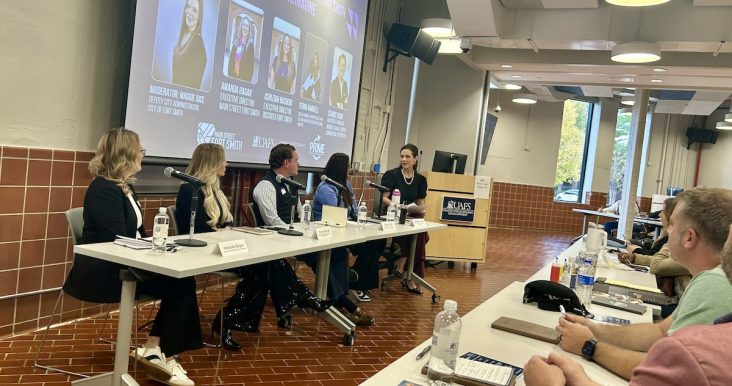
Panelists discussing downtown Fort Smith at the Nov. 13 Invest Fort Smith event were (from left) Amanda Hagar, Terra Harvell, Stuart Ghan, and Ashleigh Bachert. Maggie Rice was the panel moderator.
There is growth in downtown Fort Smith, but more needs to be done to support small business investment, add quality residential space, and create “intentional collaboration” between public and private interests. Folks also need to quit “badmouthing” downtown and the city.
Such are some of the observations offered during a Nov. 13 panel discussion and Invest Fort Smith. The event, held in The Bakery District in downtown Fort Smith, was a partnership between Main Street Fort Smith, PRIME: River Valley Professional Summit, and the University of Arkansas at Fort Smith. According to organizers, the event was “designed to connect entrepreneurs, small business owners, and community leaders with resources, insights, and opportunities that are shaping Fort Smith’s future.”
“Reinvesting in Downtown Fort Smith: How to Revitalize, Restore, and Reimagine,” was the final panel discussion of the daylong event. Panelists were Amanda Hagar, director of Main Street Fort Smith; Stuart Ghan with Ghan & Cooper Commercial Properties; Ashleigh Bachert, director of the Fort Smith Advertising and Promotion Commission; and Terra Harvell, with Harper Ellis Hair Company. Ghan and Harper are based in downtown Fort Smith.
The panel was moderated by Fort Smith Deputy City Administrator Maggie Rice.
“We as a community have to take stewardship of our downtown and through that stewardship of our downtown we create a place that everyone wants to be,” Hagar said to begin the panel discussion. “To get that you have to have investment in terms of not only small businesses, but also housing. I would love to see some second story housing. … We want it to have a nice lived-in feeling when you come in.”
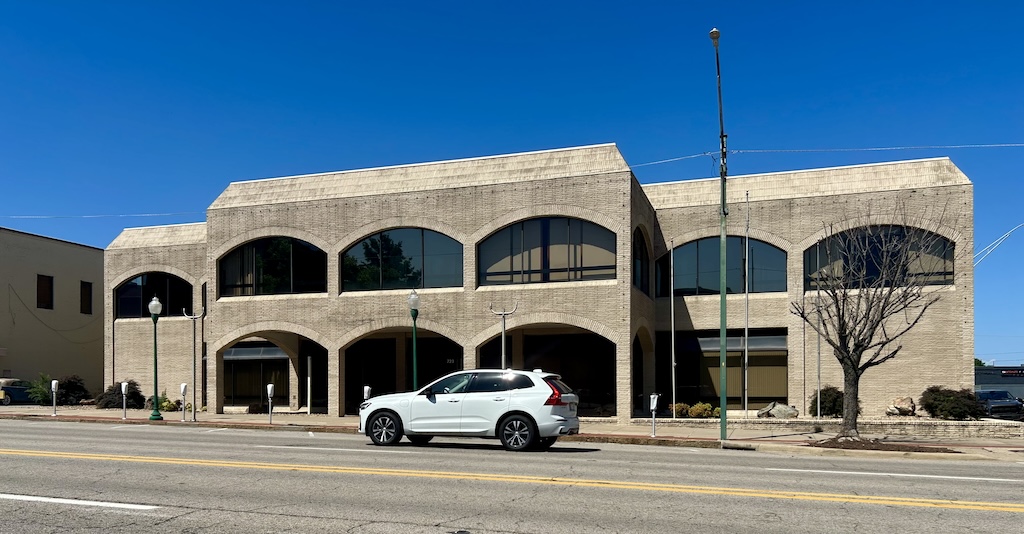
Hagar said she is optimistic about the future of downtown, noting that she is seeing “an evolution of intentional collaboration” among public and private groups with an interest in improving the area.
Topics covered during the panel included strategies to attract small business investment, the role of arts and culture in downtown development, the role of local governments in downtown growth, and the challenges to growth. Following are comments from the panelists on the numerous topics during the more than hour-long discussion.
• Meaningful downtown investment
Harvell: “I think we have to invest in these young business owners to become great business owners that know how to scale, that know how to run a business, and turn into legacy (businesses). We don’t want transactional business owners that go out of business after a few years. We want long-term business owners who bring in the right crowd.”
Ghan: “That living component is very important, too. You know, at 5 o’clock when we all go home, where do we go home? If you can retain those people in the downtown area after business hours, that creates that nightlife and that activity. And when you have continuous people walking around and keeping things active, it creates a safer community as well.”
• Need for improved appearance of downtown Fort Smith
Bachert: “I think there is a component of, how can we make things look aesthetically pleasing, so that when people come in, they say, ‘OK, I can see myself here. I can see investing in a business. I can see living down there.”
Hagar: “It’s these beautification and infrastructure projects that actually make our space safer, and that’s happened through these very intentional collaborations. So I really see that that is the way that downtown has evolved since I moved away and came back. It is such a great vibe to see downtown.”
• Strategies to recruit and retain businesses downtown
Harvell: “We need to create a strategy, like, who are we trying to attract? Who is that person? Is it a transactional entrepreneur? Is it legacy businesses? And then it’s just like a business, you know, we have to market to that ideal client, and we have to find reasons for those people to come downtown and want to build a business and stay down there.”
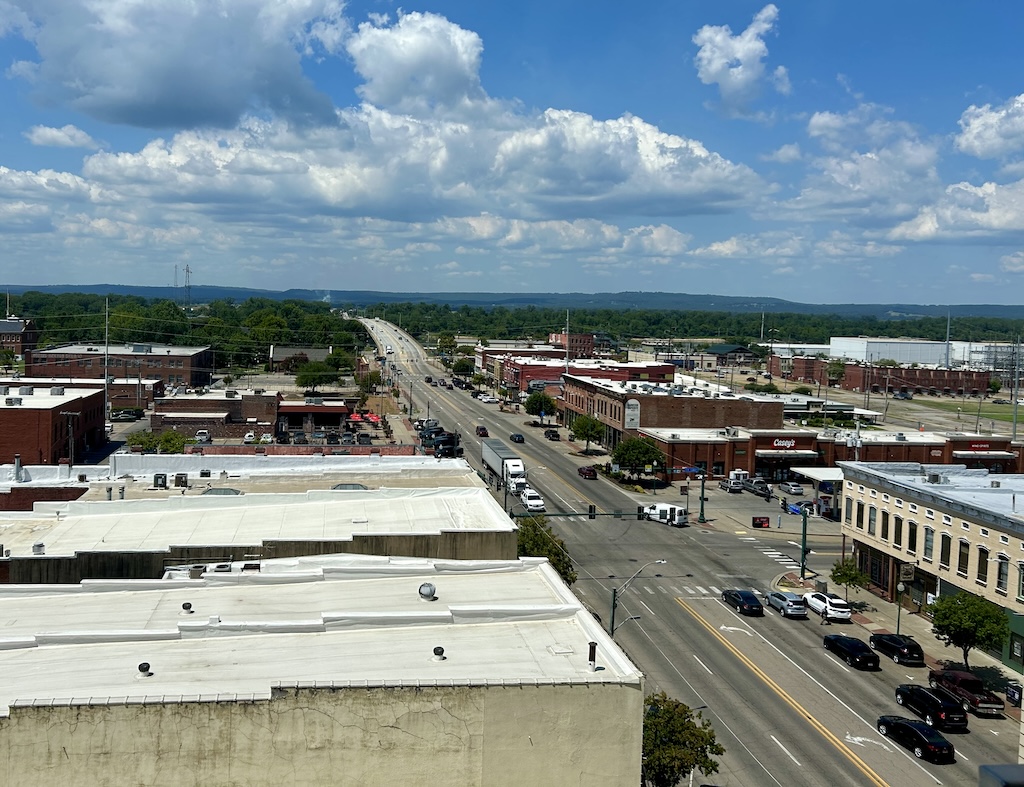
Hagar: “Revitalization is not a short race. Revitalization is a years-long, even decades-long race. So there are no quick fixes. … How can we support a business or property owner that just needs to replace their windows and get the cardboard out of their windows? How do we update these awnings? … It’s a really hard balance to strike of how do we attract business owners that are new and give them a space that they can afford to renovate.”
Hagar added that such support includes “many little ways” to help business owners and property owners navigate federal, state, and local grants or regulations. Bachert said part of recruitment also includes residents to “stop badmouthing ourselves.”
Ghan: “There have been some projects that have been done downtown that are no doubt passion projects. That is not a realistic expectation of growth. There is definitely a few people that have passion for downtown that did a lot of work in the area. The trick is how to get people to invest and to then also get a return. Because that’s how you get people to invest, right?”
Addressing investment attraction is to “make downtown more approachable” for people to learn more about what is needed to make a sound investment, Ghan said. He said the Central Business Improvement District, of which he is a commissioner, is working on that approachability.
Rice: “I see local government being able to help downtown in a way that we should be looking at ways to remove regulatory barriers, trying to lower the walls and being more accessible to people. … I also think the city has a responsibility in placement, quality-of-place initiatives.”
• Efforts to recruit visitors to downtown Fort Smith
Bachert: “I love our Old West culture, but that’s not for everybody. I’m not a history buff. That’s not me. So if all I hear is history, history, history, guess what, I’m not visiting Fort Smith. So we’ve got to go through and have events that hit a cross section of our demographic, but also really what people are trying to experience, and that’s the food, that’s the culture, that’s the arts. That’s really what drives people and their spending habits and where they want to visit.”
Bachert also praised local groups like the Peacemaker Festival, which brings thousands of people from around the country, and other countries, for the annual music event at Harry E. Kelley Riverfront Park in downtown Fort Smith.
Hagar: “There is nowhere else that has the art that we have in Fort Smith. Yes, other places have art, but we have 30 incredible pieces (murals), more than 30 incredible pieces, that are within walking distance in our downtown. … We have a lot of unique arts and culture already happening downtown.”
• Notes on optimism about downtown Fort Smith growth
Ghan: “There are other people that have bought (downtown) buildings that are currently being renovated right now. Our city committed to buying its building. Those are major things. The city is longer renting from a landlord. There are people that are moving businesses down here. … I think that’s what is encouraging from what I’ve seen lately.”
Harvell: “We have our clients come in from all over the country and now all over the world. We just had someone from Canada last week. The No. 1 thing they always say is how safe they feel down here and how peaceful it is and chill it is. And they also really brag on the restaurants and the businesses that are down here. Being a business owner that brings in people, that’s wonderful.”
In his closing comment, Ghan encouraged residents with ideas or complaints to get involved instead of just complaining.
“Think about what you want to see in your downtown area, and then how you contribute to that,” he said. “If it’s a complaint, how do we address that complaint constructively, instead of just typing out on Facebook, the complaint. We can do that real easily, but being part of the change is the hard part.”