
Filing: State can’t seek a stay in Senate District 26 special election case
by November 7, 2025 2:59 pm 685 views
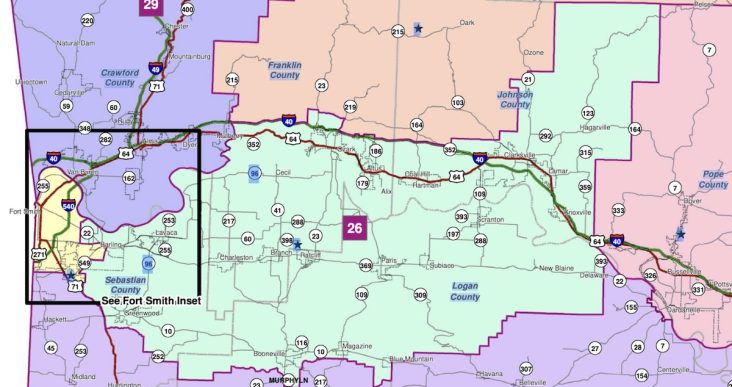
Arkansas Senate District 26
Gov. Sarah Sanders can’t seek a stay from the Arkansas Supreme Court of a ruling requiring a new date in the Senate District 26 special election because the state didn’t first seek a stay in the circuit court that issued the ruling.
That’s part of an 11-page response filed Friday (Nov. 7) with the Arkansas Supreme Court by Jennifer Waymack-Standerfer, the attorney representing Franklin County resident Colt Shelby.
Shelby on Oct. 6 filed a lawsuit with the Pulaski County Circuit Court to seek an earlier date for a special election in the Senate District 26 seat left vacant with the Sept. 2 passing of Sen. Gary Stubblefield, R-Branch. The lawsuit lists Gov. Sarah Sanders and Arkansas Secretary of State Cole Jester as defendants.
Senate District 26 includes parts of Franklin, Johnson, Logan and Sebastian counties. Towns in the large legislative district include Barling, Booneville, Charleston, Clarksville, Greenwood, Lamar, Lavaca, Ozark, and Paris.
Sanders set the primary election for March 3, 2026, with the special general election date set for June 9. In her election call, Sanders declared that it is ‘impracticable or unduly burdensome” to hold an election within 150 days of the declared vacancy in the district seat.
Shelby, in his filing, said Sanders is required to set an election within 150 days of a declared vacancy. Standerfer argued for the same schedule set by then Gov. Asa Hutchinson when Arkansas Sen. Lance Eads, R-Springdale, resigned in October 2021 to take a job with a lobbying firm. She said election officials have testified that they can make the same schedule work for a Senate District 26 special election.
Circuit Court Judge Patricia James ruled for Shelby on Oct. 22. In a request for stay filed Nov. 5, Noah Watson, deputy solicitor general for Arkansas Attorney General Tim Griffin, said James’ ruling “does not even account for all the statutory requirements or any real-world logistics.”
“Appellants’ request for a stay should be denied because Appellants did not request a stay in Circuit Court, there is no Circuit Court record on the matter from which to appeal, and Appellants have given no explanation for their failure to do so,” Standerfer noted in the response filed Friday.
The AG’s office disputed Standerfer’s assertion that the state should have requested a stay in the circuit court.
“The rule that opposing counsel references only applies to requests to stay ongoing circuit court proceedings – it doesn’t apply here,” said AG Communications Director Jeff LeMaster. “In this case, the circuit court proceedings ended when the circuit court issued a final judgment, which we appealed. It is the final judgment, not any proceeding, that we asked to be stayed.”
Standerfer also reiterated that a stay and subsequent legal actions will only serve to extend the disenfranchisement of voters in district 26.
“January 30, 2026 is one hundred fifty (150) days after Senator Stubblefield’s passing,” Standerfer wrote. “If the special election is not immediately moved up to the next practicable date after January 30, 2026, then even if the Circuit Court’s ruling is affirmed, the county election officials will not have adequate time to prepare for the earlier election dates. The requested stay and a procedural delay will prevent representation of Senate District 26 for two hundred seventy-nine (279) days and through the 2026 Fiscal Session, leaving Senate District 26 with no voice in their Republic and no remedy in the courts.”