
Executive Summary: Policing more than ‘nabbing the bad guy,’ says Fort Smith Police Chief Danny Baker
by November 2, 2025 10:01 am 780 views
Editor’s note: The Fort Smith Metro Daily News Executive Summary series is focused on looking under the title, so to speak, of a business, government, and nonprofit executive in the Fort Smith metro.
Danny Baker is the chief of police of the Fort Smith Police Department. He was appointed as interim chief in April 2019 and named chief of police in September of the same year. He has served with the department for 24 years and has almost 30 years of law enforcement experience in Arkansas and Oklahoma.
He was named the 2022 Outstanding Chief of Police by the Arkansas Fraternal Order of Police and received the 2023 Community Service Award from the Fort Smith Roundtable for his work in building police and community relationships in Fort Smith.
He serves on or as an adviser to several boards, commissions and nonprofit organizations which include the State of Arkansas 911 Board, the River Valley Communications Board, the Hamilton Center for Child Advocacy, the Fort Smith Health Advisory Council, Christmas Honors Program, the Sebastian County NAACP, Sentinel Outdoors, and President of the Fort Smith Museum of History Board of Trustees.
• What was your first job and what did it teach you?
The first “paying” job I recall was as a teenager hauling hay for the whopping wage of 10 cents a bale, stacked in the barn. I learned so many valuable life lessons from this experience, and it is unfortunate that very few farmers use square bales anymore. Every aspect of farming hay, including getting it off the field, has been mechanized, robbing generations of young people the joys of “bucking hay” in the sweltering summer heat. In addition to being physically demanding and requiring dogged determination (particularly when a storm is brewing with hay on the field), it taught me the importance of the economy of resources. Being effective, and thus marketable (word of mouth was the only advertising I ever had to do) meant I had to hire other people to help me. 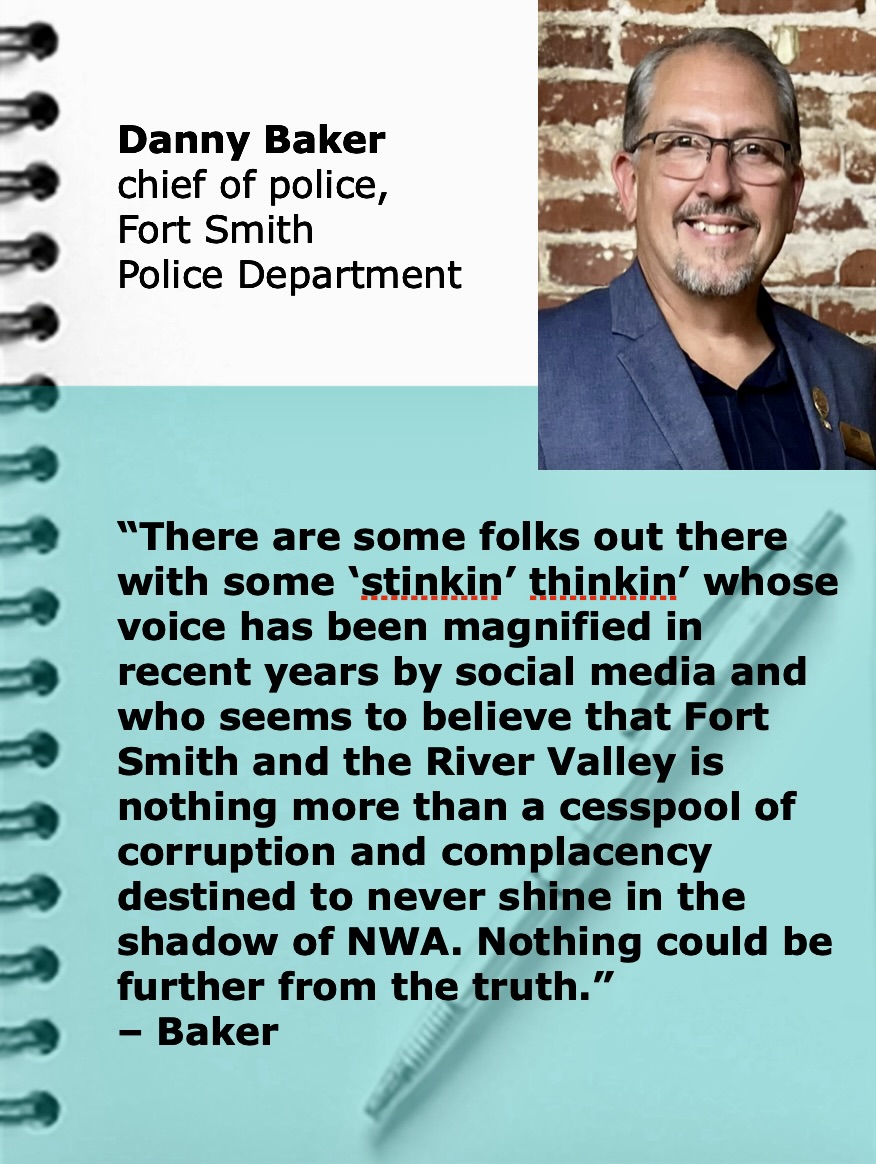 This also meant sharing profits, not a concept fondly embraced by a teenager. That old 1972 Ford didn’t run on air so fuel expenses cut deep into that dime, making every single bale worth less the longer the truck ran and it certainly wasn’t fuel-efficient by any means. There was to be no idling or hot-rodding with my gas! Even after all expenses were considered and money was in hand, spending that hard-earned cash took on an entirely new meaning. Being responsible for over $20 million of taxpayer funds, I see every dime of the millions spent as a bale of hay someone else had to buck.
• What is a principle or value on which you never compromise?
As chief, I meet with every single new officer we hire face-to-face both on Day 1 and at the conclusion of their training. I do this for numerous reasons but most important is that they know and understand our vision and my expectations of them. Before I approve their release from training and turn them loose in our community with a badge and gun, there is a question they must satisfactorily answer: “What does honesty and integrity mean to you, and do you think there will ever be a reason to compromise either?” Responses often vary on meaning but any answer other than “there will never be a reason to compromise my honesty or integrity” is unacceptable. These values are a must for anyone aspiring to be a police officer and I have always held them in the highest esteem for myself, even when it resulted in criticism and negative consequences. As humans, mistakes and bad choices will be made. Most can be forgiven and recovered from. To compromise one’s honesty and integrity is a deliberate decision to elevate personal preservation above all else that is good and wholesome and cannot be tolerated from a public servant.
• What’s one belief you held strongly 10+ years ago that you’ve changed your mind about?
For a good portion of my career, I simplistically and conveniently viewed my “job” as a police officer to be nothing more than to “nab the bad guy.” I believed in, and was often encouraged to hold fast to the idea that my purpose was only to catch as many law breakers as I could and hold them accountable to the fullest extent of the law. It was someone else’s responsibility to figure out how to make sure the people I arrested or cited corrected their behavior to line up with society’s wants and needs. I watched as our prisons filled to beyond capacity, an alarming number of children were being shoved into foster care, families were being dismantled, mental health issues and homelessness plagued our streets and strained our services, and cries went up from all across the nation about how we, the police, were contributing to the problem. Watching as things only seemed to worsen while I continued with business as usual, I had to ask myself if, by some chance, I was in fact part of the problem. It was a hard pill to swallow but when I looked at the problem objectively through the lenses of people who had much different experiences than I, the conclusion I came to was that there was no one better situated than me to make a difference. Who better to connect a person in crisis to the medical help they desperately needed than the police officer called in the moment of crisis? Who better to help keep families intact by working with DHS and other social services to find the best outcomes?  Who better to slow down and work to de-escalate rather than draw a line in the sand and dare one to cross it? The answer I came to fundamentally changed how I approached this thing called “policing” and helped shape many of the programs and policies I’ve implemented as chief. Don’t get me wrong: there will always be a need for enforcement and consequences. There are people who need to be in prison and there are children who need to be in better environments. But anything we can do as first responders to improve the lives of those we encounter will be time, money, and effort well spent.
• If you could change one thing about the Fort Smith metro, what would it be?
There are some folks out there with some “stinkin’ thinkin” whose voice has been magnified in recent years by social media and who seems to believe that Fort Smith and the River Valley is nothing more than a cesspool of corruption and complacency destined to never shine in the shadow of NWA. Nothing could be further from the truth. We have an incredible community of good, honest, hard-working citizens who are capable of being just as relevant and vibrant in our own right. In fact, a great many people are working very hard and spending a lot of personal time and money every day to again make Fort Smith the destination city she once was. If I could change one thing about us, it would be to soften the rampant negativity and distrust by encouraging those who doubt to get involved. Put the keyboard and the forums down and go see what Fort Smith has to offer. Yes, as with any community, mistakes and questionable decisions are sometimes made. Trust must be earned and is hard to regain when it’s lost. But I’ve found that if one looks for a positive way to contribute, a place to jump in, roll up the sleeves, and work alongside neighbors, government employees, and elected officials, many of those negative thoughts and that ole stinkin’ thinkin’ often fades away. Imagine what we could become working together instead of constantly tearing one another down.
• What seemingly small thing had a big impact on your life?
The very first time I attended the Special Olympics Arkansas Summer Games in Searcy, Ark., I was given the honor of presenting awards to athletes after each competition. It has long been a tradition for uniformed police officers to fill this important and prestigious role. As I approached the podium to present an award, the athlete, a middle-aged lady with some obvious cognitive and physical disabilities (I like to say “dif-abilities” because I assure you these folks have plenty of abilities. They might just be different than ours.) was literally quivering with excitement. As I leaned in to place the medal around her neck, she grabbed my head and landed one of the biggest, most sincere kisses I think I have ever had. You would’ve thought she had just met a movie star. After recovering from the initial shock and surprise, I was overcome with a deep sense of humility and a desire to share that same pure, unabashed excitement and joy with as many of those athletes as I could, sans kissing of course. It completely changed the way I viewed not only those with ‘dif-abilities,’ but every person facing challenges. A simple, pure, unexpected kiss opened my eyes to the incredible impact that I could have on people’s lives as a police officer, sometimes just by showing up.
• What about you would surprise most people?
I think most who’ve come to know me in the last 15 years or so and those who only know me from my public facing roles as the chief would be surprised to learn that I’ve had to overcome a lot of self-doubt, apprehension, and probably a bit of introversion to be an effective police chief. There have been many people in my life, at various times, who have seen potential in me; encouraging, mentoring, and sometimes pushing me to grow out of and beyond my comfort zone. Each new, uncomfortable experience has opened even more opportunities for me to implement change where needed and make a positive difference for someone else. I think most good leaders struggle with “imposter syndrome” from time to time which helps to keep them grounded and their egos in check. For me, I’ve learned to turn those moments into a time of honest self-assessment. Sometimes an ego-check is in order. That internal gut-check continually reminds me that I would not be where I am, doing what I do, were it not for the men and women who put in the hard work every day, and for those who believed in me and invested a bit of themselves in that belief.
• There are many promises and concerns with the advancement of artificial intelligence (AI). What societal benefit do you hope AI will produce?
I am very worried about the threat AI poses to humanity. There is no doubt that, in its current stage of development, it can be a very useful tool, helping us be more effective in public safety. Facial recognition, predictive policing, automated language translation, and video processing are all areas in which AI is impacting policing across the globe right now. It is becoming more and more difficult for anyone to hide for very long. There are obvious concerns everyone should have: How do we prevent AI from being used in destructive ways? How do we keep AI from becoming too ‘smart’? What freedoms are we willing to give up to the use of AI-influenced technologies under the guise of ‘public safety’? Perhaps my biggest fear, and thus my biggest hope, is that as humans come to rely too heavily on this technology (which we are destined to do), we will be forced to once again learn the importance of face-to-face interaction. We are already seeing the division and erosion of trust in one another that AI is capable of creating. I believe true social interaction (not via an online platform) will become the only way to keep AI in its proper place. If AI drives us back to the dinner table, back to places of worship, back to community gatherings and family outings, back to having face-to-face conversations where words have consequences and effective communication occurs, that will be the biggest benefit of AI technology. I only hope the road isn’t too bumpy and painful getting there.
• If you were able to get one piece of legislation through the U.S. Congress and signed into law, what would it be?
I believe every full-time police officer, deputy and firefighter should be guaranteed a livable wage, commensurate to the level of sacrifice they are expected to make. As society has come to expect these public servants to assume more and more community caretaking roles and rightly demands higher standards and more training for them, appropriate compensation has not been forthcoming. This is especially true in smaller agencies where funding is always a challenge while expectations continue to rise. I don’t necessarily like the idea of a federally-funded mandate but I do think legislation requiring every state to commit a percentage of their annual budgets to supporting police, deputy, and firefighter salaries across the state (not just state agencies) would be a huge investment in the selection and retention of the people who are needed and committed to keeping us safe.
EXECUTIVE SUMMARY SUBJECTS
Following are the links to previous posts in the Executive Summary series.
ArcBest Chair and CEO Judy McReynolds
Fort Smith Mayor George McGill
BHC President and CEO Marty Clark
Maryl Koeth Purvis, director of the Van Buren Advertising and Promotion Commission
University of Arkansas at Fort Smith Chancellor Dr. Terisa Riley
Fort Smith Public Library Director Jennifer Goodson
Bill Hanna, president, CEO, board chairman, Hanna Oil & Gas
Rodney Shepard, regional executive for Arvest Bank’s southwest region
Van Buren Mayor Joe Hurst