
ASU veterinary college to help reduce Arkansas’ shortage
by November 4, 2025 10:00 am 773 views
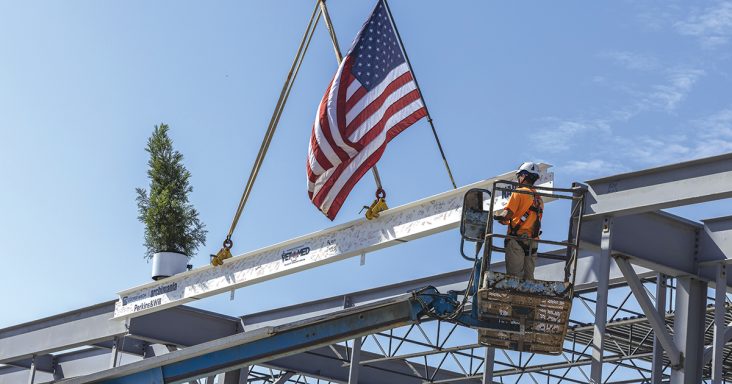
In mid-October, the College of Veterinary Medicine at Arkansas State University in Jonesboro has the final beam set into place for the building, which is expected to be completed in the spring.
Arkansas has never had a veterinary school and now the state is on the verge of having two. Construction on the first public school in the state is on schedule.
In mid-October, the College of Veterinary Medicine (CVM) at Arkansas State University had the final beam set into place for the building, which is expected to be completed sometime next spring. A topping off ceremony was held.
“We imagined this college, funded it, and now we’re building it. Arkansas and this entire region need more animal health professionals,” said A-State Chancellor Todd Shields. “This college will train them, hands-on, from day one, solving problems for producers, clinics, agriculture and communities.”
Each year, students pursuing doctor of veterinary medicine degrees leave the state to attend a veterinary college. Upon the opening of the CVM, the first 120 students will be the first wave of new veterinary professionals in Arkansas.
“Every bolt in that beam represents a student’s future,” Shields said. “This is not just about a building, it’s about the capacity to care for animals, to support agriculture, help food insecurity, and keep talent right here in Arkansas.”
Dr. Heidi Banse, CVM dean, said they have worked to build a team to instruct future students so they are best prepared to enter veterinary practice.
“One of the things we’re proudest of is our program and facilities that align to create a day-one-ready graduate,” said Banse.
For the state, many of the needs are from rural, mixed animal practices. The building will house administrative offices, classrooms, anatomy, and small animal clinical and surgical skills training spaces.
“We are building two barns at the animal science farm next door that will allow our students hands-on experience with cattle and horses to make sure they are day-one-ready,” Banse said.
During the ceremony, attendees had the opportunity to sign the final beam before it was hoisted and secured into place.
“This structure represents not only just the parts that it is made of, but the spirit of teamwork and doing things the right way,” said Adam Seiter, executive vice president of operations at Nabholz, the project contractor.
Banse said they are thankful for many along the journey, including partners across the state.
“We have many partners that contribute to our educational experiences, including the Department of Corrections, the University of Arkansas Division of Agriculture, Arkansas Department of Agriculture, National Toxicology Research Center, and our over 400 general veterinary practices across Arkansas, Southern Missouri, and beyond that are training our students in their fourth year of their curriculum,” Banse said.
The 56,000-square-foot facility is estimated to cost $33.2 million. It will be the second vet college in the state. Lyon College is slated to open one in fall 2026 in Cabot.
“We’re making very good progress,” Banse said. “We are on track to welcome our first class in the fall of 2026.”
The ASU System Board of Trustees approved a $30.6 million bond issue in December to finance construction for the new facility. The university plans to finance the building through the issuance of taxable Student Fee Revenue Bonds and use of institutional reserve funds. Tuition and fees from CVM students will ultimately fund debt service for the construction.
Annual tuition for Arkansas residents has been proposed at $17,000 per semester, with out-of-state student cost at $27,000 per semester. The average annual cost of tuition for in-state doctorates of veterinary medicine (DVM) students according to the American Association of Veterinary Medical Colleges was $34,289 per academic year for residents and $55,158 for non-residents in 2022-23.
School officials hope to have 120 students in the initial class. About 40 faculty and staff will be employed in the new school.
Nationwide, there is a growing shortage of DVMs to fill a growing demand for services. In Arkansas, the number of households with pets has reached almost 1 million. A generation of companion animal care veterinarians are reaching, or are beyond, retirement age. The more than 12,500 farms in Arkansas have a growing need for vet services, as well as Arkansas’ expanding food production industry.
An estimated 10% of the state’s counties don’t have a single veterinarian. The U.S. Department of Agriculture lists more than a dozen counties in Arkansas with some type of veterinarian shortage. Poinsett, Cross, Crittenden and St. Francis counties are among those in Northeast Arkansas that are identified as having a shortage.
Lyon College is slated to welcome its first class of students in the fall of 2026. An estimated 120 students will take classes at its facility in Cabot.
The American Veterinary Medical Association lists 31 schools in the country as accredited. It lists four as provisionally accredited. States with accredited schools that border Arkansas include Texas (2), Tennessee (2), Mississippi, and Missouri.