
The Supply Side: Walmart continues its milk processing facility expansion
by May 27, 2026 3:20 pm 1,350 views
Milk is a frequent purchase at grocery stores and is why the milk section is at the back of the store. Improving the margins on milk sales is also why Kroger, Albertson’s, Walmart and other major grocery retailers have worked to control more of the milk supply chain.
Since 2018, Walmart has moved to vertically integrate the milk supply chain for its Great Value private brand to better control pricing and product availability.
The retail giant recently opened its third milk-processing facility in Robinson, Texas, a town of about 12,000 people located 22 miles south of Waco. Walmart said the 300,000-square-foot facility represents more than a $350 million investment that will create around 400 jobs in the community.
“By sourcing directly from local dairy farmers, we’re strengthening our supply chain and improving freshness, consistency and transparency from farm to shelf,” said Julie Barber, chief merchandising officer at Walmart U.S. “This is how we deliver everyday essentials with the same intentionality we bring to fashion, quality, reliability and affordability at scale.”
Walmart said the plant will process and bottle a variety of milk products, including gallon, half-gallon, whole, 2%, 1%, skim, and 1% chocolate milk for Walmart’s Great Value and Sam’s Club Member’s Mark brands. The new operation will supply more than 650 Walmart and Sam’s Club stores in the South Central United States, including Arkansas.
Walmart’s first milk-processing plant was in Fort Wayne, Ind., and opened in 2018. It’s a smaller plant and only bottles milk for Great Value, sold at select Walmart stores. A larger second plant opened in Valdosta, Ga., in 2025. Walmart said 64 dairy farms are supplying the three plants, and the number can fluctuate from year to year based on output. At full capacity, Walmart said 120,000 milking cows will supply the three processing facilities.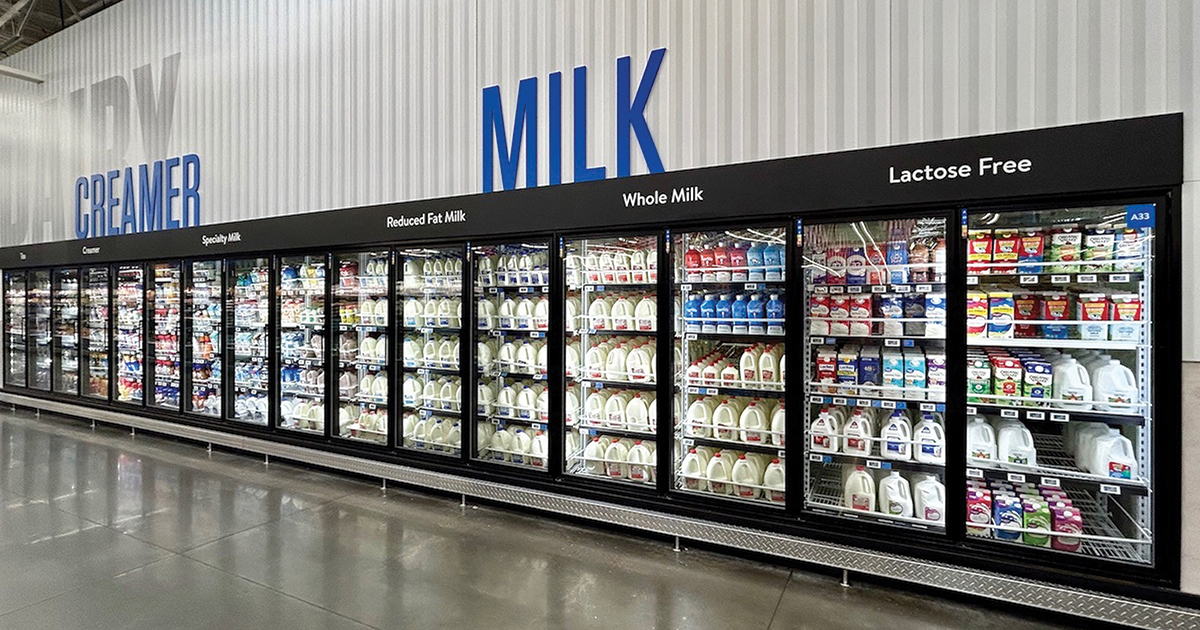
Walmart sources the milk it processes from regional cooperatives and independent dairy farms, and it still buys milk from large producers, such as Dairy Farmers of America, to supply stores outside the reach of its milk-processing plants. Walmart operates more than 4,700 stores, and each one of them sells milk. The three Walmart processing plants have the capacity to supply about 1,900 stores, or roughly 40% of its stores.
This is still less than competitors like Kroger, which have been in the milk business for decades. Kroger operates 19 processing plants for milk, ice cream and other dairy products, supplying roughly 90% of its private-brand milk sales. Albertson’s operates 7 U.S. dairy plants and has for decades supplied milk and other products, such as cheese, creamers and yogurt, to its stores under its private-brand labels.
San Antonio-based H-E-B owns and operates three large dairy facilities that supply its private-label milk and other dairy products, such as ice cream and cheese, to the majority of its stores across Texas.
CONSOLIDATION CONCERNS
Critics of Walmart’s milk-processing expansion are concerned the consolidation of milk processing by Walmart and other large retailers makes it tougher for small family farms.
The dairy industry has been under consolidation for years amid volatile feed prices and regulated milk prices. The U.S. Department of Agriculture (USDA) reports that the U.S. dairy industry saw a 50% decline in the number of small, family-scale farms between 2002 and 2019. Production shifted to fewer, larger-scale dairies with at least 2,500 cows.
Michael Looper, professor and head of the Department of Animal Science at Bumpers College at the University of Arkansas, said dairy industry consolidation has been underway for three decades. Having grown up on a fifth-generation dairy farm in Sebastian County, he said his dad was one of the last of 30 dairy farms in that county to sell out more than 25 years ago.
“Much of the dairy industry migrated out west to New Mexico about that time, where the air is drier, and the climate is warmer and better for dairy cow health,” he said. “Farms out there average around 1,200 to 1,500 head per dairy. For perspective, at last count, there were about 1,000 dairy cows in the entire state of Arkansas.”
He said the economies of scale work in the dairy industry where there is support infrastructure like large-animal veterinarians, milk machine technicians and other tradesmen. Looper said dairy farms often cluster around that ecosystem. He said Walmart’s initiatives in the milk-processing industry are a win for the retailer and could be a win for dairy farm owners, who have another contract option.
THE PRICING FORMULA
The Federal Milk Marketing Orders (FMMO) are among the most complicated commodity-pricing regimes in agriculture, according to the American Farm Bureau Federation.
The latest regulations on milk prices were part of the major reforms in 2000 that introduced end-product pricing formulas, which require milk handlers to pay producers based on their use of the milk.
There are 11 federal marketing areas based on region, and there are several steps in determining the farm-level milk prices. In FMMO milk pricing, commodity value, component and class are all used in the pricing formulas. Fluid milk is generally ranked as class 1 and receives the highest price. Soft products like ice cream are class 2, hard cheeses are class 3, and whey or powdered milk are class 4. But the price is influenced by composition, such as the value of butterfat, protein and other solids in the milk. Wholesale market surveys are done weekly to determine FMMO prices, and farmers receive a blended price or a weighted average of the different classes in their region, rather than the specific product made from their milk.
The state of Arkansas passed the Arkansas Milk Stabilization Act in 2021 to increase the average pay for state dairy farmers. A federal court struck down the law in 2023, ruling that it violated the Dairy Farmers of America contracts.
Looper said milk pricing is complicated, and there are also cases where milk is shipped across states for one contract, while it may pass a truck hauling milk going the other direction for another contract. Ideally, he said, if dairies can sell to a local processor, then it benefits the farmers and the processor.
Editor’s note: The Supply Side section of Talk Business & Politics focuses on the companies, organizations, issues and individuals engaged in providing products and services to retailers. The Supply Side is managed by Talk Business & Politics.