
The Supply Side: Happy Egg on a growth trajectory, expands national distribution
by May 7, 2026 12:30 pm 1,164 views

What started as a niche premium retail egg business in California around 2012 is now a national brand. Happy Egg, now based in Rogers, is on a fast track, expanding distribution to more than 17,600 U.S. retail stores, including 2,800 Walmart locations in 2026.
Privately owned Happy Egg has grown its staff to about 130, up from approximately 53 in 2024. The company grew organically through 2023, and then acquired Egg Innovations in late 2024 to add 50% more capacity, a feed mill, and a processing and packing plant in Warsaw, Ind.
Whitney Fortin, chief marketing officer at Happy Egg, said it’s been an incredible ride for the startup since moving its business in 2017 to Northwest Arkansas where agriculture and the retail supply chain converge.
“The majority of our farms were in Missouri in 2017, and we went from being a day or two days’ worth of travel from our farms to now being around three hours or closer,” Fortin said. “There was also a good bit of leadership change and more focus on connecting with our farmers. It was the right transition and huge decision that led to a lot of growth.”
Happy Egg now has 180 growers in the Arkansas Ozarks, Missouri and Indiana. The Indiana production, served by a feed mill and packing facility there, has allowed the company to vertically integrate that part of the business. They work with third-party feed mills and a packing facility in Berryville to service their business in the Ozarks.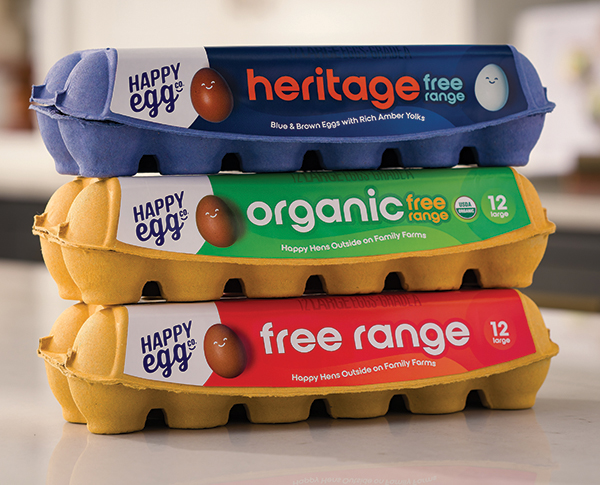
Fortin said each farm has about 20,000 laying hens. The hens are required to have 21.8 square feet of space each. They are not caged but housed in a large barn with doors open from dawn to dusk, with 8 to 10 acres of fenced area to roam.
Fortin said the farms also have “play stations” that resemble a child’s playhouse out in the roaming area. The play stations provide places to perch, a covered area for protection, and sandy ground underneath that allows for dust baths, which help birds maintain feather hygiene. Water lines are also required in the roaming area, and farmers must ensure the barn doors are open at certain times and the birds are coaxed out to get fresh air and exercise. According to the company, happy hens produce happy eggs on small family farms.
NICHE MARKET
Fortin said cage-free, free-range, pasture-raised, and organic varieties are part of a niche premium egg sector. Happy Egg has distribution in the free-range, pasture-raised and organic sectors.
She said the hens are very much like backyard chickens that have become so popular in recent years. All Happy Eggs come from four different breeds of birds that originated in Europe. The Heritage hens, blue or brown, were developed in-house by Happy Egg ownership. The company also uses the Hy-line Brown and the Lohmann Brown hens in its grower operations.
“We own the genetics with our Heritage hens, which is not the norm for most egg companies,” she said. “The Heritage hens eat more and lay fewer eggs that contain plump amber yolks with a creamy flavor.”
The company launched Heritage free-range egg products in retail at scale in 2019. This is a premium product with an average price of around $7.99 per dozen. Other Happy Egg products range in price between $5.60 and $6.99, depending on the variety and the retailer’s markup.
The company’s main niche competitors include publicly traded Vital Farms and Pete Gerry’s Eggs, which is owned by a Los Angeles-based private equity group. Fortin said being owned by a farm family that does not seek personal attention is also a major differentiator at Happy Egg.
“We have been able to grow this company and truly value our farmer relationships without having to worry about a share price,” Fortin said. “We have a waiting list of farmers who want the opportunity to work with Happy Egg.”
PERFECT STORM
Happy Egg has seen robust sales growth as the specialty egg market continues to outpace the growth of the traditional egg segment.
Faunalytics found evidence in its research that specialty eggs are capturing more of the market. The market share by value of conventional eggs – those with no animal welfare or treatment claims – fell from 41% in early 2008 to 27% by the end of 2018. In contrast, pasture-raised eggs, which weren’t on the market in 2008, captured 5% of all consumer egg spending by 2018.
“Consumers are increasingly concerned about animal welfare in egg production, from the way the hens are housed to what they’re fed,” the report noted. “It’s often assumed that this demand translates into a willingness to pay higher prices for products with welfare-friendly labels.”
Fortin said the company has seen double-digit growth annually since moving to Rogers in 2017. That is also the same year the company introduced its organic eggs into Walmart, having previously sold its products primarily at Kroger, Albertsons, Sprouts and regional grocery chains.
According to Nielsen, Happy Egg grew sales 94.1% annually from 2019 after the acquisition of Egg Innovations and supply chain chaos from the COVID-19 pandemic. In 2021, sales grew another 37%, as a bird flu virus outbreak hit larger traditional producers like Cal-Maine.
Fortin said as egg supplies at grocery stores ran short, consumers had more time at home and tried Happy Egg products. Many of them became customers. Nielsen reports Happy Egg sales grew 31% in 2022 and 17.1% in 2023.
There was another round of the bird flu in 2024 and 2025, which sent traditional egg prices much higher. Again, more consumers found Happy Egg as Nielsen found the company grew sales by 26.4% in 2024 and 32.4% in 2025.
Fortin said as egg supplies have become more plentiful since late 2025, prices have settled to more normal levels. But the company’s retail distribution continues to grow. She did not provide 2026 growth projections, but demand for specialty eggs continues to rise as more consumers care about how animals are treated in the food supply chain.
Retailers are listening and expanding their assortment in these premium egg products. Watt Poultry reports that free-range eggs and specialty eggs are projected to grow at an annual compounded rate of 8.9% through 2033.
Editor’s note: The Supply Side section of Talk Business & Politics focuses on the companies, organizations, issues and individuals engaged in providing products and services to retailers. The Supply Side is managed by Talk Business & Politics.