
Vikings, unknown monuments part of Fort Smith history class
by January 5, 2026 2:35 pm 1,246 views
Vikings were in the Fort Smith area between 600 and 800 AD, well before federal regiments were sent to the area. Also, an estimated 12,000 Native Americans called the area home around 800 AD.
Also, Jefferson Davis was in Fort Smith when he was campaigning for presidency of the Confederacy and there is a small monument in downtown Fort Smith to prove it, according to Dr. Steve Breedlove. He said “you really have to be looking for it to even notice that it is there.”
“This is the type of stuff I want people to learn,” Breedlove said. “I want people to sit back and say, ‘Wow. Look at this history that is here in Fort Smith. This is incredible.’”
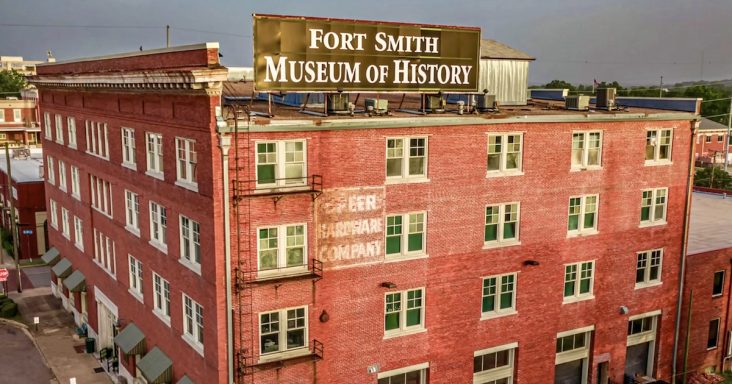
That type of stuff will be some of the lessons in a monthly class to be held at the Fort Smith Museum of History.
Breedlove, a retired educator, high school principal, and former Arkansas legislator with a doctorate in education and master’s degree in history, worked with the museum to organize the classes. The museum will begin the six-month class on Jan. 17, with the class held the third Saturday of each month with the final class set for June 20. The classes begin at 9 a.m. and conclude around 3 p.m., with each Saturday including a guest speaker that focuses on a part of the city’s history.
Each class is limited to around 40-45 people. Each class is $20, or $50 for those who sign up for all classes. Link here to register and for more information about the classes. All of the proceeds go to support the museum.
The first class will focus on an overview of the city’s history, Breedlove said. The February class will feature Catherine Gray with the Cherokee Nation who will discuss the Trail of Tears, the Spiro Mounds, and other Native American history in the region.
Breedlove said he was driven in part to design the class because the Arkansas history taught in public schools has little to say about the Fort Smith area.
“In that Arkansas history textbook, the vast majority of the book deals with central Arkansas, the Little Rock area,” Breedlove said. “There is the grand total of two paragraphs in that book that mention Fort Smith. What is irritating to me personally about that is there is more history in Fort Smith than anywhere else in the state of Arkansas.”
He said many people who have lived in the area for decades are surprised to learn that the Vikings were hanging around the area long before Judge Isaac Parker had other folks hanging around. He said the Heavener (Oklahoma) Runestone is one marker of their presence in the region.
“I can date the history of Fort Smith back to 600 AD,” Breedlove said. “Now, they didn’t settle in Fort Smith. But the Vikings actually came up from the Gulf of Mexico, they came up the Mississippi River. They turned left at the Arkansas River. They came to Fort Smith and turned left at the Poteau River. … and they settled in Heavener. At least part of them settled in Heavener.
“What’s interesting about that is that they (Vikings) came over here about the same time as the fall of Rome. And the Vikings were instrumental in the fall of Rome. I mean this is going to be some really good history.”
There are several things Breedlove hopes to accomplish with the class: that people develop a sense of pride in the region’s history; they are educated about the region’s deeper history; and “to promote Fort Smith and the rich history that we have.”
He also said the class will count as continuing education credits for educators through the Guy Fenter Education Service Cooperative.