
Family, relationships fueled Kirkwood’s long career at AOG, Summit
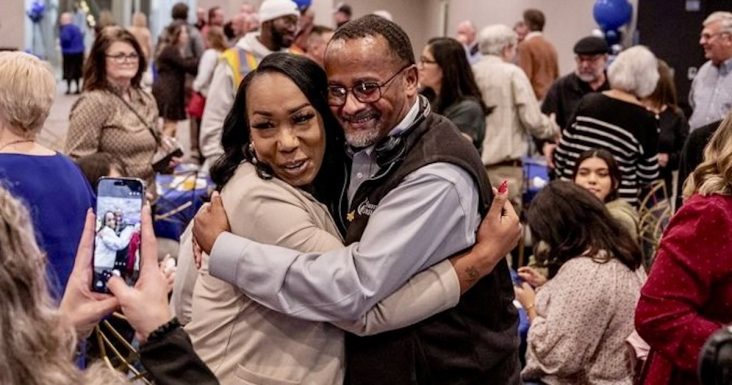
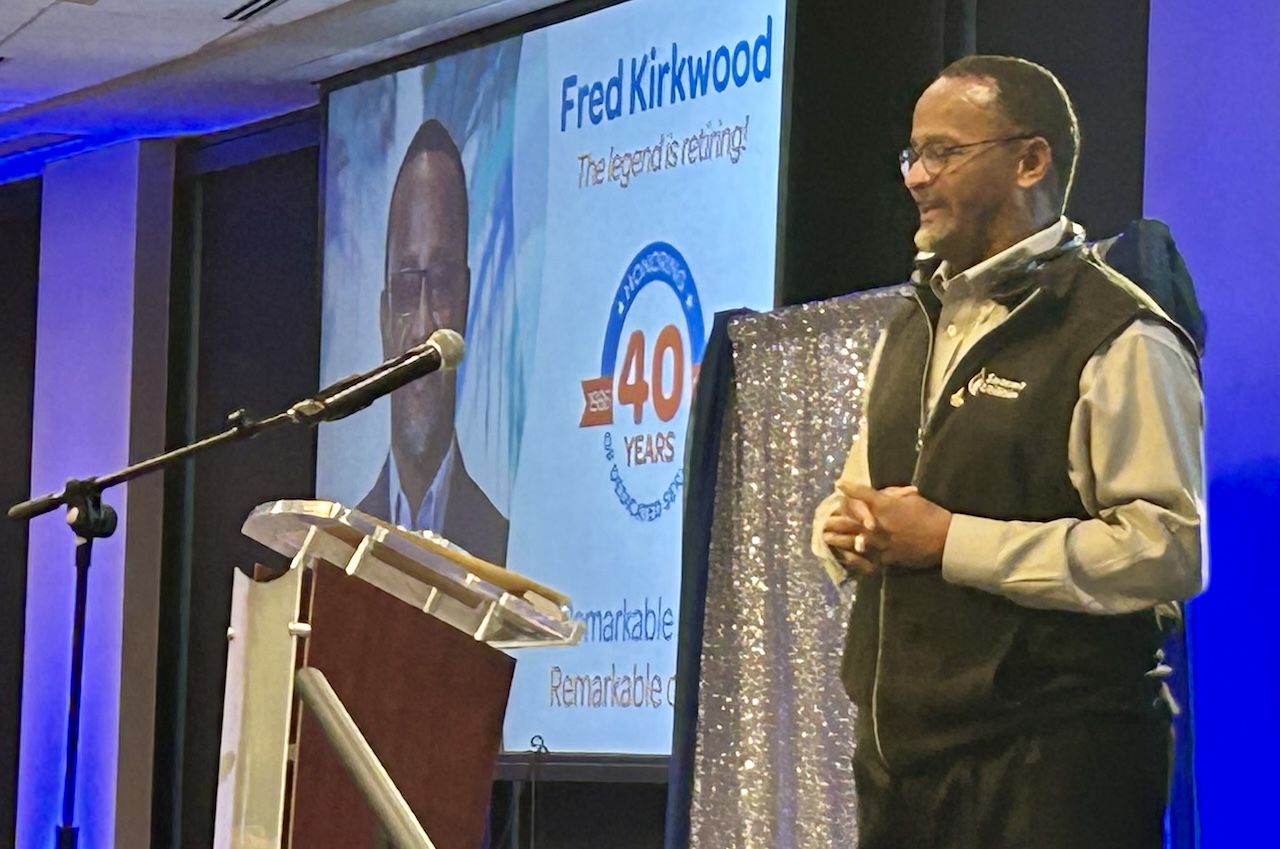
Fred Kirkwood with a well wisher after a Jan. 8 retirement luncheon in his honor. (photo courtesy of Summit Utilities)
Fred Kirkwood was following love – her name is Carla – when he arrived in the Fort Smith metro more than 40 years ago. Four decades later, he developed a following of folks who love him.
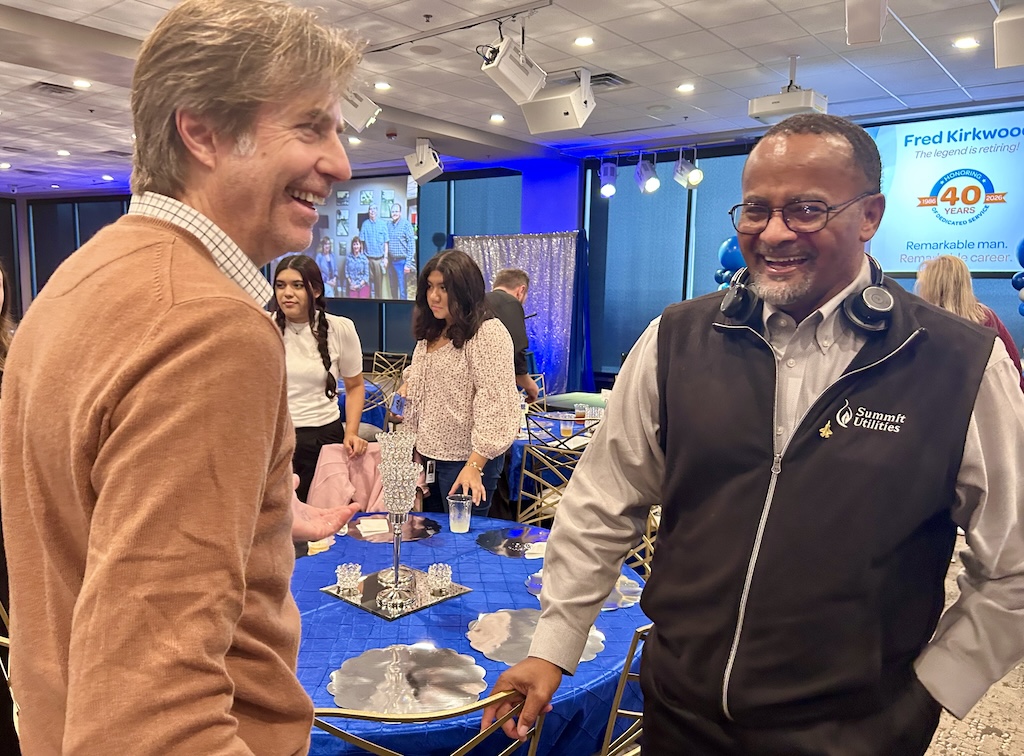
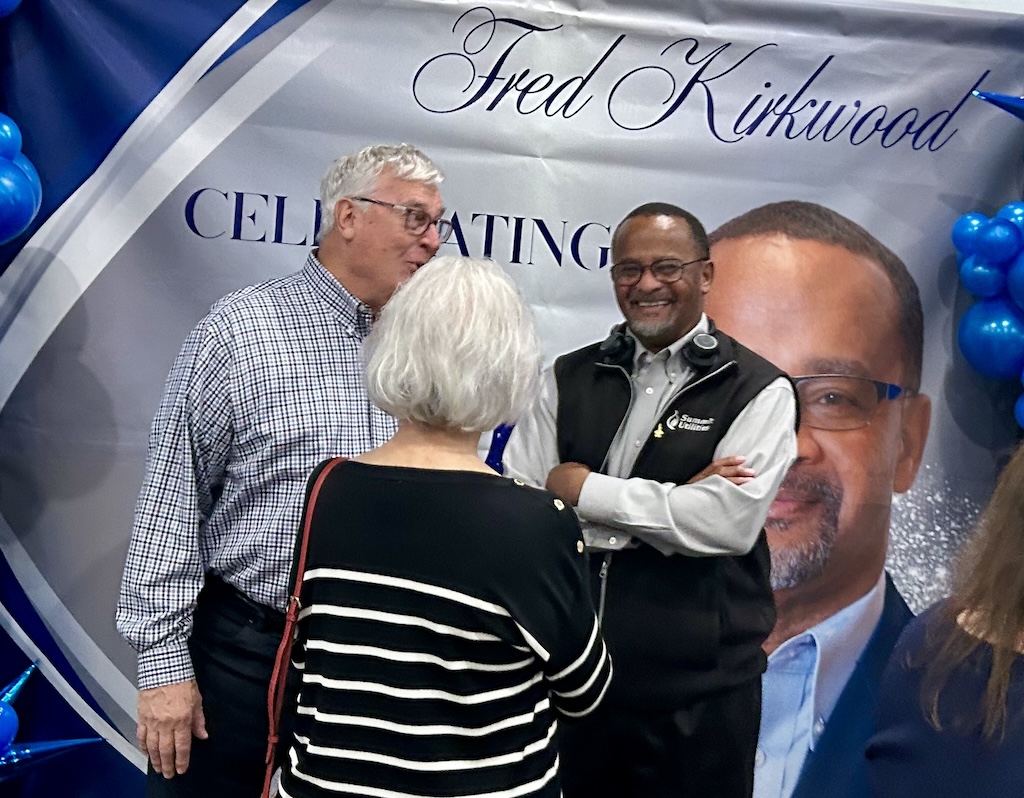
More than 250 people gathered Jan. 8 for a 2-hour retirement luncheon for Kirkwood, who officially retires Jan. 13, exactly 40 years from his first day as a sales rep with Fort Smith-based Arkansas Oklahoma Gas Corp., aka AOG.
Kirkwood, 65, is senior vice president of marketing and customer development for Summit Utilities, the Colorado-based natural gas provider that has more than 625,000 customers in six states. Summit is the parent company of AOG.
‘MAN OF GAS’
He was feted during the luncheon by Fort Smith Mayor George McGill, former AOG executives, and others he has worked with in the community. AOG may be owned by Summit, but many in western Arkansas and eastern Oklahoma refer to it as “Fred’s gas company.”
“Fred is a man of gas. And we all have gas because of Fred,” Rocky Walker, owner of Cobblestone Homes who represented the Greater Fort Smith Home Builders Association, said at the luncheon. “What makes Fred remarkable is not just how long he served, but how well he served for so long.”
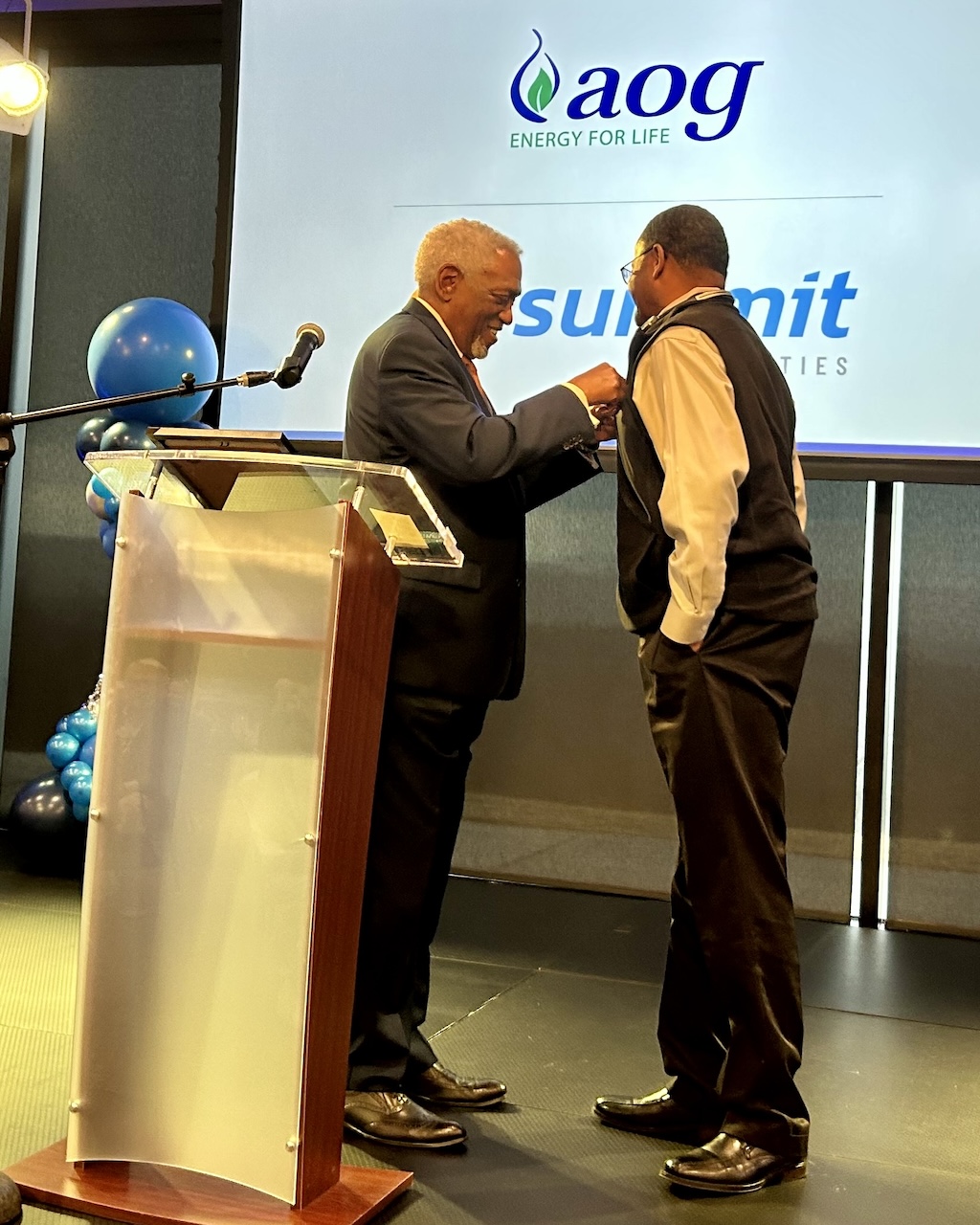
Former AOG President Mike Callan said Kirkwood initially “didn’t know anything about natural gas,” but “made it his life’s ambition to learn as much as he could, and he did it and he did it in a hurry.” Callan also said Kirkwood would become a key voice with big decisions.
“You could always count on him to provide a very sensible solution to a problem,” Callan said. “It may not have been what I wanted to do, but more times than not it was the right thing to do.”
Kim Linam, another former AOG president, said Kirkwood “was a servant leader before that was even a thing.” She said he also was respected by Arkansas and Oklahoma commissioners charged with regulating energy companies.
“He was a great witness in regulatory hearings in Arkansas and Oklahoma,” she said. “Mike (Callan) and I would just get all kinds of abuse from those commissioners, and Fred would get smiles and encouragement.”
GETTING TO FORT SMITH
Smiles and encouragement were not always there for Kirkwood.
A 26-year-old Kirkwood, born and raised in Memphis, was focused on following his then-girlfriend Carla back to the Fort Smith area. They were talking about marriage. She lived in Roland, Okla.
He graduated in 1983 from Central State University in Edmond, Okla., with a bachelor’s degree in marketing management, and returned to work for Pitney Bowes in Memphis. He was offered a job by Fort Smith-based ABF Freight but would have to work a year in Nashville before being eligible to move to Fort Smith. The next day, AOG called and coincidentally offered the same salary as ABF, which was $19,500.
“When I came here I knew nothing about gas other than my mother paid a gas bill,” Kirkwood said. “So I wasn’t really looking at it as a career path, but looking at it as more of a good stable organization and that it gets me here. Little did I know how really intriguing the industry was going to be and that I would be here 40 years after that.”
In addition to the challenge of learning about a business with which he had no experience, he would face other challenges.
CORPORATE CULTURE
The first challenge was internal. AOG was in transition from a company with a monopolistic mindset of just delivering natural gas to a company trying to broaden its customer base. Kirkwood said it was then AOG President Emon Mahony “who had the vision, who knew that this (monopoly approach) had to change.”
He said customer service was not part of the AOG culture, so he created a process to focus on service within the company and “to get them to know why it’s important what we do, and educating all of our employees on why customers are important, and why it’s important to be part of a community.”
Many did not want to change. In those first few months, Kirkwood said. Mahony explained to everyone that he supported Kirkwood in his efforts to transform the company.
“If it wasn’t for Emon Mahony, I probably wouldn’t have made it because that was not the culture, and they did not want that to be the culture,” he said. “It wasn’t that we didn’t have good people in the business, it was that they didn’t understand the value of it, the value of taking care of that customer.”
BUILDER CULTURE
Kirkwood also had to connect with home builders in AOG’s service area who for years had to deal with a natural gas company that was not a good partner.
“My first hurdle was coming in and getting builders convinced again, first of all, that we can get you gas and it won’t cost you a million dollars, and you can count on us to deliver it,” he said. “And then it turned into services, because we were just as bad on the service side. … When I came in to sell, I had to do a lot of clean-up through the process and making guys at (AOG) operations realize that it’s important to go put that service in, to go run that line.”
Long-time regional home builder Paul Walker said Kirkwood did make it easier to work with AOG.
“On time, every time. In fact, early some times,” Paul Walker said when asked about how the service changed under Kirkwood.
Kirkwood said momentum picked up when he was able to show people across all divisions of the company how it benefited the company to increase the number of customers and improve the level of customer service.
“We went from nobody wanting to do that work, to people hustling to do the work, to people sending (sales) leads to my team,” he said.
RACE CULTURE
Kirkwood, a black man from Memphis with long hair and a confident attitude, was not always welcome in his early years in the Fort Smith area.
“When I got there I was the only black to move into any leadership, in any management. So that was really a change,” he said.
He would learn a few years after he began with AOG that some company execs didn’t think he would last six months in a white-dominated business world. He said Mahony again had his back, telling the execs he would place his bets on Kirkwood.
“I’m telling you, I owe a lot to Emon,” he said. “He was the backing, the foundation for me.”
Kirkwood also had to prove himself to the builder community.
“I met builders who never had actually engaged with blacks. Period. It was a challenge,” he said.
He said Paul Walker was the first builder who welcomed him, and that opened the door for broader acceptance.
“Paul, he was a lot like Emon in that respect. If Paul signed off on you, you were signed off on,” Kirkwood said.
Kirkwood also said years later a person in the home builder industry told him, “Fred, I got to tell you, I had never experienced a black person before you. Getting to know you and understand you has done a world of good for me and my family.”
Kirkwood said he was also successful despite the race challenge because he worked hard to deliver on promises.
“I came in, I did my job, I did it the best I could, and that’s what mattered,” he said. “And then you just see that change with folks accepting all the way around.” He added that he is now working with the sons of those first builders he met.
But it wasn’t easy. Kirkwood said he is “super competitive” by nature, and having to push beyond race to prove he could do the job was frustrating. There were times he wanted to lash out.
“I had to learn to control that when it came to business,” he said. “Emon told me the world is not fair but you have to learn how to operate in it. If you operate at a mad level, you’re never going to be your best. … I had to soak that in. That was a hard lesson to learn.”
RELATIONSHIPS
Kirkwood provided a short answer when asked how he was able to change a company culture, and push through a white-dominated culture to not only be accepted but in some cases change opinions.
“We just established relationships,” he said. “Most people are really good people, and sometimes they have to learn that they are, and part of my job was pulling that out of them.
“In business and whatever I have done, I mean, I have worked since I was 14. And I will tell you, to me relationships are the most important piece of business. Period. Hands down. You don’t have to be the smartest, but if you’ve got a relationship, you’ve got an opportunity. And you can know exactly what’s happening, but if you don’t have that (relationship), nobody is going to listen to you,” he added.
He said he learned the importance of relationships early from his single mother who raised four boys because she always treated everyone with respect and courtesy.
“that’s all I’ve ever known. I just always thought that was what you did,” he said.
Kirkwood also stressed that relationships are a two-way street. He said he may get credit for changing the AOG culture, but it took a lot of people, including himself, supporting each other.
“I learned more from the dispatchers, from guys in the field,” he said of his early days at AOG. “That’s how I learned how this business operates, not from asking management. I learned from people who are doing the job. … I don’t want to just say I manage it, but then don’t know what the hell I’m managing. Or I’m making decisions and I don’t know how they trickle down.”
NEXT STEPS
More time with family was Kirkwood’s response when asked about retirement. He and Carla have a daughter, Jasmine, and twin granddaughters, Alani and Siya Palmer. He said they grew up in the gas business with him, and he would not have been able to devote so much of his life to the company and community involvement without their support.
He plans to take at least 90 days after retirement to focus on family and his other interests, which include Shady Grove Baptist Church and possibly getting involved again with the Fort Smith Boys and Girls Club.
After the 90 days, Kirkwood plans to begin a leadership consulting role companywide with Summit, “working with leaders trying to go to the next level,” he said.
He’s not concerned about the Summit and AOG culture when he leaves, saying “if one person leaves, it doesn’t weaken the culture. That’s what I’ve been working on.”
And what would he tell the 26-year-old Fred Kirkwood who 40 years ago walked into a corporate job and community reality that would prove challenging on many levels?
“What I would tell that 26-year-old now is that you made a really good decision,” he said with a laugh. “I hate to say it, I didn’t really mean to, but I made a really good decision.”