
UA marks opening of ‘unique to the world’ $95 million semiconductor lab
by November 14, 2025 9:10 pm 1,299 views
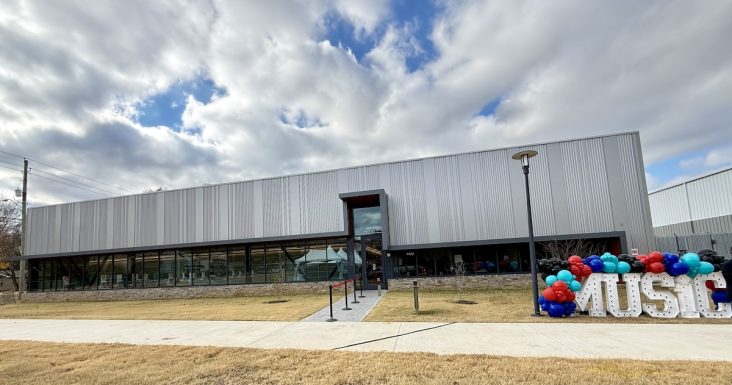
The University of Arkansas hosted an opening event Friday (Nov. 14) for its new $95 million semiconductor fabrication facility in Fayetteville. The facility is the first of its kind.
More than 200 people, including University of Arkansas, state and federal leaders, celebrated on a mild Friday (Nov. 14) the opening of a $95 million semiconductor fabrication facility that’s the first of its kind.
The 22,000-square-foot National Multi-User Silicon Carbide Research and Fabrication Laboratory (MUSiC) is the only openly accessible fabrication facility. It’s at 2079 S. Innovation Way in the UA’s Arkansas Research and Technology Park in south Fayetteville.
MUSiC will allow the federal government – through national labs – businesses and universities to develop semiconductor prototypes with silicon carbide, a capability that was previously unavailable. Silicon carbide is a semiconductor that can outperform basic silicon chips, and silicon carbide electronics can operate in extreme environments. At the new facility, chips can go from developmental research to prototyping, testing and fabrication.
Alan Mantooth, UA Power Group’s founding director and Distinguished Professor of engineering, said the new facility is unique because it’s not a “typical research facility that you find in most universities. It’s not a small clean room. It’s a full fab, but it’s just like a miniaturized commercial fab. So that allows us to be a bridge to high-volume manufacturing. In that way, you’ve got traditional R&D that will happen but very industry relevant. With low-volume prototyping capability and process control you find in a major fab, you’re able to be a bridge to that high-volume manufacturing.”
Asked where one might find another facility like this, Mantooth said, “You won’t… This is unique to the world.”
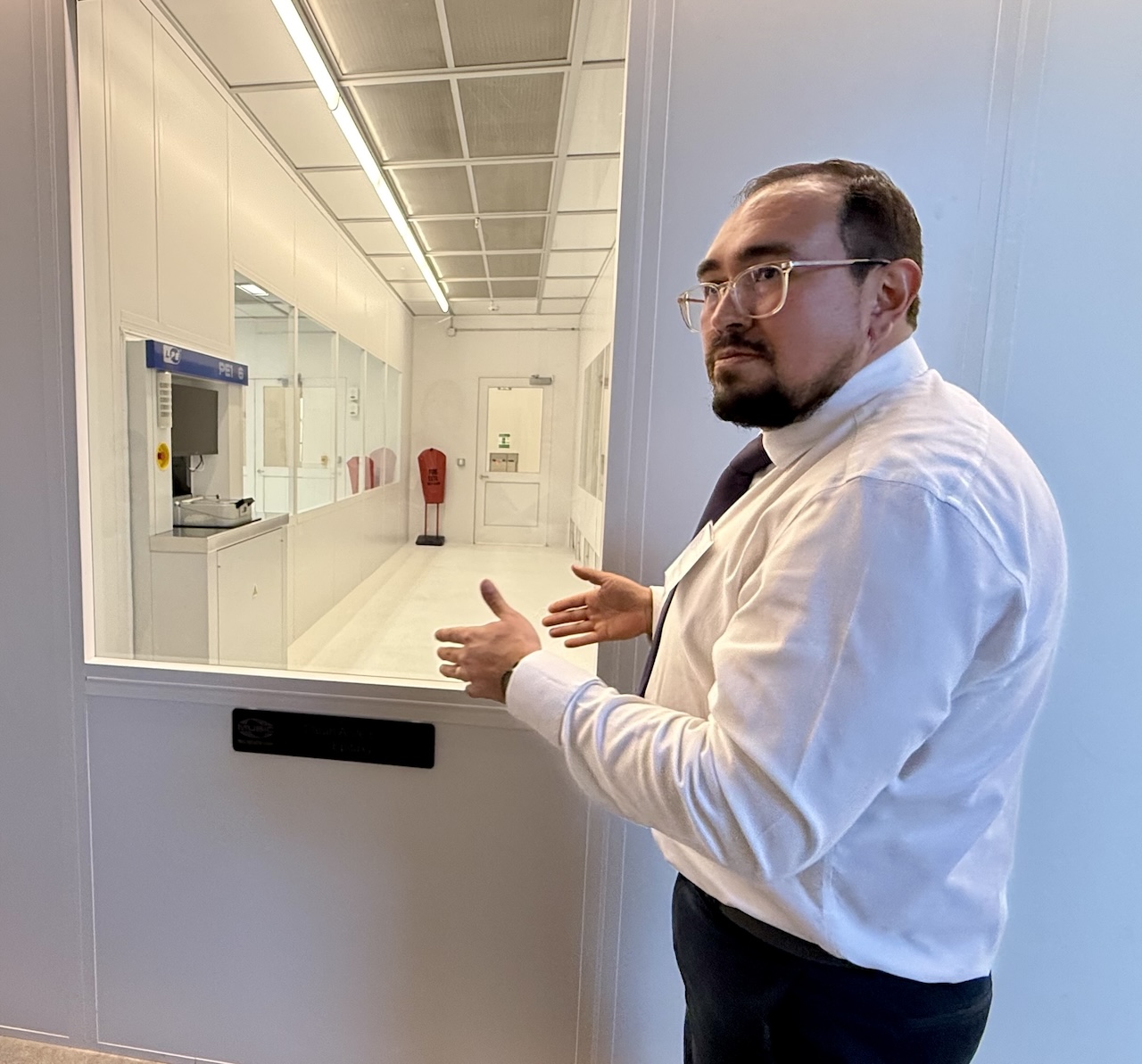
He said the cost for the facility was “roughly $95 million. It’s a $45 million building. And then the equipment inside is roughly another $50 million.” Mantooth said the UA provided the funding for the building, and the equipment was federally funded.
The facility features an eight-bay cleanroom that’s expandable to 10 bays. Designers included Tsoi Kobus and Wittenberg Delony & Davidson Architects. Whiting Turner was the general contractor.
Mantooth said the facility will likely become available for companies to use in mid-2026. In early 2026, the facility will undergo “qualification runs” to ensure it is properly calibrated. After that, clients can start using it. The facility has seven staff, but by the end of 2026, it is expected to have 14.
Mantooth was one of the featured speakers at the opening event along with U.S. Rep. Steve Womack, R-Rogers, Arkansas State Attorney General Tim Griffin, Kim Needy, dean of the College of Engineering, and UA Chancellor Charles Robinson. Robinson said when Mantooth presented the plan for the facility to him, he knew that he wanted to make it a reality.
“And we did figure it out,” Robinson said. “And we figured it out by using primarily our own resources because we recognized that this is important, not just to the University of Arkansas but to the state of Arkansas and to the country.”
“This facility is vital — vital to our nation, vital to our national security, vital to our economic development,” Womack said. “And we’re in a fast-paced cavalry battle right now with near-peers around the globe for research on these issues. It is essential we win that race.”
Griffin said he’s been in the Army for 29 years, and “the most important part of this is really our national security. If you’re not secure and safe as a country, you don’t have time to worry about all the rest… We must win this technological competition, this technological race… It is absolutely essential to our national security, to our economic well-being.”
Griffin also highlighted the facility’s open access.
“It’s not exclusive to a particular company,” he said. “If you want to use it, you can make that pitch. And that will allow for the growth of innovation.”
Needy said the new fabrication facility will serve as “a bridge between university research and commercial production that will benefit educational institutions, businesses of all sizes, national laboratories and our military. When the semiconductor industry looks for leadership in silicon carbide technology, they will look to the University of Arkansas…
“MUSiC will provide the University of Arkansas students opportunities to learn on equipment that they won’t see again until they’re working in advanced industry positions, if they even see it at all,” she added. “In addition, this facility will serve as a tool to promote STEM education at an earlier age, enhancing the strategic goal to produce more STEM students coming from the K-12 ranks here in the state of Arkansas. Young students will be introduced to the exciting field of engineering as they tour the facility and meet with our amazing team members at MUSiC.”
Education and training within the new facility are expected to help develop the workforce that Mantooth and other leaders previously said is key to bringing semiconductor manufacturing back to the United States after it was offshored in the late 1990s and early 2000s.
“We are in a foot race with others, other nations,” Mantooth said Friday. “And this is what’s going to keep us ahead.”
He said when the CHIPS Act was passed, the facility was already in the works. Congress approved the Creating Helpful Incentives to Produce Semiconductors and Science Act in 2022.