
Pakko: Uncertainty, but no recession on horizon
by November 7, 2025 1:29 pm 631 views
Rising tariffs have helped make this the “year of uncertainty,” but there are no signs of a recession on the horizon, according to Dr. Michael Pakko, chief economist and state economic forecaster at the Arkansas Economic Development Institute at the University of Arkansas at Little Rock.
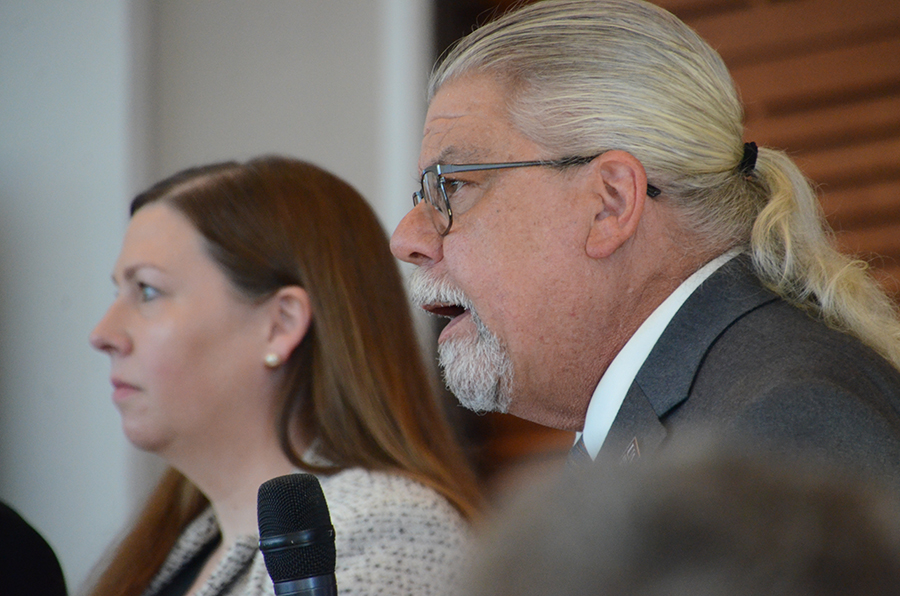
Pakko spoke at the Arkansas Economic Forecast Event at the Clinton Presidential Center Nov. 6. It was hosted by the Institute along with the Federal Reserve Bank of St. Louis Little Rock Branch.
Also speaking were two Federal Reserve Bank of St. Louis economists: Kathleen Navin, senior economist; and B. Ravikumar, senior vice president and deputy director of research. The three discussed economic trends, although they were hampered by the federal government shutdown making third quarter economic numbers unavailable.
Pakko focused on Arkansas. He doesn’t forecast a recession. Inflation remains elevated. Arkansans are spending 32% more on groceries than they were in 2019 while buying about the same quantity. But inflation rates overall for Arkansas’ region of the country are closer to 2%, compared to 3% for the nation.
“As a result of this lower inflation, recently Arkansas has resumed its place as the lowest cost-of-living state in the nation,” he said. “So here’s a good example of being last is good.”
He expects the state’s unemployment rate, currently about 3.8%, to reach perhaps 4.2% next year. He forecasts payroll employment to grow less than 1%. The state’s labor force participation rate in Arkansas will remain around 58.5%, which is lower than the national rate of 62.3%.
Pakko said 2025 is the “year of uncertainty” with tariffs rising from an average of 2.5% to an estimated 18% now. The last time tariffs were close to that high was the 1930s. It’s also been unclear what the monetary policy response will be. In addition to tariffs, other risks include rising prices, the threat of supply chain disruptions, and weakness in the global and U.S. economies. Arkansas-based risks include potential diminished consumer spending and the challenges facing row-crop agriculture.
In many ways, Arkansas’ economy has outpaced the nation’s, he noted. The state’s unemployment rate of 3.8% is lower than the national rate of 4.3%. Since the beginning of 2020, Arkansas’ nonfarm payroll employment growth has outpaced the United States’, 7.1% to 4.8%. Preliminary revisions will bring those numbers down .8% in Arkansas and .6% in the United States, with final estimates coming out in January.
Arkansas’ gross domestic product grew 5.5% in the first quarter of 2024, and when the data for last year’s third and fourth quarters first was released, Arkansas had the nation’s fastest growth. After revisions, the state remained in the top 10. But in the first quarter of 2025, it had the nation’s slowest growth with about a 1% drop. Remove farm income, and that first quarter growth was more than 2.5%.
Navin provided a big-picture look at the national economy. The 19-member Federal Open Markets Committee cut interest rates last week by 25 basis points to between 3.75% and 4%. It was the second rate cut this year. As of September, three rate cuts were expected in 2025 leading to a rate of 3.5% to 3.75%, or a midpoint of 3.6%. But Chairman Jerome Powell said the December cut is not a foregone conclusion. By 2028, rates are projected to return to a midpoint of 3.1%.
Economists only had access to data through the second quarter because of the government shutdown. The first quarter showed a surge in imports as businesses tried to get ahead of projected tariffs. Imports reduce the gross domestic product, which fell .6% in the first quarter. In the second quarter, GDP grew 3.8%. The Atlanta Federal Reserve’s most recent estimate on Nov. 3 was 4% growth for the third quarter.
Navin said personal consumption expenditures were soft in the first quarter but picked up in the second and was projected to be healthy in the third quarter. However, while upper-income households and corporations have been spending on travel, events and luxuries, middle-income consumers are becoming more cautious and are using credit to maintain their spending.
The Federal Reserve has a target of 2% inflation on personal consumption expenditures. As of August, it was 2.7%, or 2.9% with the more volatile components of food and energy removed. The inflation is coming from core goods, with tariffs a contributing factor. She said inflation will be elevated this year and next but should return to 2% by 2028.
Navin said the national unemployment rate for August was 4.3% and should rise to 4.5% by the fourth quarter before falling gradually to 4.2% by 2028. Payroll numbers have been weak over the last four months through August. Slowing overall economic conditions have created less demand for jobs, but there’s also been a large decline in supply because of federal immigration policy. Hiring, layoffs and quits have been flat.
“The big qualifier of the labor market is that it’s a ‘no-hiring, no-firing economy,’” she said.
However, many firms are signaling layoffs, some of it related to artificial intelligence adoption. Pakko said in a panel discussion that each time a new technology has arisen, such as mechanization, people have worried about all the jobs being lost. But new jobs always have been created.
“I can’t predict what the new jobs of the future are going to look like, but they’re going to be there,” he said.
Navin said uncertainty grew earlier this year and seems to have improved over the last few months.
“We did see a slowing in the first half of the year,” Navin said, summing up her comments. “Still pretty solid, and the expectation is Q3 looks pretty good. However, we’re still dealing with an inflation rate that is above the 2% objective, with the risks to the upside. On the employment side, we have stable conditions, but the downside risks are something we’ve got to be paying attention to. We did get two rate cuts over the last two meetings, but December is not a foregone conclusion. And kind of around all of this is that we’re dealing with this continued uncertainty, which really clouds the outlook.”
Ravikumar focused largely on tariffs. He said the trade deficit between imports and exports, which is not new, represents less than 3% of gross domestic product. While the United States does run a trade deficit with respect to goods, it runs a surplus in the services sector.
Ravikumar said tariff revenues historically only compose a small percentage of GDP – 0.3% compared to 10% collected from corporate and personal income taxes. Recent high-end estimates of tariff revenues place the figure at 1.5% of GDP temporarily. He said if the goal of restoring manufacturing through high tariffs is met, then the United States will import fewer goods and therefore raise fewer tariff revenues.
He said the percentage of Americans employed in manufacturing has fallen from less than 40% during World War 2 to a stable 6% to 7%. Much of that decline is due to automation. In the 1950s, nine workers were required to produce one car. Today, one worker can produce nine cars.