
Gov. Sanders discusses mansion, prisons, health care
by November 23, 2025 8:41 am 1,678 views
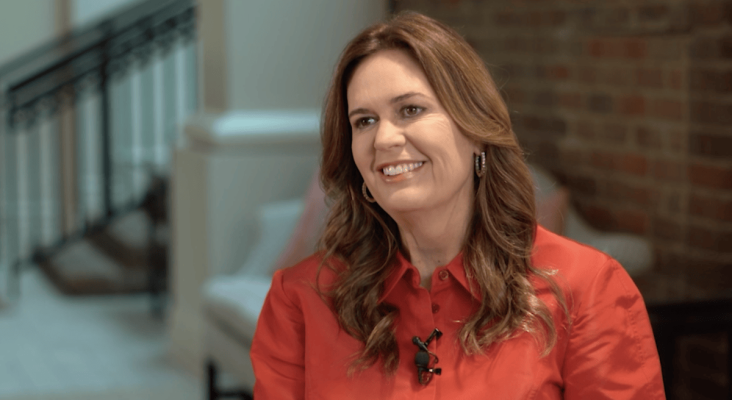
In a wide-ranging interview on this week’s edition of Talk Business & Politics, Gov. Sarah Sanders offered thoughts on a variety of policy subjects and the 75th anniversary of the Governor’s mansion.
The Arkansas Governor’s mansion, which sits in Little Rock’s Quapaw Quarter District, was first occupied by Gov. Sid McMath in the early 1950’s.
On Thursday night (Nov. 20), Sanders hosted a reception at the mansion that included all living governors: Bill Clinton, Mike Huckabee, Mike Beebe, and Asa Hutchinson. Former First Ladies also participated in the mansion gala.
“This is the 75th anniversary of the Arkansas Governor’s Mansion and it’s a place that holds so much historical significance for our state,” said Sanders. “A lot of big moments have happened here, so many people have attended events and had experiences, but it’s also home to Arkansas’ first families, and so it’s still the place my family has lived longer than any other.”
“Having my dad serve as Arkansas governor for almost 11 years and now getting to come back and raise our kids and create new memories here is something that we’ve loved. This week, we’ll get to highlight a lot of the families that have lived in the mansion, hear their stories, and bring people together from every corner of this state to celebrate this amazing place and preserve a piece of history and culture forever,” she added.
The interview turned to several policy topics, including the state’s recent federal application for funding through Rural Health Transformation grants. The grant money was part of the One Big Beautiful Bill passed by Congress earlier this year after Medicaid cuts were instituted.
The state’s application focused on medical residency slots, workforce, and telehealth among other goals.
“We worked really hard not to take a top-down government approach, but really to bring in stakeholders from every sector of health care and look at how can we do things differently? How can we be innovative? Because what we’re doing right now as a country in health care isn’t working,” said Sanders. “There’s an expectation that every state will get at least $500 million. We certainly think we’ve met the criteria to do that, but I’m hopeful that we will go above and beyond and get additional funding beyond that because of the work that we did collaboratively with so many stakeholders around Arkansas.”
Sanders said it is possible that the state’s waiver request to add a work requirement to certain Medicaid beneficiaries could be a part of the decision-making process on the rural health transformation funding.
“We expect that as they’re going through these applications that that will be one of the things that’s factored in and we’re hopeful that that is something that happens very quickly,” she said.
Sanders added that she is unsure of the timeline for the feds to reach a decision, so she’s not certain if Arkansas will know the amount it will be funded by the start of the fiscal session next April.
She also said she’s not prepared to say how large of an income tax cut she may propose for the fiscal session. She affirmed that additional tax cuts are part of the current discussion, but declined to give a specific number.
“We want to continue responsibly working to phase out the state income tax,” she said. “The ultimate goal is to get to zero and we’re going to keep chipping away at that. And I feel confident we’ll be able to put forward another significant tax cut next year.”
PRISONS
Gov. Sanders remained steadfast in her decision to build a new state prison facility in Franklin County. The controversial prison did not receive new construction funding from legislators last regular session, but it does have enough preliminary funding to begin feasibility studies.
Sanders said workforce is a big reason for the Franklin County site.
“We did an exhaustive look statewide. When you start putting parameters in place that you need to meet in order to build a new prison – that the land is available, that the workforce is available, where do we not already have existing space that we can add and not hurt [workforce] … the circle gets really small, really fast. A lot of those communities we looked at, they simply don’t meet a lot of the key criteria that are needed. Franklin County does. It still remains the best place for us to do that,” she said.
Some communities have floated building the prison in their cities, while others have argued for an expansion of existing prison facilities. The governor, who is seeking re-election next year, said she has added beds to current prisons, but it’s not enough.
“We’ve already added 1,500 beds to existing facilities, but we can’t keep doing that. It’s not a viable long-term option. It has helped relieve some of the pressure. We’ll continue to look for ways we can add a hundred beds here, 200 there. But what we need is a long-term solution,” she said.
When asked further why more beds can’t be added to existing prisons, Sanders said workforce and recidivism are two factors influencing her decision to stay focused on Franklin County.
“One of the biggest reasons is the workforce. We’re already in some of the areas where we could expand but struggle to meet the workforce in those areas. So adding more people and needing to expand the workforce is going to be really challenging,” she said.
“Let’s not forget too, a lot of the population growth, a lot of the increase where we’re actually arresting people is happening in the northwest corner of our state. We know that you have better long-term recidivism rates when people are incarcerated closer to where they are from and where they live. So there’s a lot of factors at play that continue to make Franklin County a much better, much more viable option than simply expanding in places where we already have an operation,” added Sanders.
You can watch Gov. Sarah Sanders full interview in the video below.