
Farm-to-school coordinator says program has positive impact on students, communities
by November 11, 2025 1:12 pm 643 views
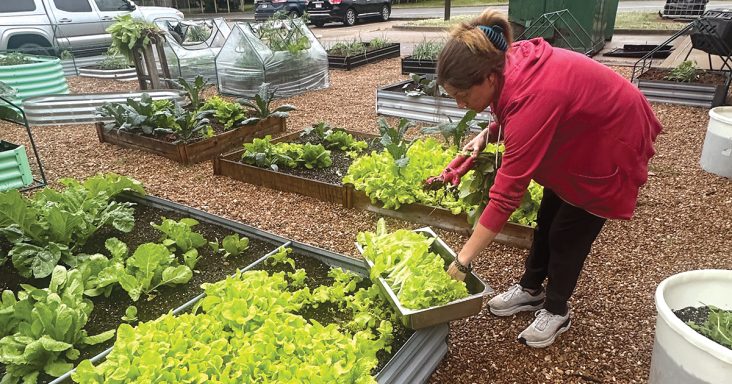
Gardens at the Atkins Middle School in Atkins, Ark.
You can’t organically grow pillars of support for farm-to-school programs, but Leslee Tell believes such pillars are as important as seeds for meaningful and sustained success in efforts to educate students about food sources, production and nutrition.
And students, Tell advocates with conviction, learn a lot about themselves in the process.
Tell is the farm-to-school coordinator with the Arkansas Department of Agriculture, a job she has held since April. Before that she worked 22 years at Conway High School in food nutrition, food safety, food science, advanced nutrition and culinary arts. She was the 2025 culinary arts teacher of the year, and in 2022 was selected by the Arkansas Farm Bureau as the Ag in the Classroom Outstanding Teacher.
The Arkansas Legislature approved legislation in 2019 — which would become Act 506 of 2019 — that created a full-time farm-to-school coordinator within the Arkansas Department of Agriculture. According to the department, the program provides funding, technical assistance and other support to connect schools with farmers and other partners “in the local food system.” The program manages a previously established statewide collaboration between schools, farmers, state agencies and food-related nonprofits.
Examples of program support include helping schools establish and maintain school gardens, providing resources for classroom education and activities related to food, farms, nutrition, and health and creating connections that allow local foods to be purchased and promoted in school cafeterias.

“The purpose, the short answer, is to educate kids about where food comes from,” Tell said in a recent interview. “It’s good to let them connect, to grow, and learn all that it takes to get it from there [garden] to a kitchen, or a meal in front of them.”
There are 13 schools in the program. On the day of the interview with Tell, she was traveling to participating schools in Bentonville and Lincoln. The following day she would be in Magazine and Paris in Logan County.
It’s not Tell’s first go at making such connections. Her work at Conway, which was recognized with the Arkansas Farm Bureau award, included classroom education — sometimes hands-on — about the different types of farms and farm products grown around the state. They learned about small and large farms.
“Each individual farm lends a new perspective of how and why food is produced, harvested, and impacts in our state and community, and offers a different window into the overall experience, allowing students to see how all these farms and the food supply are connected to our everyday lives and food choices,” Tell said in April 2022.
She is now taking the lessons learned from her more than 22 years and traveling to schools around the state. An important part of that, maybe the most important part, Tell said, is that a good farm-to-school program requires three pillars of support. First, a principal or some administrator has to not only buy in but also be an active supporter.
Second, there has to be a “base of teachers who have a passion for it,” Tell said. And third, the community — local farmers, ag companies, people with financial resources, etc. — has to get involved.
“What I see is that when you would have one of those missing, that’s when you see it struggling,” Tell said. “When you have all three, it will do well. Like at Atkins [Middle School]. Everyone there is all in with this. You have the food service [cafeteria] take the garden produce and use it in the food supply.”
It’s that necessary circle of support, Tell believes, that makes the best impression on students. Students take the classroom discussion to the gardens, they see the work and care it takes to go from seed to harvest, and then they see — in some cases — that work as part of their meal in the cafeteria, Tell explained.
“Students have taken an active role in every aspect of the garden experience,” said Lindsay Riedmueller, the Atkins Middle School principal. “They have helped build raised beds, plant seeds, harvest produce and maintain the garden throughout the school year. These hands-on activities have deepened their understanding of agriculture, responsibility and teamwork.”
That active role, according to Tell, often has an ancillary benefit of “positively impacting discipline.” Students with disciplinary problems often improve because they have something for which they are responsible, she said. At Ward Central Elementary in Cabot, third- and fourth-grade students known as “Sprout Scouts” work in gardens as part of a “cultivating kindness” program, Tell said.
Back in Atkins, Riedmueller said gardens there provide fresh produce used in the school cafeteria, with surplus produce donated to a community pantry to support local families in need. She said the goal with the program in Atkins is to grow enough produce so it can be sent home in backpacks to give students “access to healthy, homegrown items even outside of school.”
“The garden has also made a powerful impact on our school culture,” Riedmueller said. “The outdoor classroom has become a beloved space where students and staff enjoy spending time, learning and working together. It fosters a sense of pride, ownership and community across our campus.”
Tell’s goal is not necessarily focused on adding as many schools as possible but to continue to develop the model, pivot around lessons learned, and then use the best practices to encourage other school districts to invest time, energy and money in school gardens.
“And I think it’s promising,” Tell said with a grin, “that schools with gardens, every one of them have higher school ratings. Every one. Look it up.”