
Research continues to block nematode that attacks soybean plant
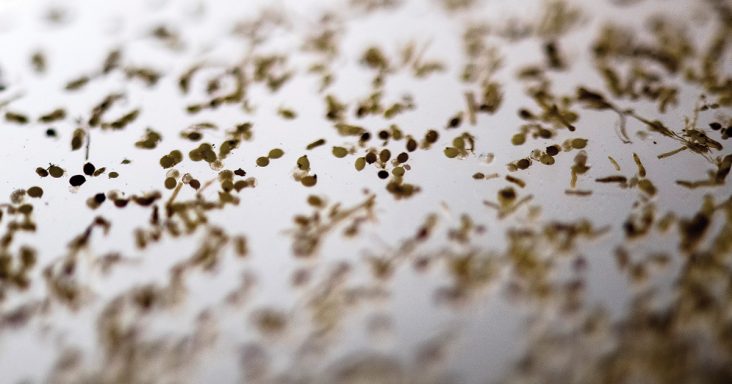
Soybean nematode cysts collected from research plants. (Courtesy University of Aarkanss System Division of Agriculture, photo by Fred Miller)
Billions of dollars of damage is caused each year by parasitic nematodes in U.S. and global agricultural crops. Dr. Asia (Joanna) Kud, a professor of nematology with the University of Arkansas System Division of Agriculture told Talk Business & Politics she has received a grant to gather data about soybean cyst nematodes.
Such nematodes are microscopic roundworms that live in the soil and infect plant roots. Rather than chewing on roots like insect pests, the nematodes invade root tissue and reprogram a small number of plant cells to serve as feeding sites.
“This plant pest can be absolutely devastating for soybean production, particularly because growers can experience up to 30% yield loss without any visible symptoms above ground,” Kud said.
Nematodes cause an estimated $10 billion in crop losses each year in the United States and more than $100 billion globally. Among them is the soybean cyst nematode, responsible for more than $1 billion in annual yield losses in U.S. soybean fields, according to the Crop Protection Network.
A myriad of treatments — chemical nematicides, soil treatments and biological controls — have had mixed success against the soybean cyst nematode, and many potential solutions carry environmental or economic limitations. Breeding soybean varieties that can withstand infection has been the most effective and environmentally friendly management tool, but its usefulness is declining, Kud said.

“The same resistance mechanisms have been used over and over for years,” Kud said. “Over time, nematodes adapt. Something that worked a decade ago may no longer be effective today, so there’s a real need to develop new sources of resistance.”
Kud was awarded almost $300,000 from the U.S. Department of Agriculture’s National Institute of Food and Agriculture to continue researching a strategy to stop the nematodes from feeding and reproducing. It is the second phase of her research into this project and will involve data collection. The goal is to use the data to secure a third phase of funding and that will involve creating biotechnologies to deal with the worms. Research like this is difficult, however.
“Nematodes are not the easiest organisms to work with,” she said. “It’s hard to see them. They are microscopic.”
The parasites inject proteins, known as effectors, directly into cells of the plant’s roots to enlarge them and transform them into feeding sites. Once established, the nematode remains attached to the root, feeding and reproducing over several weeks and producing the next generation that continues the cycle.
In Kud’s preliminary research with Shahid Siddique, an associate professor of entomology and nematology at the University of California-Davis, they identified two effectors of particular interest.
“Typically, these nematodes will have hundreds of effectors, and some of them are more important than others,” Kud said. “We have high confidence that these two effectors this project focuses on are very important because we actually looked at those feeding sites inside plant cells and found those proteins are very abundant.”
Rather than targeting the nematode directly, the goal of the research is to identify weak points in the nematode’s life cycle by understanding how these effectors interact with soybean proteins. The project will examine where these effector proteins function inside plant cells, determine how important they are to nematode infection and reproduction, and identify which soybean proteins they interact with during parasitism.
In the long term, the knowledge could guide development of new soybean varieties using gene-editing or RNA-based technologies that prevent nematodes from exploiting the plant without harming normal plant growth or function, Kud said. Gene-editing approaches can make precise changes without introducing foreign DNA, and some gene-edited plants may fall outside certain USDA biotechnology regulations.
The idea would be to maintain the normal function of the plant proteins but change them slightly so the nematode effector can no longer bind to or manipulate them, she said. There shouldn’t be any negative effects on plant health, yield or nitrogen fixation.
Preliminary data supporting the NIFA proposal were generated through a Research Incentive Grant from the University of Arkansas Division of Agriculture and built on collaborative work with Siddique, who contributed key data identifying nematode effectors inside plant cells. Finding a solution to this problem would help farmers increase yields and save money, Kud added.
“This knowledge is so critical,” she said.